
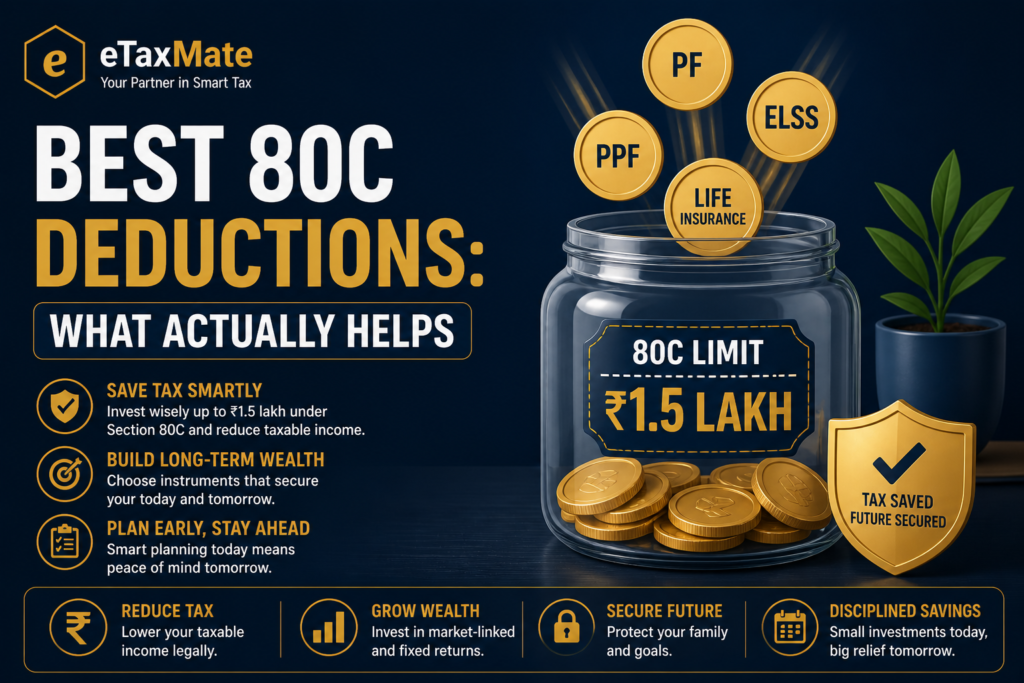
Most salaried readers approach Section 80C the wrong way. They treat it as a checklist — buy LIC, open a PPF, lock in some ELSS — and assume that more instruments mean more tax savings. That is not how 80C works. The ₹1.5 lakh cap is a single ceiling across every eligible investment, and most salaried people are already filling a chunk of it through their EPF without realising. The best 80C deductions for you depend on what you already pay into, which regime you have opted for, and how long you want your money locked away. This post sorts through the real options.
Quick answer
Section 80C lets you deduct up to ₹1.5 lakh of specified payments and investments from your taxable income, but only if you file under the old regime. Under the new regime, 80C is unavailable.
Before you invest a single rupee for 80C purposes, check:
- Are you filing under the old regime or the new regime for the relevant assessment year?
- How much 80C space is your EPF contribution already using up?
- How long can you afford to lock the remaining amount away?
The first question: which regime are you in?
Section 80C is a creature of the old tax regime. Under the new regime — the default since AY 2024-25 for individuals — almost all Chapter VI-A deductions, including 80C, are not available. You can still invest in PPF, ELSS, or life insurance under the new regime, but you cannot claim them as deductions.
This single fact changes everything. If you are filing under the new regime, the best 80C deductions for you are none, because the section does not apply. The investment may still be sensible on its own merits, but it stops being a tax-planning lever.
Choosing between regimes is a separate decision in itself, and the right choice often comes down to how much of your 80C bucket you actually use — covered in detail in our old vs new tax regime breakdown.
The rest of this post assumes you have already decided to file under the old regime, where 80C is alive and useful.
What Section 80C actually covers
Section 80C of the Income Tax Act 1961 allows a deduction of up to ₹1.5 lakh for a wide list of specified payments and investments. The same overall limit also covers Sections 80CCC (pension fund contributions) and 80CCD(1) (employee NPS contributions) — together, these three are capped at ₹1.5 lakh combined, not separately.
The eligible items broadly fall into four buckets:
- Forced or near-forced contributions that are already happening in the background (EPF, statutory PF, certain pension contributions).
- Pure investments chosen specifically for tax saving (PPF, ELSS, NSC, tax-saving fixed deposits, Sukanya Samriddhi).
- Insurance premiums on life insurance policies for self, spouse, or children.
- Loan-linked or expense-linked items — home loan principal repayment, stamp duty on a new house, and tuition fees for up to two children at any Indian school, college, or university.
The Income Tax Department portal lists every eligible item under the section. The list is long, but as you will see, most salaried readers genuinely benefit from only four or five of them.
The Section 80C investments options that genuinely help most salaried readers
Take Rahul, a 32-year-old salaried professional in Pune earning ₹14 lakh a year. His employer deducts EPF at 12% of his basic salary, which alone covers about ₹70,000 of his 80C limit. He has a small term life insurance policy with an annual premium of ₹15,000. That leaves him with roughly ₹65,000 of unused 80C space. Where should that go?
The instruments that earn their place for someone like Rahul tend to be these:
Employee Provident Fund (EPF). Already deducted from your salary if you work for an organisation with more than twenty employees. The employee’s share counts towards 80C automatically. For most salaried people, this is the single largest contribution to the 80C limit and requires no action. Check your salary slip — the line typically reads “Employee PF” or “PF Contribution.”
Public Provident Fund (PPF). A fifteen-year government-backed account with tax-free interest and tax-free maturity. Suits readers who want the safest possible option and do not need the money for at least seven years (partial withdrawals allowed from year seven). Minimum ₹500 a year, maximum ₹1.5 lakh a year.
Equity-Linked Savings Scheme (ELSS). A type of mutual fund that invests in equity and carries the shortest 80C lock-in at three years. Suits readers comfortable with market-linked returns and a longer time horizon. Returns are not guaranteed, but historically ELSS funds have outperformed most other 80C instruments over five-plus years. The mechanics of ELSS, including how the three-year lock-in works and how to compare schemes, are covered separately in our ELSS funds guide.
Term life insurance premium. If you have dependants, a pure term plan is one of the most cost-effective uses of 80C space — you get genuine financial protection plus the deduction. Avoid bundling investment with insurance through endowment or ULIP products unless you have a clear reason; their returns are typically modest and the lock-ins are long.
Home loan principal repayment. If you are repaying a home loan on a self-occupied or let-out property, the principal portion of every EMI counts under 80C. For most homeowners in their first ten years of EMIs, this alone fills the limit. Home loan principal repayment counts towards 80C, but interest is a separate deduction — see our post on home loan tax benefits for the full picture.
Children’s tuition fees. Tuition fees paid to any Indian school, college, or university for up to two children qualify. Note: only tuition. Not transport, not uniforms, not donations, not capitation fees.
For Rahul’s leftover ₹65,000 of 80C space, the practical answer is usually a mix — an ELSS SIP for growth and a small PPF top-up for safety — rather than dumping the entire amount into one instrument.
The 80C options that get oversold
Some 80C-eligible products are pushed hard by agents and bank relationship managers because the commissions are good, not because they suit you. A few worth flagging:
Endowment plans and money-back policies. These bundle life cover with a long-term guaranteed-return savings component. Returns typically work out to 4–6% over the life of the policy, with lock-ins of fifteen years or more. For someone like Priya, a 28-year-old salaried reader who already has term cover, an endowment plan is rarely the best use of leftover 80C space. PPF or ELSS will usually deliver more.
ULIPs (Unit Linked Insurance Plans). Combine insurance and equity investment in one product. Charges in the early years can be heavy, and the lock-in is five years. A clean term plan plus a separate ELSS fund typically does the same job better.
Tax-saving fixed deposits. Five-year lock-in, returns taxable each year, and the interest does not enjoy the tax-free status that PPF interest does. Useful only if you genuinely cannot tolerate any market exposure and have already exhausted PPF.
The pattern: when 80C eligibility is the main selling point and the underlying product is mediocre, treat that as a warning, not a recommendation.
How to think about the best 80C deductions for your situation
A practical sequence for most salaried readers:
- Start by counting your existing EPF contribution for the year. Whatever is left is your real 80C decision space.
- If you are repaying a home loan, add the principal portion. This often closes the gap entirely.
- If you have dependants and no term cover, buy a term plan. Use that premium towards 80C.
- For any remaining space, choose between PPF (for safety and a fifteen-year horizon) and ELSS (for growth and a three-year lock-in). Many readers split the balance between both.
- Skip endowment, ULIPs, and tax-saving FDs unless there is a specific reason.
The point is not to maximise the deduction at any cost. It is to maximise the after-tax return on money you would have saved or insured against anyway.
When you should not stretch to fill the ₹1.5 lakh limit
Three situations where pushing harder on 80C is the wrong move:
- You are filing under the new regime. 80C does not apply. Any investment made purely for the deduction is a sunk lock-in for nothing.
- Your taxable income is already below ₹5 lakh under the old regime, or below ₹12 lakh under the new regime. The Section 87A rebate already brings your tax to zero. Adding 80C investments saves you no tax — though the underlying investment may still be worthwhile on its own merits.
- You are scrambling in March with no liquidity. Borrowing money or breaking an emergency fund just to dump into a five-year tax-saving FD is rarely sensible. The interest cost or the lost flexibility usually outweighs the tax saved at your slab rate.
Tax saving should be the consequence of good financial planning, not the goal that distorts it.
Documents and proofs to keep ready
For salaried readers claiming 80C at the time of filing the income tax return, keep these handy:
- Form 16 from your employer, showing EPF deduction and any 80C declared
- PPF passbook or annual statement for the financial year
- ELSS statements showing investments made between 1 April and 31 March
- Premium receipts for life insurance policies in the relevant year
- Home loan repayment certificate from the lender, with principal and interest split
- School or college fee receipts mentioning tuition fees specifically
- Stamp duty and registration receipts, if claiming on a property purchased that year
Your employer’s payroll team also typically asks for these before finalising TDS each year. Submitting them on time means less excess tax deducted and fewer adjustments at filing.
Final takeaway
The best 80C deductions are not the ones with the most exotic names or the highest commissions. For most salaried readers under the old regime, the answer is simple: count what is already happening through EPF and home loan principal, add a term plan if you have dependants, and put the rest into a sensible mix of PPF and ELSS. Skip the bundled insurance-plus-investment products unless you have a clear reason. And if you are under the new regime, none of this applies — invest for your own goals, not for a deduction you cannot claim.
Confused about which 80C investments suit your situation, or unsure whether the old or new regime works better for you? eTaxMate can help you review your salary structure, identify what you already qualify for, and plan the rest of your 80C bucket sensibly before filing.
This blog post is for general information only and does not constitute professional advice. Tax laws are subject to change and their application depends on individual facts and circumstances. Readers should consult a qualified professional before taking any action based on this content. eTaxMate accepts no liability for any action taken based on the information in this post.
Frequently Asked Questions
1. Is Section 80C available under the new tax regime?
No. Section 80C is one of the deductions disallowed under the new regime, which has been the default for individuals since AY 2024-25. You can still invest in PPF, ELSS, or life insurance under the new regime, but you cannot claim the ₹1.5 lakh deduction. The section only works if you specifically opt for the old regime when filing your return.
2. Does the EPF deducted from my salary count under 80C?
Yes. The employee’s share of EPF — the 12% deducted from your basic salary each month — counts towards the ₹1.5 lakh 80C limit automatically. For many salaried readers, this single contribution covers half or more of the limit before any other investment is made. Check the “Employee PF” or “PF Contribution” line on your salary slip to see your annual figure.
3. Can I claim more than ₹1.5 lakh by combining multiple 80C investments?
No. The ₹1.5 lakh limit is a single combined cap across every 80C-eligible item, plus Sections 80CCC and 80CCD(1). It does not matter whether you spread the amount across PPF, ELSS, life insurance, and home loan principal — the deduction stops at ₹1.5 lakh. Investing more is fine for financial reasons, but it gives no extra tax benefit.
4. Are tuition fees for my child’s coaching classes eligible under 80C?
No. Section 80C allows tuition fees paid only to a recognised Indian school, college, or university, for up to two children. Coaching classes, private tutors, and exam-prep institutes are not covered, even if the fees are substantial. Donations, capitation fees, transport charges, and uniform costs are also excluded — the deduction is strictly for tuition.
5. Should I buy an endowment policy or ULIP just to save tax under 80C?
Generally not. Endowment plans and ULIPs bundle insurance with investment, and the returns are usually modest with long lock-ins. A pure term life insurance plan combined with a separate PPF or ELSS investment typically delivers better protection and better returns for the same premium outlay. Buy these products only if you have a specific financial reason beyond the 80C deduction.
6. I started my home loan this year. Can I claim stamp duty under 80C?
Yes, but only for the financial year in which the stamp duty and registration charges were actually paid. This is a one-time claim, not a recurring one. The amount counts within the same overall ₹1.5 lakh 80C limit, alongside your home loan principal repayment, EPF, and any other 80C investments. Keep the registered receipts safely for proof during filing.