
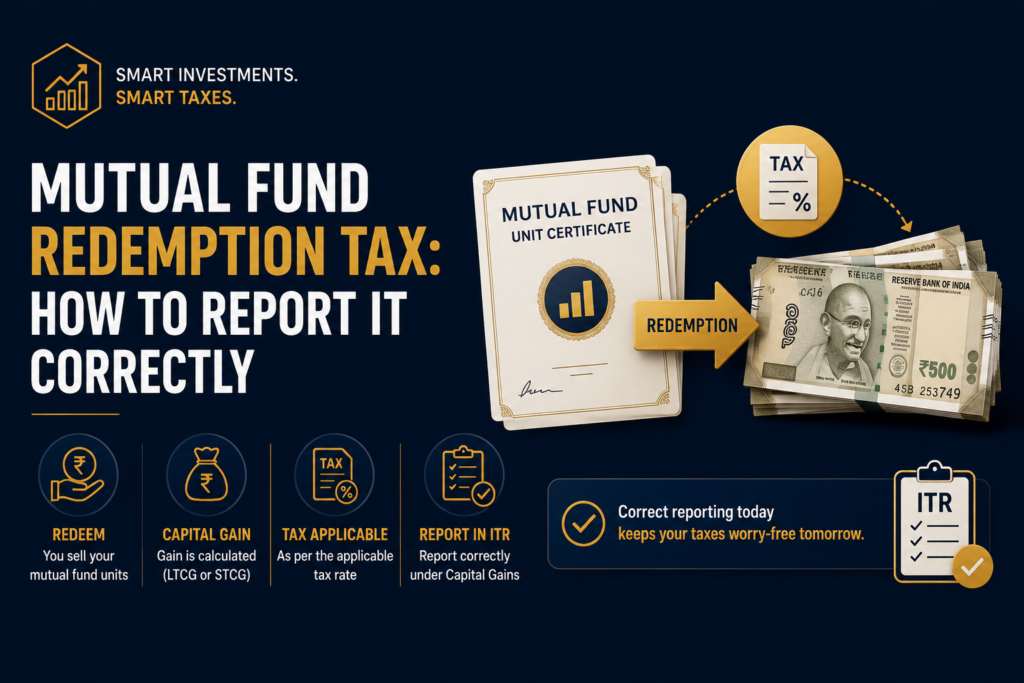
If you redeemed mutual fund units in the last financial year and you are now staring at your AIS wondering what to do, you are in the right place. Mutual fund redemption tax is one of the most searched and most misunderstood items in Indian personal taxation — partly because the rules changed sharply on 23 July 2024, and partly because the tax depends on what kind of fund you held, for how long, and through what route. This post walks through the rates that now apply, the four broad categories of funds, and where exactly each gain goes in your ITR.
Quick answer
Redemption of mutual fund units is treated as a transfer under the Income Tax Act 1961, so any gain is capital gain — not “income from other sources.” Equity-oriented funds attract 20% STCG (held 12 months or less) or 12.5% LTCG above ₹1.25 lakh per year (held more than 12 months). Most debt funds are taxed at slab rate regardless of holding period. Other funds (gold, international, hybrid) follow a 24-month rule with 12.5% LTCG.
Before filing, check:
- Is the fund equity-oriented (≥65% in Indian equities) or non-equity?
- Was the unit purchased before or after 1 April 2023, and was it sold before or after 23 July 2024?
- Are you eligible for ITR-1, or do you need ITR-2 or ITR-3?
How mutual fund redemption tax works: the four categories
Indian mutual funds are not taxed as one block. The Income Tax Act treats them under four distinct buckets, and the bucket determines both the holding period that splits short-term from long-term, and the rate that applies. Get the bucket wrong and your return either over-pays tax or comes back as defective.
The four categories are:
- Equity-oriented funds — schemes that invest at least 65% of net assets in Indian listed equities. Includes large-cap, mid-cap, small-cap, ELSS, sectoral, thematic, and most flexi-cap funds. Securities Transaction Tax (STT) is paid on redemption.
- Specified mutual funds (debt funds purchased on or after 1 April 2023) — schemes that invest 65% or more in debt and money-market instruments. Section 50AA applies, and the holding period is irrelevant.
- Other specified mutual funds (debt-heavy funds) — same scheme type as above, but units acquired before 1 April 2023.
- Hybrid, gold, and international funds (non-specified) — fund-of-funds, gold mutual funds, international funds, and hybrid funds where neither the equity nor debt threshold is crossed.
The table image below summarises the holding period and rate for each category.
Equity-oriented funds: STCG and LTCG after 23 July 2024
This is where most retail investors sit. An equity-oriented fund is one that invests at least 65% of its net assets in Indian listed equity. Section 111A applies to short-term capital gains (STCG) and Section 112A applies to long-term capital gains (LTCG), provided STT was paid on the redemption.
Take Rahul, who buys ₹2 lakh worth of a large-cap equity fund on 1 May 2024 and redeems the entire holding on 1 March 2025 for ₹2.4 lakh. Holding period is 10 months — short-term. Gain of ₹40,000 is taxed at 20% under Section 111A, giving a tax of ₹8,000 plus cess.
Now consider Priya, who bought the same fund for ₹4 lakh on 1 January 2023 and redeems it on 1 February 2025 for ₹5.5 lakh. Holding period is over 24 months — long-term. Gain is ₹1.5 lakh. The first ₹1.25 lakh is exempt under the annual LTCG threshold; the balance ₹25,000 is taxed at 12.5%, giving ₹3,125 plus cess.
The ₹1.25 lakh exemption is per financial year, not per fund. If Priya also redeems another equity fund the same year with an LTCG of ₹50,000, she has already used her exemption — the second ₹50,000 is fully taxable.
Debt funds: slab rate for almost everyone
The Finance Act 2023 introduced Section 50AA, which classifies any mutual fund with 65% or more in debt and money-market instruments as a “specified mutual fund.” For units of these funds purchased on or after 1 April 2023, all gains — irrespective of how long you hold them — are treated as short-term capital gains and taxed at your slab rate. There is no LTCG benefit, no indexation, and no concessional rate. Liquid funds, ultra-short-duration funds, gilt funds, and corporate bond funds all fall here.
For units purchased before 1 April 2023 that you still hold and redeem now, the older “non-specified” rule applies: short-term if held 24 months or less (slab rate), long-term if held more than 24 months. Long-term gains on these legacy units, when sold on or after 23 July 2024, are taxed at 12.5% without indexation. Budget 2024 removed the indexation benefit that earlier made debt funds attractive for high-bracket investors.
Hybrid, gold, and international funds
Funds that are neither 65% equity nor 65% debt fall into a residual bucket — “non-equity, non-specified.” The holding period split is 24 months, and after Budget 2024, LTCG is 12.5% without indexation. STCG is at slab rate. There is no ₹1.25 lakh exemption here; that benefit is only for equity-oriented funds under Section 112A.
This bucket catches a lot of investors by surprise. Fund-of-funds investing in international equity, gold mutual funds, gold ETFs, conservative hybrid funds, and arbitrage funds with low equity exposure all sit here. A ₹50,000 long-term gain on an international fund is not free — it is fully taxable at 12.5%.
SIP redemptions and fund switches
A systematic investment plan (SIP) is not one purchase — it is a series of monthly purchases. Each instalment has its own purchase date, and the holding period is checked instalment by instalment using the FIFO method (first-in-first-out). Redemption of older units happens before newer ones.
Take Arun, who has been investing ₹10,000 a month into an equity fund since January 2024 and redeems the full corpus in February 2026. Instalments from January 2024 to February 2025 have crossed 12 months — those gains are LTCG. Instalments from March 2025 to February 2026 have not — those are STCG. A single redemption can therefore generate both LTCG and STCG, and both go in different parts of the ITR.
A fund switch — moving from one scheme, plan, or option to another — is treated as a redemption of the old units plus a fresh purchase of the new units. This applies even when you switch from Regular to Direct plan within the same scheme, or from Growth to IDCW (income distribution cum capital withdrawal) option. The capital gain on the redeemed units is taxable in the year of switch, even though no money has reached your bank account.
Setting off and carrying forward capital losses
Not every redemption ends in a profit, and the Income Tax Act has specific rules for how a loss can be used. The asymmetry between short-term and long-term losses is what most investors miss.
A short-term capital loss can be set off against either short-term or long-term capital gains in the same year. A long-term capital loss, however, can be set off only against long-term capital gains — not against short-term gains, and not against any other head of income such as salary or interest. This rule is strict and there is no flexibility.
The practical impact shows up in mixed years. Suppose a debt fund redemption produces a short-term loss of ₹50,000 and an equity fund redemption produces an LTCG of ₹2 lakh in the same financial year. The short-term loss can be set off against the long-term gain, reducing the gross LTCG to ₹1.5 lakh, of which the first ₹1.25 lakh remains exempt. The same loss could not have been used in reverse — a long-term loss cannot offset a short-term gain.
Unabsorbed capital losses do not vanish at year-end. They can be carried forward for eight assessment years following the year of loss. Long-term losses carried forward can only be set off against future long-term gains, while short-term losses carried forward can be set off against either short-term or long-term gains in the future. The carry-forward, however, is conditional: the original return for the loss year must be filed within the due date under Section 139(1) of the Income Tax Act 1961. A return filed late preserves the loss for the current year but loses the right to carry it forward — and that right cannot be revived later.
Schedule CFL of the ITR is where carried-forward losses live. It is worth checking every year before filing, because losses from three or four years ago may still be available to offset this year’s gain. This is one of the most under-used planning levers in retail investing, and missing it leaves real money on the table.
A note for NRI investors
Non-resident investors face one structural difference from resident investors when redeeming mutual funds. TDS is deducted by the AMC or registrar at the time of redemption, before the proceeds are credited to the NRO or NRE account. Resident investors face no such deduction and pay tax themselves through advance tax or self-assessment.
The TDS rates broadly track the applicable tax rates. On equity-oriented funds, short-term capital gains under Section 111A attract 20% TDS, and long-term capital gains under Section 112A attract 12.5% TDS on the amount above the ₹1.25 lakh annual exemption. On debt funds and other non-equity funds, short-term gains generally face 30% TDS (the highest slab is assumed by the deductor), and long-term gains, where applicable, face 12.5% TDS. Cess and surcharge apply on top.
A common misunderstanding is that the deducted TDS is the final tax. It is not. If the NRI’s actual tax liability for the year is lower — for example, if total Indian income falls in the 5% or 20% slab, or the equity LTCG is below ₹1.25 lakh — the excess TDS is recoverable as a refund. The only way to claim the refund is to file an Indian income tax return. Even where no further tax is payable, filing is the mechanism that reconciles the TDS with the actual liability.
DTAA relief is the second lever worth knowing. NRIs from countries with a Double Taxation Avoidance Agreement with India may be eligible for a lower rate on certain capital gains. To claim DTAA benefit, a Tax Residency Certificate from the home country, along with a Form 10F filing on the income tax portal, is generally required. The exact relief depends on the wording of the relevant treaty article and whether the gain is taxable in the resident country at all.
NRIs investing through SIPs face the same FIFO classification issue as residents, with the added complication that the AMC will deduct TDS automatically on each redemption based on its own classification logic. The classification used by the AMC is not always perfect, especially for partial redemptions and switches. Filing an accurate ITR — with the gain classified correctly and TDS reconciled against actual liability — is the only way to recover any over-deducted tax.
Which ITR form to use and where to report
For FY 2025-26 onwards, the form choice has eased slightly. If your only LTCG is from listed equity shares or equity-oriented mutual funds under Section 112A, total LTCG does not exceed ₹1.25 lakh, and you have no carried-forward or carry-forward capital losses, you can file using ITR-1 or ITR-4. Anything beyond that — STCG, LTCG above the exemption, debt fund gains, gold or international fund gains, or any carry-forward losses — pushes you to ITR-2 or, if you have business income, ITR-3.
Where each gain is reported:
- Equity LTCG (Section 112A): Schedule 112A. Scrip-wise (or fund-wise) reporting is required, with ISIN, units, sale value, cost of acquisition, and the grandfathered cost where applicable.
- Equity STCG (Section 111A): Schedule CG, Section A — short-term capital gains on STT-paid equity.
- Debt fund gains (specified mutual funds under Section 50AA): Schedule CG, in the dedicated row for specified mutual funds.
- Other non-equity LTCG and STCG: Schedule CG, under the appropriate sub-sections.
Cross-check every entry against your AIS (Annual Information Statement) and the Capital Gains Statement issued by the AMC or registrar (CAMS or KFintech). Mismatches between AIS and the return are now the most common trigger for defective return notices on capital-gains-heavy ITRs.
When you should not redeem in a hurry
Redemption is irreversible, and a poorly timed exit can cost more in tax than it saves. Hold off on the redemption click in these situations:
- You are days away from crossing the 12-month equity threshold. Redeeming on day 359 instead of day 366 changes the rate from 12.5% to 20%, on the same gain.
- You have already used the ₹1.25 lakh equity LTCG exemption this year. Splitting the redemption across two financial years can save the entire 12.5% on the second tranche.
- You are switching only to chase a slightly better past return. The switch triggers a taxable event today, and the new fund’s future returns are uncertain. The tax friction often eats more than the alpha.
- You are redeeming debt funds bought after 1 April 2023 only because you “held them long enough.” Holding period does not help — gains are slab-taxed regardless.
- Your total income for the year is unusually low. For debt fund STCG taxed at slab rate, a low-income year is the cheapest year to redeem; do not redeem in a high-income year if you can wait.
The old vs new tax regime choice also matters here, especially for slab-rate gains on debt and non-equity funds.
Documents and figures to keep ready before filing
Keep these in front of you before you open the ITR:
- Capital Gains Statement from CAMS or KFintech for every folio held during the year
- Statement of Accounts from each AMC, especially for SIP holdings
- Bank statements showing redemption credits, to reconcile with the AGS
- AIS and TIS from the income tax e-filing portal
- Form 26AS, to check any TDS deducted (relevant for NRIs)
- ISIN of each fund (available on the consolidated account statement)
- Date of each purchase instalment for SIP folios
- Acquisition value and grandfathered NAV as on 31 January 2018, where applicable for pre-2018 equity holdings under Section 112A
Final takeaway
Mutual fund redemption tax is no longer a one-line answer. It depends on what category the fund falls in, when the units were bought, when they were sold, and through what route. The 23 July 2024 cut-off and the 1 April 2023 cut-off for debt funds are the two anchors that decide the rate. Match the gain to the right schedule in the ITR, reconcile with AIS, and the return will go through cleanly. Get the bucket wrong and even a small redemption can attract a defective-return notice.
Confused about how to classify your mutual fund redemption or where to report it in your ITR? eTaxMate can help you review your fund statements, classify each redemption correctly, and file your return without the mismatch errors that trigger notices.
This blog post is for general information only and does not constitute professional advice. Tax laws are subject to change and their application depends on individual facts and circumstances. Readers should consult a qualified professional before taking any action based on this content. eTaxMate accepts no liability for any action taken based on the information in this post.
Frequently Asked Questions
1. Do I need to pay tax if I only switch between mutual fund schemes without withdrawing to my bank?
Yes. A switch is treated as a redemption of the old units followed by a fresh purchase of the new units, so the capital gain on the redeemed units is taxable in the year of switch — even if no money reaches your bank account. This applies to switches between schemes, between Regular and Direct plans within the same scheme, and between Growth and IDCW options.
2. How is tax calculated on SIP redemption when some units are held for less than a year and others for more?
Each SIP instalment is treated as a separate purchase, and redemption follows the first-in-first-out method. So a single redemption can generate both long-term and short-term gains. Instalments held more than 12 months (for equity funds) qualify as LTCG; the rest are STCG. Both must be reported separately in the ITR under the relevant capital gains schedule.
3. Can I file ITR-1 if I have long-term capital gains from equity mutual funds?
Yes, but only if the LTCG is from listed equity shares or equity-oriented mutual funds under Section 112A, the total LTCG does not exceed ₹1.25 lakh in the financial year, and you have no carried-forward or carry-forward capital losses. Anything above ₹1.25 lakh, any STCG, any debt fund gain, or any prior-year capital loss pushes you into ITR-2 or ITR-3.
4. Are debt mutual fund gains still eligible for indexation?
For units purchased on or after 1 April 2023, no — Section 50AA classifies these as specified mutual funds, and gains are taxed at slab rate regardless of holding period, with no indexation. For units purchased before 1 April 2023 and sold on or after 23 July 2024, long-term gains are taxed at 12.5% without indexation. Indexation is no longer available on any debt fund redemption.
5. Where do I report mutual fund capital gains in the ITR?
Equity LTCG under Section 112A goes in Schedule 112A with scrip-wise details including ISIN, units, sale value, and cost. Equity STCG under Section 111A goes in Schedule CG, Section A. Debt fund gains go under the specified mutual funds row in Schedule CG. Hybrid, gold, and international fund gains go under the appropriate non-equity sub-section of Schedule CG.
6. Does the ₹1.25 lakh LTCG exemption apply to gold funds and international funds?
No. The ₹1.25 lakh annual exemption is available only for long-term capital gains on equity-oriented funds and listed equity shares under Section 112A. Gold mutual funds, gold ETFs, international funds, and fund-of-funds fall in the non-equity bucket — their LTCG is taxed at 12.5% without indexation from rupee one, with no annual exemption.