
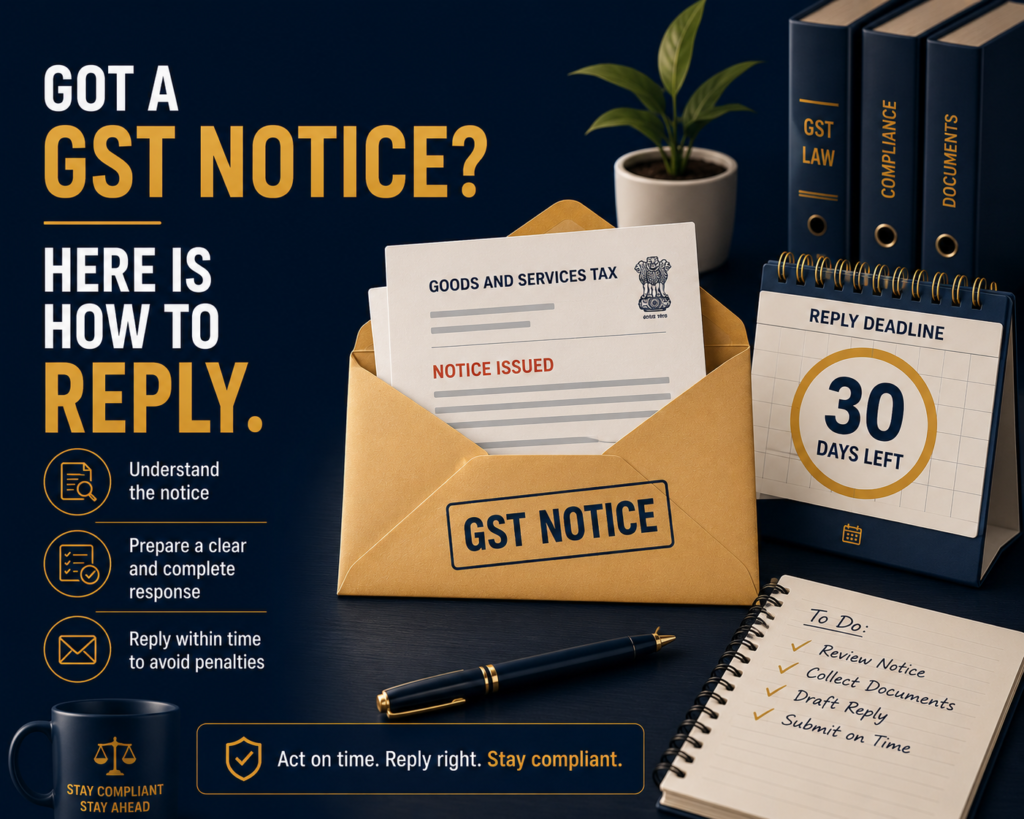
If you have just received a GST notice and your first reaction is panic, take a breath. Most GST notices are not accusations — they are questions. The department has spotted something in your returns, registration, or filings that does not add up, and they want an explanation. A well-drafted GST notice reply, filed within the deadline, closes most matters without escalation. A missed deadline or a sloppy reply is what turns a routine query into a recovery proceeding. This post explains how to identify the notice you have received, how long you have to reply, and how to structure a response that the officer will accept.
Quick answer
The first thing to do with any GST notice is identify the form number printed on it — that single detail tells you the section, the deadline, and the reply form you need to file. Most replies are filed online through the GST portal under Services > User Services > View Additional Notices and Orders. Standard timelines are 7 working days for registration notices and 30 days for scrutiny and demand notices.
Before drafting your reply, check:
- The form number (ASMT-10, DRC-01, REG-03, REG-17, etc.) — this determines which reply form to use.
- The exact reply deadline mentioned on the notice — never assume the standard timeline; the officer can specify shorter.
- The financial year the notice covers — this decides whether Section 73, 74, or the new Section 74A applies.
First, identify which GST notice you have received
The form number is the single most important piece of information on a GST notice. It tells you which section of the CGST Act 2017 the officer is acting under, what the notice is asking, how many days you have to reply, and which form you must file your reply in. Treat the form number as the lookup key — everything else flows from it.
Take a typical example. A Bengaluru-based SaaS startup files its GSTR-3B and claims input tax credit (the GST it has paid on its software subscriptions and office rent, which it offsets against the GST it has collected from clients) of ₹8 lakh. The auto-populated GSTR-2B, however, shows only ₹6.5 lakh of eligible credit.
Two months later, a notice in Form ASMT-10 lands in the company’s portal inbox, asking it to explain the ₹1.5 lakh gap. This is a scrutiny notice under Section 61 — not yet a demand. The startup has 30 days to reply in Form ASMT-11, attach a reconciliation, and either justify the credit or pay the difference. Handled correctly, the matter closes with an ASMT-12 acceptance order. Ignored, it escalates to a DRC-01 show cause notice within weeks.
The takeaway: identify the form, identify the section, identify the deadline. Then draft.
The four most common GST notices, in plain English
Most startups will encounter one of four notice types. Here is what each one means and what the response looks like.
ASMT-10 (Scrutiny notice under Section 61) The officer has scrutinised your returns and found discrepancies — typically a mismatch between GSTR-1 (outward supplies you declared) and GSTR-3B (the summary return where you pay tax), or between your GSTR-3B and the auto-populated GSTR-2B. ASMT-10 Reply in Form ASMT-11 within 30 days. If the explanation is accepted, you receive an ASMT-12 closure order and the matter ends.
DRC-01 (Show cause notice under Section 73, 74, or 74A) This is more serious. The officer has already determined a tax shortfall and is asking why you should not pay tax, interest, and penalty. Section 73 covers genuine errors (3-year limit, 10% penalty). Section 74 covers fraud or wilful suppression (5-year limit, up to 100% penalty). Section 74A, effective from FY 2024-25 onwards, consolidates both into a single 42-month window with a 60-day reduced-penalty payment option. Reply in Form DRC-06 within 30 days. You can also pay voluntarily through Form DRC-03, either fully or in part, to reduce penalty exposure.
REG-03 (Query during GST registration) The officer has reviewed your GST registration application and wants more information — usually clarification on business address, document mismatch, or principal place of business proof. Reply in Form REG-04 within 7 working days. Miss the deadline and your application is rejected under REG-05, forcing you to start over.
REG-17 (Show cause for cancellation of registration) The officer is proposing to cancel your GSTIN — typically because of non-filing of returns, mismatch in business address, or a complaint received. Reply in Form REG-18 within 7 days, with documentary proof that the grounds for cancellation do not apply.
How to draft your GST notice reply — the structure that works
A reply that the officer accepts has three qualities: it addresses every point raised, it is backed by documents, and it is written without emotion.
A useful pattern is the point-by-point reply. Number each allegation in the notice, write a short factual response under it, and reference the supporting document. For an ASMT-10 ITC mismatch, that means producing a reconciliation table showing invoice-by-invoice why your GSTR-3B claim differs from GSTR-2B — perhaps because some invoices appeared late on the supplier’s GSTR-1, perhaps because some credit was reversed in a later month. Attach the reconciliation as a PDF. Do not argue, do not editorialise, do not blame the supplier in writing.
If you partly agree with the notice, say so clearly and pay the agreed portion through DRC-03 before filing the reply. Reference the DRC-03 challan in your ASMT-11. Voluntary payment before the SCN stage often eliminates penalty entirely under Section 73 and reduces it sharply under Section 74A.
Below is a quick-reference infographic showing the four notice types, their reply forms, and the deadlines side by side. Print it or save it — most disputes about timelines arise from confusion between these four.
How to file your GST notice reply on the portal
All replies — except for certain enforcement-wing matters — are filed online through the GST portal. Log in, then navigate to Services > User Services > View Additional Notices and Orders. The notice will be listed against its reference number and date. Click Reply, and the system opens the correct reply form automatically — ASMT-11 for an ASMT-10, DRC-06 for a DRC-01, REG-04 for a REG-03, REG-18 for a REG-17.
Fill in your point-wise statement in the text field. Attach supporting documents as PDFs — typically capped at a small file size per attachment, so larger reconciliations may need to be split. Name the files clearly: GSTR2B_Reconciliation_FY2425.pdf is far more useful to the officer than Document1.pdf. Companies and LLPs must submit using a Digital Signature Certificate (a USB token-based electronic signature). Proprietors can submit using an Aadhaar-linked Electronic Verification Code (an OTP-based alternative to a DSC). Save the acknowledgement number — it is your only proof of timely filing.
If the officer has fixed a personal hearing, the date appears on the same screen. Attendance is not optional. An ex-parte order — an order passed without hearing your side — is the standard consequence of skipping a hearing.
When you should not delay or self-file the reply
Some GST notices warrant immediate professional help rather than a do-it-yourself attempt. Be cautious in these situations:
- Section 74 or Section 74A show cause notices alleging fraud or suppression. The penalty exposure runs up to 100% of the tax demanded. The reply needs to address the fraud allegation directly, not just the numerical mismatch. A weak reply on a fraud SCN can hurt you more than no reply.
- DRC-01 demands above ₹10 lakh, or any matter involving multiple financial years. The cumulative exposure compounds quickly with interest.
- ADT-01 audit notices under Section 65. A GST audit is a deeper review than a scrutiny notice, and the reply must be coordinated with your books, GSTR-9, and GSTR-9C reconciliation. This is also where overlap with tax audit requirements under the Income Tax Act becomes relevant for larger businesses.
- Notices issued by enforcement wings (DGGI, Anti-Evasion). These often involve search-and-seizure proceedings and require physical replies in addition to portal filing.
- You have already missed the original deadline. A late reply with a request for condonation is a different exercise from a timely reply, and the framing changes.
- REG-17 cancellation notices where your business cannot operate without an active GSTIN. The 7-day clock is unforgiving and re-registration takes weeks.
Documents to gather before drafting your reply
A reply is only as strong as the documents behind it. Pull these together before you start writing:
- Copy of the notice itself, with the form number, reference number, and date noted.
- Returns for the period covered — GSTR-1, GSTR-3B, GSTR-2B (and GSTR-9, GSTR-9C if the year is reconciled).
- Reconciliation worksheet matching GSTR-1 vs GSTR-3B, or GSTR-3B vs GSTR-2B, depending on the discrepancy alleged.
- Sales and purchase invoices for the period.
- Payment challans (for any DRC-03 voluntary payment).
- E-way bills, shipping bills, or bills of entry, if exports or interstate movement are in question.
- Bank statements supporting the reported turnover.
- Correspondence or supplier confirmations, if a supplier-side issue is the root cause.
Final takeaway
A GST notice is not a verdict — it is a question with a deadline. The form number identifies the question, the reply form delivers the answer, and the calendar tells you when the answer is due. Read the notice carefully, identify the form, file the right reply within the timeline, and back every claim with documents. Most notices end at ASMT-12 or with a quietly accepted DRC-06. The ones that escalate to DRC-07 are almost always the ones that were ignored, replied to late, or replied to without evidence.
GST notice reply confusion or need expert help with an ASMT-10, DRC-01, or registration notice? eTaxMate can help you review the notice, draft a point-wise response, gather the supporting reconciliations, and file it on the portal within the deadline.
This blog post is for general information only and does not constitute professional advice. Tax laws are subject to change and their application depends on individual facts and circumstances. Readers should consult a qualified professional before taking any action based on this content. eTaxMate accepts no liability for any action taken based on the information in this post.
Frequently Asked Questions
1. What is the difference between ASMT-10 and DRC-01 under GST?
ASMT-10 is a scrutiny notice issued under Section 61 when the officer spots a discrepancy in your returns and wants an explanation — it is not a demand. DRC-01 is a show cause notice under Section 73, 74, or 74A, issued after the officer has determined that tax is due. ASMT-10 is replied to in Form ASMT-11; DRC-01 is replied to in Form DRC-06. ASMT-10 can close with an ASMT-12 acceptance order. DRC-01, if unanswered, escalates to a final DRC-07 demand.
2. How many days do I have to reply to a GST notice?
It depends on the form. ASMT-10 scrutiny notices and DRC-01 show cause notices give 30 days. Registration-related notices like REG-03 and REG-17 give only 7 working days. The notice itself will state the exact deadline, and the officer can specify shorter timelines than the standard. Always treat the date printed on the notice as the binding one. An extension of up to 15 days can be requested through the portal in some cases.
3. Can I drop a GST notice without paying anything if my reply is satisfactory?
Yes. If the explanation in your reply is supported by documents and addresses every point the officer raised, the matter can close without payment. For an ASMT-10, a satisfactory reply leads to an ASMT-12 closure order and the proceedings end. For a DRC-01, the officer may drop the proceedings or pass a reduced-demand order based on your reply. The key is point-wise responses backed by reconciliations and supporting invoices.
4. What happens if I ignore a GST notice?
For scrutiny and demand notices, the officer can pass an ex-parte order — an order without hearing your side — confirming the full tax, interest, and penalty in Form DRC-07. For registration notices, the application gets rejected (REG-05) or the GSTIN cancelled. Bank account attachment, recovery proceedings, and prosecution under Section 132 are possible in serious cases. An ignored notice is almost always more expensive than the worst-case outcome of a properly filed reply.
5. What is Section 74A in GST and how is it different from Section 73 and 74?
Section 74A is a unified demand provision effective from FY 2024-25 onwards. It replaces the earlier two-track system where Section 73 covered non-fraud cases (3-year limit, 10% penalty) and Section 74 covered fraud cases (5-year limit, up to 100% penalty). Section 74A applies a single 42-month notice window and offers a 60-day reduced-penalty payment option after the demand order. For periods up to FY 2023-24, the old Sections 73 and 74 still apply.
6. Can I pay part of a GST demand voluntarily and contest the rest?
Yes, and this is often the right move. Use Form DRC-03 to pay the portion you agree with — typically the genuine shortfall — along with applicable interest. Reference the DRC-03 challan number in your ASMT-11 or DRC-06 reply. Voluntary payment before a show cause notice is issued can eliminate penalty entirely under Section 73, and reduce it sharply under Section 74A’s 60-day window. The remaining contested portion is then defended on facts and documents.