
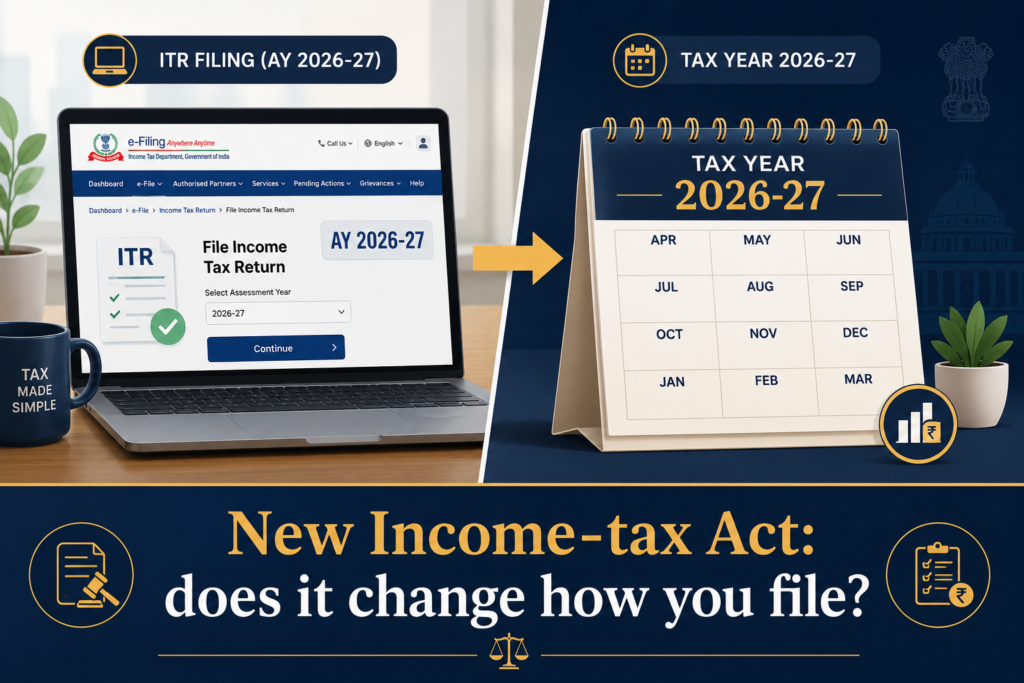
The New Income-tax Act 2025 replaced the 1961 law on 1 April 2026, and every headline about the change made it sound like the entire tax system had been rebuilt overnight. If you are sitting down to file your return for FY 2025-26 and wondering whether something fundamental has shifted — the short answer is: less than you think, but not nothing. This post explains exactly how new Income Tax Act 2025 impact on ITR Filing and which law governs the return you are filing right now, what has genuinely changed about the filing process, and what you need to watch out for before you hit submit.
Quick answer
For income earned in FY 2025-26, your return is still filed under the Income-tax Act 1961 — not the new Act. The new act impact on ITR filing is felt differently depending on which year’s income you are filing for: the 2025-26 return uses old forms and old rules; the 2026-27 return, due in July 2027, will be the first fully governed by the Income-tax Act 2025.
Before filing, check:
- Are you selecting the correct tab on the e-filing portal — Tab 1 (1961/AY 2026-27) for your current return?
- Has your filing deadline changed? Non-audit business filers now have until 31 August, not 31 July.
- Can you now file a revised return until 31 March instead of 31 December?
Which law actually governs the return you are filing right now?
This is the single most important thing to understand, and it catches many taxpayers off guard.
The Income-tax Act 2025 came into force on 1 April 2026. But the return you file in July 2026 relates to income earned between 1 April 2025 and 31 March 2026 — that is, FY 2025-26. Even though the filing typically occurs after 1 April 2026, when the new Act has already come into force, the return relates to a period beginning before that date and is therefore governed entirely by the old Act.
In practical terms: Section 80C is still Section 80C on your AY 2026-27 return. Your Form 16 is still Form 16. ITR-1 is still ITR-1. You are filing under the Income-tax Act 1961, just as you did last year.
The first return governed by the Income-tax Act 2025 will be for Tax Year 2026-27 — income earned from 1 April 2026 to 31 March 2027. That return will not be due until July 2027.
Think of it this way: Rahul, a salaried employee in Bhopal, earns his FY 2025-26 salary and files in July 2026. His return is AY 2026-27, filed under the 1961 Act. His colleague Priya earns her income from April 2026 onwards under the new Act framework, and will file that return as Tax Year 2026-27 in July 2027. Both are filing on the same portal, but under different laws. The portal now accommodates both simultaneously.
What is different on the e-filing portal this year
The most visible change this year is the e-filing portal itself. The income tax e-filing portal now shows two separate tabs — Tab 1 for “Income Tax Act 1961” (use this for AY 2026-27 / FY 2025-26 returns) and Tab 2 for “Income Tax Act 2025 / Tax Year 2026-27,” which will be used for FY 2026-27 returns filed from 2027 onwards.
For your FY 2025-26 return, you must use Tab 1. Clicking the wrong tab does not just put you in the wrong section — it means you are working with the wrong law’s framework entirely, and the form fields, section references, and available deductions will not match your situation. A return filed under the wrong tab is defective.
Also new this season: challan forms for tax payments have been split. New challans are live on the portal for Tax Year 2026-27 payments under the Income-tax Act 2025. For any payment relating to FY 2025-26 — advance tax top-up, self-assessment tax, or any outstanding demand — use the old challan under the 1961 Act section of the portal.
Cross-checking your Annual Information Statement before filing remains essential. The AIS continues to show all income linked to your PAN, and the department actively uses mismatches between AIS entries and filed returns to issue notices. The AIS is available under the same e-filing portal login regardless of which tab you are using.
The filing deadlines have changed — here is what applies to you
Budget 2026 introduced a staggered deadline structure for AY 2026-27. This is new, and it meaningfully affects freelancers, consultants, and small business owners who previously had to file alongside salaried employees by 31 July.
Here is a visual summary of who files when, what is new, and what you need to do.
Anil runs a small consultancy in Jabalpur — no tax audit required. Previously he had to file by 31 July, competing with millions of salaried filers for the portal’s bandwidth in the final week. From this year, his deadline is 31 August. The extra month gives him time to reconcile his professional receipts, check TDS credits, and file without rushing.
One important caveat: if Anil has business losses he wants to carry forward — capital losses, or business losses other than house property loss — he must file by his applicable original deadline. Belated returns filed after that date lose the right to carry forward such losses.
What changes about the ITR forms themselves
For AY 2026-27, the ITR forms are still the familiar set — ITR-1 through ITR-7 — governed by the 1961 Act. But CBDT has made structural changes to the forms this year worth knowing.
From AY 2026-27, ITR-1 can now be used where there are two house properties, whereas previously only one was permitted — taxpayers with two properties had to file the more detailed ITR-2. This is a meaningful simplification for the large number of taxpayers who own both a self-occupied property and a rented or vacant second property.
Section 80C disclosure is now more granular: taxpayers must break down which specific investments they are claiming — EPF, PPF, ELSS, LIC premium, tuition fees — rather than reporting a single aggregate figure. The forms also require specifying the TDS section under which tax was deducted on each income entry, aiding reconciliation with Form 26AS and the AIS.
For freelancers and consultants filing ITR-4 under presumptive taxation, a new column under Financial Particulars requires disclosure of investments made during the year, improving income-investment reconciliation.
The choice between the old and new tax regime must still be made at the time of filing. The new regime remains the default. Opting into the old regime — which allows deductions such as 80C, HRA, and home loan interest — requires a deliberate choice on the return form, and for business income, a separately filed Form 10-IEA before the filing deadline.
The revised return window has been extended
One quietly significant change introduced by Budget 2026 applies to AY 2026-27 directly: the deadline to file a revised return has been extended from 31 December to 31 March 2027.
Under the old framework, if you filed in July and later noticed a missed bank interest entry or an incorrectly reported capital gain, you had until 31 December of the same year to correct it. That window is now three months longer. Taxpayers who receive belated Form 16s from employers, or whose AIS is updated with entries appearing after the July filing date, now have meaningful breathing room.
If the error involves income that was never declared at all — across any of the last four years — the option to file an updated return (ITR-U) remains available, subject to additional tax of 25–70% on the shortfall depending on timing.
What does not change about filing
For the return you are filing this July, the following are exactly the same as last year. The ITR form names are unchanged for AY 2026-27. Deduction limits — Section 80C at ₹1.5 lakh, Section 80D, home loan interest under Section 24(b) — apply as before. Tax slab rates set by Finance Act 2025 are unchanged; Budget 2026 made no modifications. The standard deduction is ₹75,000 under the new regime and ₹50,000 under the old. E-verification within 30 days of filing — using Aadhaar OTP, net banking EVC, or DSC — is still required.
Common mistakes to avoid this season
Selecting the wrong portal tab. Use Tab 1 (Income Tax Act 1961) for your FY 2025-26 return. Tab 2 is for Tax Year 2026-27 onwards. This is the mistake most likely to produce a defective return in the first year of the two-tab interface.
Using a new challan for an old-year payment. If you are paying self-assessment tax for FY 2025-26, use the 1961 Act challan. Mixing them creates reconciliation problems on the portal.
Assuming your deadline is 31 July when it is 31 August. Non-audit business and professional income filers now have until 31 August 2026. But late payment of tax still attracts interest under Section 234B regardless of when you file — do not treat the extended filing date as permission to delay the payment.
Not breaking down Section 80C investments. The AY 2026-27 form requires itemised disclosure — EPF, PPF, ELSS, LIC premium, tuition fees as separate entries. A lump-sum figure will not be accepted.
Filing ITR-2 when ITR-1 now suffices. If you have two house properties but no business income and no capital gains beyond the ITR-1 threshold, you may now be eligible for the simpler form. Check before defaulting to what you filed last year.
Documents and checks before you file
- PAN linked to Aadhaar — mandatory prerequisite for filing
- Form 16 from your employer (for AY 2026-27, this is still Form 16, not Form 130)
- Annual Information Statement from the e-filing portal — cross-check all entries against your records before submitting
- Bank account interest certificates — all savings and fixed deposit interest must be declared, even where TDS has already been deducted
- Capital gain statements from your broker or mutual fund house if you sold investments in FY 2025-26
- Investment proofs for old regime filers — 80C receipts, Section 80D premium certificate, home loan interest certificate with principal and interest split
- Advance tax and self-assessment tax challans paid during FY 2025-26 — reconcile against the return before submitting
- HRA rent receipts and landlord PAN if rent exceeds ₹1 lakh annually and you are claiming under the old regime
Final takeaway
The new act impact on ITR filing is real but concentrated in specific places: the two-tab portal interface, the extended ITR-3 and ITR-4 deadline for non-audit cases, the longer revised return window, and some structural changes to what the forms require you to disclose. For income earned in FY 2025-26, the governing law is still the Income-tax Act 1961. File the right return for the right year, under the right tab, check your AIS, and the process this season is not dramatically different from last year. The full shift to the new Act’s framework — new form names, Tax Year terminology, Form 130 instead of Form 16 — comes with the return you will file in July 2027.
Uncertain about which ITR form applies to your situation, whether the old or new regime works better this year, or how to reconcile AIS mismatches before filing? eTaxMate can review your income details, identify the right form and regime, and handle your filing correctly.
This blog post is for general information only and does not constitute professional advice. Tax laws are subject to change and their application depends on individual facts and circumstances. Readers should consult a qualified professional before taking any action based on this content. eTaxMate accepts no liability for any action taken based on the information in this post.
Frequently Asked Questions
1. Does the new Income-tax Act 2025 affect my FY 2025-26 return?
Not directly. Your FY 2025-26 return — filed for AY 2026-27 in July or August 2026 — is still governed by the Income-tax Act 1961. The same ITR forms, section numbers, deduction limits, and tax slabs apply as last year. The Income-tax Act 2025 fully governs only income earned from 1 April 2026 onwards, with that return due in July 2027.
2. What are the two tabs on the income tax e-filing portal and which should I use?
From April 2026, the e-filing portal shows two tabs — Tab 1 for the Income Tax Act 1961 (for AY 2026-27 and earlier returns) and Tab 2 for the Income Tax Act 2025 (for Tax Year 2026-27 returns, filed from 2027). For FY 2025-26 income, always select Tab 1. Selecting Tab 2 by mistake means working in the wrong legal framework, which can result in a defective return.
3. Is the ITR filing deadline still 31 July for everyone?
No longer. Salaried individuals and investors filing ITR-1 or ITR-2 still have a 31 July 2026 deadline. Non-audit business and professional income filers using ITR-3 or ITR-4 now have until 31 August 2026 — an extension introduced by Budget 2026. Tax audit cases remain at 31 October 2026. If you miss your deadline, a belated return can be filed until 31 December 2026 with applicable fees.
4. Can I correct my return after filing if I find a mistake?
Yes, and the window is now longer. For AY 2026-27, a revised return can be filed up to 31 March 2027, extended from the previous 31 December deadline. This is useful if your AIS is updated after your July filing date, or if you receive a revised Form 16. For missed income from earlier years, an updated return (ITR-U) is the route — with additional tax of 25–70% on the shortfall depending on timing.
5. My employer issued a Form 16 for April 2026 salary — is that the correct document?
No. Form 16 applies to salary income up to FY 2025-26 (AY 2026-27). For salary earned from 1 April 2026 onwards — Tax Year 2026-27 — the correct TDS certificate is Form 130 under the Income Tax Rules 2026. A Form 16 issued for Tax Year 2026-27 salary is technically non-compliant and may create portal mismatches when you file that year’s return in 2027.
6. What is the most common filing mistake to avoid this season?
Selecting Tab 2 (Income Tax Act 2025) on the portal when filing for FY 2025-26 income. Your return this season belongs entirely under Tab 1. A related error is using the new Income-tax Act 2025 challan for self-assessment tax payments relating to FY 2025-26. Both create reconciliation problems that can delay a refund or trigger a defect notice from the department.