
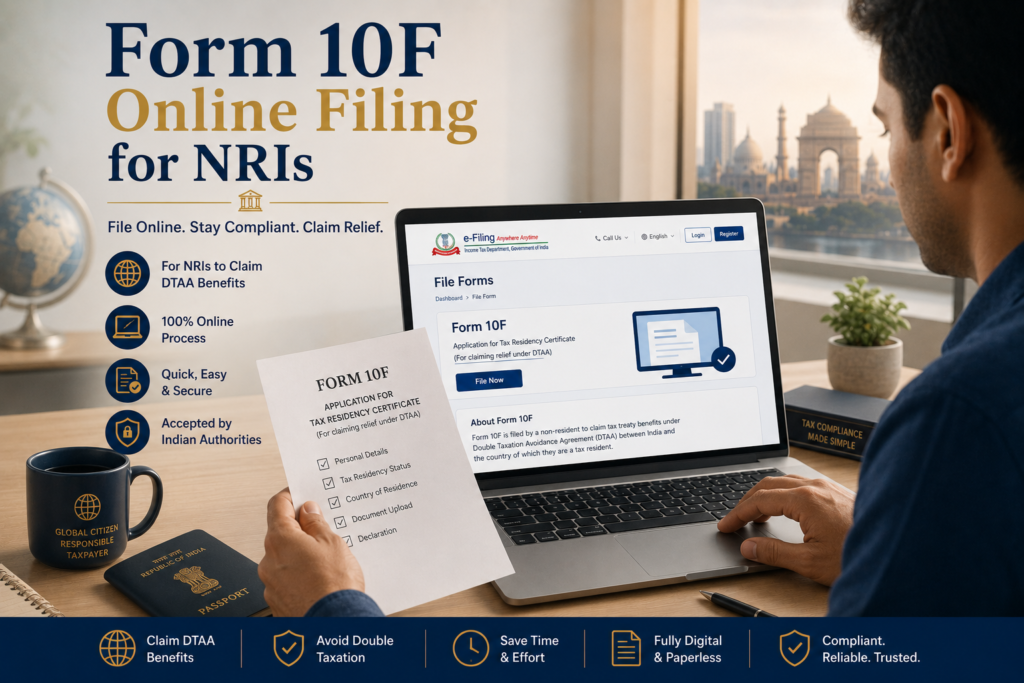
If someone in India is paying you income — rent, professional fees, interest, or dividends — and you want them to deduct TDS at the lower rate your tax treaty allows, they will almost certainly ask for Form 10F. Most NRIs encounter this form for the first time when a payer’s accountant calls asking for it, urgently, just before the TDS due date. Form 10F is not complicated, but it has a mandatory online filing requirement that catches many NRIs unprepared. This post explains what the form is, when you actually need it, and how to complete the Form 10F online filing for NRIs correctly on India’s e-filing portal.
Quick answer
Form 10F is a structured self-declaration that NRIs file to supplement their Tax Residency Certificate (TRC) when claiming a DTAA benefit — it supplies the specific details the TRC does not. Filing it is now mandatory online through the Income Tax e-filing portal at eportal.incometax.gov.in.
Before acting, check:
- You have a valid TRC from your country of residence — Form 10F cannot substitute for a missing TRC.
- Your TRC does not already cover all seven details required under Rule 21AB — if it does, you may not need Form 10F at all.
- Whether you have a PAN and a portal login — and if not, that you can register under the portal’s no-PAN category for non-residents to file online.
What is Form 10F and why do you need it?
Section 90 of the Income Tax Act 1961 allows India to honour its DTAAs (Double Taxation Avoidance Agreements) by taxing non-residents at lower rates or exempting certain income. Section 90(5) adds a condition: the non-resident must provide specified information prescribed under Rule 21AB of the Income Tax Rules before the benefit can be applied.
The primary document for this purpose is the TRC, issued by your country of residence to confirm you are tax-resident there. But TRCs from many countries — the UAE, Singapore, the UK, the US — do not always include every item Rule 21AB lists. The seven prescribed details are: your name, your status (individual, company, etc.), your nationality, your country of residence, your taxpayer identification number (TIN) in that country, your period of residence there, and your address during that period.
Form 10F fills the gap. It is a self-declaration on which you supply the missing details under your own signature. You give the filed form together with your TRC to the Indian payer. The payer’s CA then has both documents, satisfies the Section 90(5) requirement, and can legally deduct TDS at the DTAA rate instead of the higher domestic rate.
Under the Income Tax Act 2025, the requirement to furnish specified information before claiming treaty relief is carried forward. The exact provision numbers in the 2025 Act should be verified against the current text of the Act, as section references have been renumbered; the substantive obligation is unchanged from the 1961 Act.
When is Form 10F online filing required?
Form 10F is required whenever you are claiming a DTAA benefit and your TRC does not contain all seven items under Rule 21AB. In practice this applies to most NRIs receiving income from India — interest on NRO deposits, rent from Indian property, professional or consultancy fees, or royalties — because the TRC alone is rarely complete enough.
You do not file Form 10F with your ITR. It is a separate compliance document you give to your Indian payer so they can deduct TDS correctly before paying you.
Timing matters. You must give the payer Form 10F before TDS is deducted. If TDS is deducted first at the higher domestic rate because the payer did not have the documents, they cannot revise the deduction at source. You would then need to file your ITR and claim the excess as a refund — waiting months for money that should not have been withheld.
Form 10F online filing for NRIs: step by step
CBDT made electronic filing of Form 10F mandatory in 2022. Before that, it was a physical form you could fill, sign, and hand directly to the payer. The shift to online filing initially created a problem for NRIs without a PAN, because the portal required a PAN to register.
That gap has since been closed. A temporary relaxation allowed self-certified manual filing without a PAN, but only until 30 September 2023. After that, the portal introduced a dedicated registration category — “non-residents not having a PAN and not required to have a PAN” — which lets a PAN-less NRI register and file Form 10F online directly. So if you do not have a PAN, the route is no longer to look for a manual exception; it is to register under this no-PAN category and file electronically like everyone else.
If you have a PAN, log in with it as your user ID. If you do not, register first under the no-PAN category described above. The filing steps below are the same once you are logged in.
Step 1 — Log in. Go to eportal.incometax.gov.in and log in with your PAN, or with your no-PAN registration credentials, as the user ID.
Step 2 — Navigate. Go to e-File → Income Tax Forms → File Income Tax Forms, then search for “Form 10F.”
Step 3 — Select the assessment year. Choose the financial year for which you are claiming DTAA relief.
Step 4 — Fill in the seven required fields. Your TRC will carry most of them; the form asks you to supply whichever items the TRC omits.
Step 5 — Upload your TRC as a supporting attachment. If your TRC is in a language other than English, attach an English translation as well — the portal will not accept a non-English TRC on its own. Note the file limits: PDF format, within the portal’s size cap.
Step 6 — Verify and submit. NRIs can verify using a Digital Signature Certificate (DSC) or an EVC via net banking. Aadhaar OTP works only if your Aadhaar is linked to an active Indian mobile number; for most NRIs, a DSC or net banking EVC is the practical option.
Step 7 — Download and share. Save the filed Form 10F and the acknowledgement PDF and send both to the Indian payer before the payment date.
How to file Form 10F: a practical walkthrough
Before starting, confirm whether you need Form 10F at all. The flowchart below captures that decision and the steps that follow.
After filing on the portal, download the Form 10F PDF — not just the acknowledgement number. Send both the filed form and the TRC to the payer’s accountant. Keep copies for yourself in case the payer’s TDS return is queried. Form 10F validity corresponds to the period stated in your TRC; when you renew the TRC, file a fresh Form 10F.
When Form 10F will not help you
There are situations where Form 10F does not solve the problem, and proceeding without understanding them leads to wasted effort or compliance errors.
You do not have a TRC. Form 10F supplements a TRC; it cannot replace one. You cannot claim treaty relief at source without a valid TRC from your country of residence.
You are not a resident of a DTAA country. If you live in a country with no tax treaty with India, neither a TRC nor Form 10F is relevant — the standard domestic TDS rates apply in full.
You are not actually a non-resident. Residential status under Indian law depends on the number of days you have spent in India during the financial year, not on your passport or visa. If your stay in India crosses the Section 6 thresholds of the Income Tax Act 1961, you may be classified as a resident for that year, and DTAA relief provisions will not apply to you.
Your income is not covered by the DTAA. Most DTAAs cover dividends, interest, royalties, professional fees, and capital gains, but coverage varies by treaty. If a particular type of income falls outside the treaty’s scope, the domestic TDS rate applies regardless of TRC or Form 10F.
The treaty’s anti-abuse rules deny the benefit. A valid TRC and Form 10F establish your residence and supply the required details, but they do not guarantee the treaty rate. India has adopted the OECD Multilateral Instrument, which adds anti-abuse tests to many treaties — notably the Principal Purpose Test, which can deny a benefit where obtaining it was one of the main reasons for an arrangement. If your structure lacks genuine commercial substance, the treaty rate can be refused even with the paperwork in order. This is a question to raise with the payer’s CA where the arrangement is anything other than straightforward.
Documents checklist
📋 Before your payer deducts TDS, keep these ready:
- Valid TRC for the relevant financial year, issued by your country of residence
- PAN card (or PAN allotment letter) — required to log in to the e-filing portal
- Login credentials for the Income Tax e-filing portal
- Filed Form 10F, downloaded from the portal after submission (PDF)
- Acknowledgement of Form 10F filing
- Proof of your foreign address and TIN, in case the portal requests supporting documents
Final takeaway
Form 10F online filing is a one-time step per financial year, but the timing is critical: file it before your Indian payer makes the payment, not after. If your TRC already covers all seven Rule 21AB details, you may not need Form 10F at all — ask the payer’s CA to confirm before filing unnecessarily. And if you do not have a PAN, check the current CBDT notification before assuming the manual filing relaxation still applies to your situation.
Form 10F confusion or need help ensuring your DTAA claim is in order before the next payment? eTaxMate can review your TRC, confirm whether Form 10F online filing is required for your situation, and assist with the portal submission and coordination with the Indian payer.
This blog post is for general information only and does not constitute professional advice. Tax laws are subject to change and their application depends on individual facts and circumstances. Readers should consult a qualified professional before taking any action based on this content. eTaxMate accepts no liability for any action taken based on the information in this post.
Frequently Asked Questions
1. Do all NRIs need to file Form 10F?
No. Form 10F is required only when you are claiming a DTAA benefit and your Tax Residency Certificate does not include all seven details listed under Rule 21AB. If your TRC is comprehensive and covers your TIN, address, period, and the other required items, Form 10F may not be needed at all. The payer’s CA should confirm whether the TRC alone is sufficient.
2. Can I file Form 10F without a PAN?
Yes. A temporary relaxation once allowed manual filing without a PAN, but it ended on 30 September 2023. Since then, the e-filing portal has a dedicated category — “non-residents not having a PAN and not required to have a PAN” — that lets you register and file Form 10F online without a PAN. You supply basic details such as name, date of birth or incorporation, tax identification number, and country of residence, then file electronically
3. What happens if Form 10F is not submitted before TDS is deducted?
If TDS is deducted at the higher domestic rate because Form 10F was not provided in time, the payer cannot revise the deduction at source. You would need to file your ITR and claim the excess as a refund — which can take months. Providing Form 10F to the payer before the payment date is the only way to avoid this.
4. How long is a filed Form 10F valid?
Form 10F is valid for the period stated in the TRC it supplements. When your TRC expires or is renewed for a new period, you need to file a fresh Form 10F covering the new validity period before your next India income payment.
5. What is the difference between a TRC and Form 10F?
A TRC is issued by your country of residence’s tax authority to confirm your tax residency there. Form 10F is your own self-declaration — filed on India’s e-filing portal — that provides specific details your TRC may not contain. Both documents together satisfy the requirements under Section 90(5) of the Income Tax Act 1961 for claiming DTAA benefits.
6. Is Form 10F required for NRO bank interest?
Yes, if you want TDS on NRO interest deducted at the lower DTAA rate instead of the standard 30% (plus applicable surcharge and cess). Without a valid TRC and Form 10F, your bank will deduct TDS at the higher domestic rate. Provide both documents to the bank before the interest credit date.