
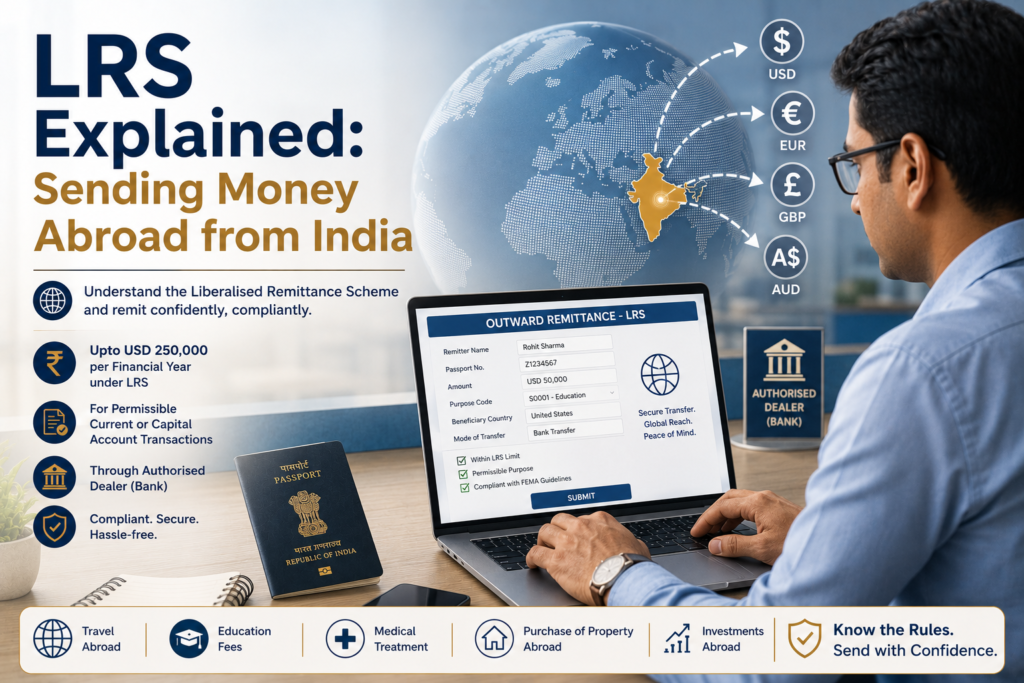
If you have ever sent money abroad from India as an individual — for a child’s university fees, a holiday, an overseas stock investment, or a relative living abroad — you have used the Liberalised Remittance Scheme, whether or not you knew it by that name. The LRS is the Reserve Bank of India’s standing permission for resident individuals to remit foreign exchange without seeking case-by-case RBI approval. It sounds simple, but there are a limit, a list of permitted uses, a list of prohibited uses, and a TCS (Tax Collected at Source) rule that surprises many people. This post covers all four.
Quick answer
Under the Liberalised Remittance Scheme, a resident individual can remit up to USD 2,50,000 per financial year for a range of permitted current and capital account purposes. Whether you are a salaried professional paying university fees, an HNI buying US stocks, or a resident sending maintenance money to a relative abroad — the limit and the route are the same.
Before acting, check:
- Your total LRS remittances for the financial year across all purposes have not already reached USD 2,50,000.
- The specific purpose of your remittance is on the RBI’s permitted list — not all foreign transfers qualify.
- You are remitting your own funds — LRS does not permit remittances funded by borrowing.
What the Liberalised Remittance Scheme covers
The LRS was introduced by RBI in 2004 and is governed by the Foreign Exchange Management Act 1999 (FEMA) and the RBI’s Master Direction on LRS (updated periodically). It applies to all resident individuals — that is, persons who ordinarily reside in India under the FEMA definition. This includes salaried employees, self-employed individuals, students, retired persons, and minors (through a parent or guardian). It does not apply to Indian companies, partnership firms, LLPs, HUFs as entities, or trusts — those entities have separate FEMA routes.
The limit is USD 2,50,000 per individual per financial year. This is a combined ceiling across all LRS purposes. A person who has already remitted USD 1,50,000 for overseas education this year can remit a further USD 1,00,000 for, say, a foreign investment — but not a rupee more without RBI approval. Married couples and families can each use their individual limits; a joint overseas property purchase is often funded this way.
Permitted uses under LRS
LRS covers both current account and capital account transactions. The key permitted purposes are:
Current account uses:
- Private travel (holiday, business, pilgrimage)
- Medical treatment abroad and accompanying attendant expenses
- Education expenses at overseas institutions
- Maintenance of close relatives abroad (parents, siblings, spouse, children)
- Gift or donation to a person or organisation outside India
- Emigration expenses
Capital account uses:
- Investment in overseas equity, bonds, mutual funds, and other financial instruments
- Overseas bank account opening and maintenance
- Purchase of immovable property outside India
- Acquisition of foreign currency-denominated insurance products
These are the broad categories. RBI’s Master Direction on LRS contains the definitive and updated list; it is worth verifying the current notification if your use case is at the margins.
What LRS does not permit
Not every outward foreign transfer by a resident individual qualifies under LRS. The following are explicitly prohibited:
- Remittances to countries under FATF non-compliance or RBI caution. The list changes; check RBI notifications before remitting to high-risk or sanctioned jurisdictions.
- Purchase of foreign lottery or sweepstake tickets and similar instruments prohibited under Schedule II of the FEMA Current Account Rules.
- Margin trading and call or put options abroad. LRS cannot be used for leveraged trading on foreign exchanges.
- Corporate purposes. If you intend to invest in an overseas company or form a foreign subsidiary through your Indian company or LLP, that requires the Overseas Direct Investment (ODI) route under a separate FEMA framework — not personal LRS.
- Remittances using borrowed funds. Funds remitted under LRS must be genuinely your own. Proceeds of a personal loan, overdraft, or leveraged product cannot be used to fund an LRS remittance.
- Acquisition of FCCBs or FCEBs of Indian companies in the overseas secondary market.
Liberalised Remittance Scheme: TCS rates by purpose
Since October 1, 2023, TCS (Tax Collected at Source) under Section 206C of the Income Tax Act 1961 applies to LRS remittances. Your authorised dealer bank collects TCS at the time of remittance. TCS is not a cost — it is credited against your income tax liability when you file your ITR, and any excess is refunded. The rate, the threshold, and the rules have all changed in recent budgets, so the current position for FY 2026-27 is set out below.
The threshold above which TCS applies is ₹10 lakh per individual per financial year, across all LRS purposes combined. (This rose from ₹7 lakh with effect from 1 April 2025.) The first ₹10 lakh of total LRS remittances in a year carries no TCS. The rate then depends on the purpose:
| Purpose | TCS rate (FY 2026-27) | Threshold |
|---|---|---|
| Education — funded by a loan from a specified financial institution | Nil (0%) | No TCS, any amount |
| Education — self-funded (no loan) | 2% | On amount above ₹10 lakh/year |
| Medical treatment abroad | 2% | On amount above ₹10 lakh/year |
| Overseas tour package | 2% | Flat, from the first rupee |
| All other LRS uses (investment, property, gifts, standalone travel) | 20% | On amount above ₹10 lakh/year |
Two timing notes. The ₹7 lakh threshold applied only until 31 March 2025; from FY 2025-26 it is ₹10 lakh. And the 2% rates for education (self-funded), medical, and tour packages took effect from 1 April 2026 under Budget 2026 — before that they were 5%. The 20% rate on investment, property, and other uses is unchanged. Standalone travel remittance (not a packaged tour) falls in the “other” category at 20%, which catches many people out.
Practical impact: If you remit ₹50 lakh for an overseas equity investment, TCS at 20% applies on ₹40 lakh — the amount above the ₹10 lakh threshold — which is ₹8 lakh. Your bank transfers ₹42 lakh and you need ₹58 lakh in your account. The ₹8 lakh shows in your Form 26AS and is set off against your income tax payable when you file.
Under the Income Tax Act 2025, the TCS provisions applicable to LRS are carried forward; the exact section reference should be verified against the current text of the Act, as provisions have been renumbered. The substantive rule — TCS on LRS above the ₹10 lakh threshold, at rates varying by purpose — is unchanged in principle.
How to remit under LRS: the bank process
All LRS remittances must go through an authorised dealer bank. You cannot make LRS remittances through informal channels or through a money transfer operator that is not an authorised dealer under FEMA.
Step 1 — Submit Form A2 (the LRS declaration form) to your bank. This declares the purpose of the remittance and confirms the funds are from your own resources. Your bank will request your PAN — PAN is mandatory for LRS.
Step 2 — Form 15CA and 15CB, where applicable. These forms attach to remittances that are chargeable to tax; for many personal LRS uses — own-funds travel, a gift, self-funded education — they are not required. Where the remittance is taxable, you may need to file Form 15CA on the Income Tax e-filing portal, and obtain Form 15CB from a Chartered Accountant. Certain categories listed in Rule 37BB are exempt from the filing requirement. Your authorised dealer bank will tell you what your specific remittance needs, so confirm with them before transferring. (Note: from 1 April 2026, Forms 15CA and 15CB were renumbered Forms 145 and 146; the requirements are unchanged.)
Step 3 — Bank deducts TCS at the applicable rate and transfers the net amount abroad.
Step 4 — Claim TCS credit in your ITR. The TCS amount appears in your Form 26AS. Include it in your ITR as advance tax paid. If your total tax liability is lower than the TCS deducted, the excess is refunded.
How to decide if your remittance qualifies
Once the remittance goes through, keep the bank’s TCS certificate and the Form A2 acknowledgement. When filing your ITR, include the TCS credit from Form 26AS. If you remit for multiple purposes across the year (say, travel in April and an equity investment in November), track the cumulative total against your USD 2,50,000 limit — the bank checks this, but so should you.
Common mistakes to avoid
Treating the USD 2,50,000 limit as per-transaction. It is an annual cap across all LRS purposes. Three remittances of USD 1,00,000 each in the same financial year exceed the limit.
Assuming TCS is a tax you lose. Many people see the TCS deduction and believe they have paid extra tax. TCS is fully creditable against your income tax liability. If you are in the 20% or 30% tax bracket, the 20% TCS on a large LRS investment will often set off most or all of your year-end tax. If your tax liability is lower than the TCS, you get a refund.
Using LRS for a company. If you are a director or partner and want to invest in or set up an overseas subsidiary, LRS does not apply to the company — and your personal LRS cannot be used for the company’s business purposes either. The correct route is the ODI (Overseas Direct Investment) framework under FEMA.
Not filing Form 15CA/15CB. Skipping the remittance paperwork where it applies. Where your remittance is chargeable to tax and crosses the relevant threshold, Form 15CA — and Form 15CB from a CA — is a compliance step you cannot ignore, and the obligation rests with you, not the bank. Equally, do not assume every LRS remittance needs 15CB; many personal uses do not. The point is to confirm the position for your specific remittance rather than guess in either direction.
Ignoring the Schedule FA disclosure. If your LRS remittance results in you holding a foreign asset — an overseas bank account, property, or investment — that asset must be declared in Schedule FA of your ITR every year. This is a separate obligation from the LRS compliance itself.
Documents checklist
📋 Keep these ready before each remittance:
- PAN card — mandatory for all LRS remittances
- Form A2 — LRS purpose declaration (bank will provide)
- Form 15CA (Part A or C depending on amount) — filed on Income Tax e-filing portal
- Form 15CB from a CA — for remittances above ₹5 lakh
- Source-of-funds proof (bank statements showing own-fund origin)
- TCS certificate from the bank (retain for ITR credit claim)
- Running total of LRS utilisation for the financial year
Final takeaway
The Liberalised Remittance Scheme gives resident individuals a reliable, RBI-sanctioned route to send money abroad — up to USD 2,50,000 a year per person, for a wide range of permitted purposes. The limit is shared across everything you send in the year, not purpose-by-purpose. TCS applies above ₹10 lakh, at rates that vary sharply by purpose — nil for loan-funded education, 2% for medical and self-funded education, and 20% for investment, property, and most other uses. The compliance steps — Form A2, any required Form 15CA, and claiming the TCS credit in your ITR — are manageable, but they need advance preparation.
LRS queries, Form 15CA/15CB filing, or need help tracking your LRS utilisation and TCS credits across the year? eTaxMate can help you structure your remittances and stay within FEMA compliance.
This blog post is for general information only and does not constitute professional advice. Tax laws are subject to change and their application depends on individual facts and circumstances. Readers should consult a qualified professional before taking any action based on this content. eTaxMate accepts no liability for any action taken based on the information in this post.
Frequently Asked Questions
1. What is the LRS limit?
The Liberalised Remittance Scheme limit is USD 2,50,000 per resident individual per financial year. This is a combined ceiling across all purposes — travel, education, investment, property, gifts — not a separate limit per category. The limit has stood at USD 2,50,000 since 2015. Always check the current RBI Master Direction for any update before a large remittance.
2. Is TCS on LRS a final tax or can I get it back?
TCS on LRS is not a final tax. It is collected at source by your bank and credited against your total income tax liability when you file your ITR. If your tax payable for the year is less than the TCS deducted, the excess is refunded by the Income Tax Department. You must file an ITR to claim the credit or refund.
3. Can I use LRS to invest in US stocks?
Yes. Overseas equity investment is a permitted capital-account use under LRS. You can remit up to USD 2,50,000 per financial year to fund a foreign brokerage account and buy listed stocks, ETFs, or funds. TCS at 20% applies on the amount above ₹10 lakh in the year. Your bank requires Form A2, and may require Form 15CA depending on the nature of the remittance.
4. Can a company use the LRS to send money abroad?
No. LRS applies only to resident individuals — not to Indian companies, LLPs, partnership firms, or HUFs. A company wishing to invest abroad or set up a foreign subsidiary must use the Overseas Direct Investment (ODI) route under a separate FEMA framework, which has different limits and approval requirements.
5. What is the TCS rate on LRS for education remittances?
It depends on the funding. Education abroad funded by a loan from a specified Indian financial institution carries no TCS. Self-funded education (no loan) attracts 2% on the amount above ₹10 lakh per year, reduced from 5% with effect from 1 April 2026. For most non-education purposes, such as investment or property, TCS is 20% above the ₹10 lakh threshold.
6. Do I need Form 15CB for every LRS remittance?
No. Form 15CB from a Chartered Accountant attaches to remittances that are chargeable to tax and cross the relevant threshold. Many personal LRS remittances — own-funds travel, gifts, self-funded education — do not require it. Certain categories in Rule 37BB are exempt from Form 15CA/15CB altogether. Confirm what your specific remittance needs with your authorised dealer bank rather than assuming.