
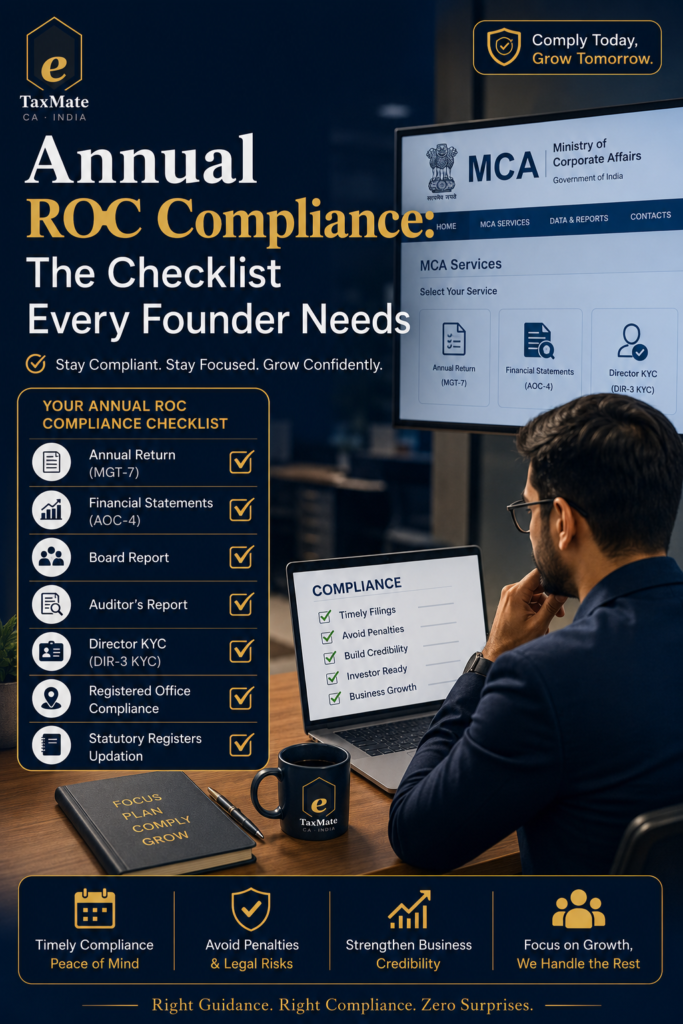
Most founders treat ROC compliance as a year-end scramble. By the time they realise a deadline has passed, the penalty clock has been running for weeks. Annual ROC compliance for companies is not a single form — it is a sequence of board meetings, approvals, filings, and disclosures that plays out across the full financial year. Miss the Annual General Meeting deadline and you pay additional fees on every subsequent form. Miss consecutive years and your directors face disqualification. This checklist covers everything a private limited company must complete each year under the Companies Act 2013.
Quick answer
Every private limited company must hold an AGM by September 30, file its financial statements in Form AOC-4 within 30 days of the AGM, and file its annual return in Form MGT-7 or MGT-7A within 60 days of the AGM. Directors must separately complete DIR-3 KYC by September 30 each year.
Before acting, check:
- Has your AGM been held within 6 months of your financial year end (September 30 for an April–March company)?
- Are your financial statements signed by the auditor and approved by the board before the AGM?
- Has every director with a DIN filed DIR-3 KYC this year?
Why ROC Compliance Cannot Be an Afterthought
The Registrar of Companies (ROC), operating under the Ministry of Corporate Affairs (MCA), maintains the public record of every registered company in India. Annual filings are not optional disclosures — they are statutory obligations under the Companies Act 2013, each carrying its own deadline, late fee, and penalty provision.
The consequences of non-compliance scale quickly. A delayed filing attracts additional fees per day. Persistent default — particularly failing to file financial statements or annual returns for three consecutive years — results in directors being disqualified under Section 164(2), which bars them from being appointed or continuing as a director in any company. The company itself can be struck off the register.
For a startup, where the same one or two founders are directors, disqualification is an existential risk. Getting the annual calendar right is not an administrative nicety; it is a governance baseline.
The Annual ROC Compliance Checklist: What Every Company Must Do
The obligations fall into five categories: meetings, financial statements, ROC filings, director-level compliances, and tax filings.
1. Board meetings — Section 173 of the Companies Act 2013 requires a minimum of four board meetings per year, with no more than 120 days between two consecutive meetings. The first meeting of the year must be held within 30 days of the start of the financial year. Minutes must be prepared and signed within 30 days of each meeting and maintained in the statutory registers.
2. Annual General Meeting (AGM) — Section 96 requires every company (other than a One Person Company) to hold an AGM within six months of the end of the financial year. For an April–March company, this means by September 30. The maximum gap between two consecutive AGMs is 15 months.
3. Financial statements — The board of directors must adopt the financial statements (Balance Sheet, Profit and Loss Account, Cash Flow Statement, and Notes) for the year, with the statutory auditor’s report attached. These must be approved before or at the AGM.
4. Directors’ Report — Section 134 requires a Directors’ Report to accompany the financial statements. For most private companies, this includes: state of affairs of the company, dividend recommendation, material changes since year-end, risk management disclosures, and declarations on internal financial controls. Larger companies have additional requirements (CSR, related party transactions, secretarial audit).
5. Statutory auditor appointment — The auditor must be appointed for a five-year term at the AGM. Form ADT-1 intimating the appointment must be filed with the ROC within 15 days of the AGM.
Annual General Meeting: The Anchor Event
The AGM is the pivot around which all other annual filings are timed. The September 30 deadline for an April–March company is firm. The ROC can grant extension only in specific circumstances — typically natural calamities or public health events — and such extensions are issued by the Central Government, not applied for ad hoc.
At the AGM, shareholders formally adopt the financial statements, approve the Directors’ Report, ratify or appoint the auditor, and transact any other ordinary business. The resolutions passed at the AGM are recorded in the minutes, and certified copies are needed for subsequent filings.
One Person Companies (OPCs) do not hold an AGM. They must file financial statements within 180 days of the end of the financial year and annual returns separately.
Key Forms and Filing Deadlines
Form AOC-4 — Financial Statements (Section 137) Filing the financial statements with the ROC. Due within 30 days of the AGM. For an April–March company holding the AGM on September 30, the AOC-4 deadline falls on October 30.
Larger companies — listed entities and certain classes above prescribed thresholds — must file in XBRL format (AOC-4 XBRL). Most private limited companies file the standard AOC-4.
Form MGT-7 / MGT-7A — Annual Return (Section 92) MGT-7 is the annual return for all companies except small companies and OPCs. MGT-7A (a shorter form introduced in 2020) applies to small companies and OPCs. Due within 60 days of the AGM. For a September 30 AGM, the deadline is November 29.
The annual return discloses: registered office details, principal business activities, shareholding pattern, list of shareholders and debenture holders, directors and key managerial personnel, and indebtedness.
Form ADT-1 — Auditor Appointment Filed within 15 days of the AGM when an auditor is appointed or reappointed.
A note on both tax laws. ITR filing and tax audit obligations are governed by the Income Tax Act 1961. The Income Tax Act 2025 carries these forward. For companies, the income tax return (Form ITR-6) is due October 31 if a tax audit is required under Section 44AB of the 1961 Act — which applies to companies above the applicable turnover threshold. Section references in the 2025 Act should be confirmed against the current text.
Director KYC and Other Annual Obligations
DIR-3 KYC — Director Identification Number KYC Every individual who holds a Director Identification Number (DIN) must file DIR-3 KYC by September 30 each year. Directors who filed in the previous year and have no changes to mobile number or email can complete this as a web-based KYC (DIR-3 KYC-Web) — a simpler process. Failure to file deactivates the DIN until the KYC is completed with a late fee. A director with a deactivated DIN is non-compliant.
DPT-3 — Return of Deposits Every company must file DPT-3 by June 30 each year, covering the period ending March 31. This return covers outstanding deposits and loans that may be treated as deposits under the Companies Act 2013. Even companies with no public deposits must file to disclose outstanding loans from directors, shareholders, or related parties that may fall within the definition.
MSME-1 — Outstanding Dues to MSME Suppliers Companies with outstanding payments to MSME-registered suppliers beyond 45 days must file MSME-1 twice a year: by October 31 (for the April–September period) and by April 30 (for the October–March period). This obligation applies only if such dues exist; companies with no MSME suppliers or no delayed payments need not file.
Your Annual ROC Compliance Calendar
The September 30 date controls everything downstream. Once the AGM is held on time, the form deadlines fall naturally: AOC-4 by October 30, MGT-7/7A by November 29, ADT-1 by October 15. Trying to compress all of this into October without an AGM held by September is the single most common error in startup ROC compliance.
Common Mistakes That Lead to Penalties
Confusing AOC-4 and MGT-7 as a single filing. They are separate forms, filed with separate deadlines. Many founders file one and assume the other is covered. It is not.
Ignoring DPT-3 because “we have no deposits.” Under the Companies Act 2013, unsecured loans from directors or shareholders above a threshold may be treated as deposits. Companies that have received such loans — common in early-stage startups — must disclose them in DPT-3. Filing nil without checking is an error; not filing at all is a penalty.
Missing DIR-3 KYC for non-executive directors. A co-founder or investor director who is not operationally active may not realise their DIN is deactivated until a filing is rejected. The KYC filing is the individual director’s obligation, not the company’s — every director must track it personally.
Signing financial statements before the auditor report is ready. The Directors’ Report and financial statements must follow the auditor’s sign-off. Backdating or pre-dating signatures is a governance risk that creates problems in future fundraising due diligence.
Not maintaining board meeting minutes. Unsigned or delayed minutes are a statutory non-compliance under Section 118. They also create problems when a new CA or company secretary reviews records for due diligence.
📋 Documents to Keep Ready
- Board meeting notices, agenda, and signed minutes for all four (or more) meetings of the year
- Signed and audited financial statements: Balance Sheet, P&L, Cash Flow, Notes to Accounts
- Auditor’s report and, if applicable, Secretarial Audit Report
- Directors’ Report signed by the chairperson or two directors
- AGM notice (21 clear days’ notice required) and signed AGM minutes
- DIR-3 KYC acknowledgement for every director
- DPT-3 data: list of all loans from directors and shareholders with amounts and interest rates
- MSME payment records if your company pays vendors (to determine MSME-1 obligation)
- Tax Audit Report (Form 3CA-3CD) from statutory auditor, if applicable
Final Takeaway
Company annual ROC compliance is fundamentally a calendar discipline. Every obligation has a known trigger — the financial year end or the AGM date — and a known window. The September 30 AGM deadline is the one to protect above all others, because every form that follows it is timed from that date. Build the compliance calendar at the start of the financial year, assign DIR-3 KYC to each director individually, and file DPT-3 before June 30 regardless of whether you think it applies. The cost of missing these is always higher than the cost of filing them on time.
Need help mapping out your company’s annual ROC compliance calendar, or want a CA to review your filings before submission? eTaxMate can audit your current compliance status, identify any gaps, and handle the filings end to end.
This blog post is for general information only and does not constitute professional advice. Laws and MCA regulations are subject to change and their application depends on individual facts and circumstances. Readers should consult a qualified professional before taking any action based on this content. eTaxMate accepts no liability for any action taken based on the information in this post.
Frequently Asked Questions
1. What is the deadline for filing AOC-4 and MGT-7 for a private limited company?
For a company with a March 31 financial year end, AOC-4 (financial statements) must be filed within 30 days of the AGM and MGT-7 or MGT-7A (annual return) within 60 days of the AGM. If the AGM is held on September 30, the AOC-4 deadline falls on October 30 and the MGT-7 deadline on November 29. Late filing attracts additional fees per day of delay.
2. What is the difference between MGT-7 and MGT-7A?
MGT-7 is the annual return form for all companies except small companies and One Person Companies. MGT-7A is a simplified form introduced in 2020 for small companies and OPCs. A company qualifies as a small company if its paid-up capital does not exceed Rs 4 crore and turnover does not exceed Rs 40 crore (thresholds as amended from time to time). Check the current MCA notification for the latest thresholds.
3. Is DIR-3 KYC compulsory every year even if there are no changes?
Yes. Every individual holding a DIN must complete DIR-3 KYC by September 30 each year, regardless of whether any personal details have changed. Directors whose details are unchanged can use the web-based DIR-3 KYC-Web process, which is simpler. Failure to file deactivates the DIN, blocking further MCA filings until it is completed with a late fee.
4. Does a company need to file DPT-3 even if it has no public deposits?
Yes. DPT-3 must be filed annually by June 30 even if the company has taken no public deposits. However, loans from directors, shareholders, or related parties that exceed prescribed thresholds may be treated as deposits under the Companies Act 2013 and must be disclosed. Companies should review all outstanding loans before assuming their DPT-3 is a nil return.
5. What happens if a company misses the AGM deadline?
Holding an AGM after September 30 without prior approval from the Registrar constitutes a default under Section 96 of the Companies Act 2013. The company and its officers face penalty provisions. All subsequent filings (AOC-4, MGT-7) also attract additional fees since their deadlines are calculated from the AGM date. Persistent non-compliance over three consecutive years can lead to director disqualification under Section 164(2).
6. Is the company’s income tax return part of ROC compliance?
The income tax return (ITR-6 for most companies) is a separate obligation under the Income Tax Act 1961, not filed with the ROC but with the Income Tax Department. It is due October 31 for companies subject to tax audit. However, the audited financial statements required for ROC filings (AOC-4) are the same set used for the ITR, so delays in audit completion affect both. Treat them as parallel obligations sharing the same source documents.