
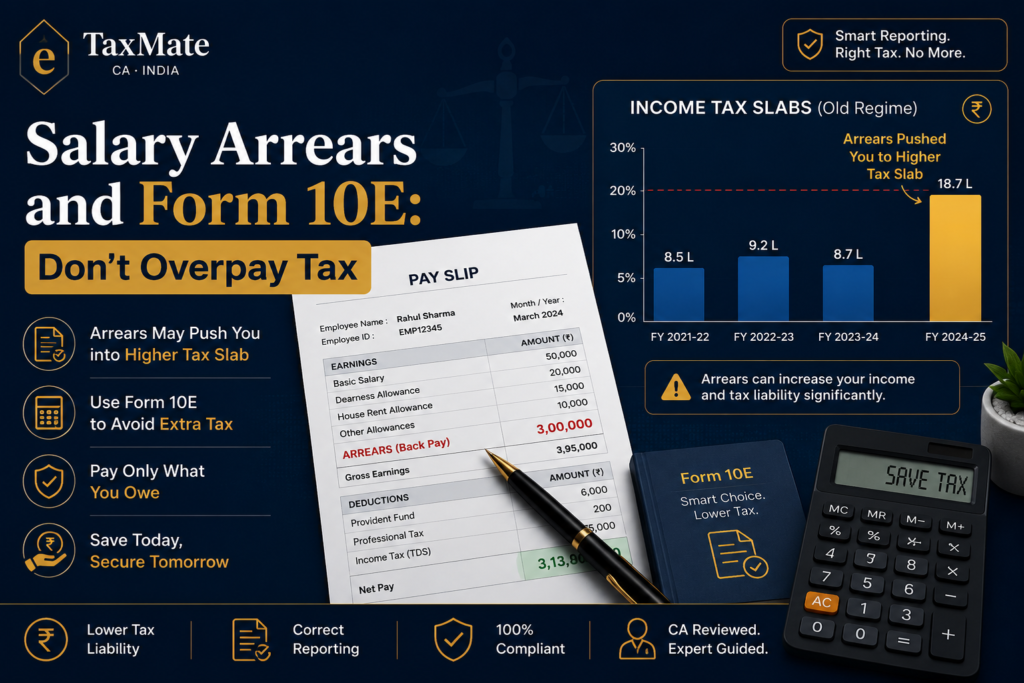
Receiving salary arrears feels like good news until you see the tax on them. When a company pays you a backdated increment or when the government revises pay scales and clears arrears from three prior years in a single payment, all that money lands in one financial year — pushing your taxable income into a higher slab than it would have occupied had you been paid on time. Thus for Salary Arrears and Form 10E (Section 89) relief exist to fix exactly this problem. But there is one critical rule: Form 10E must be filed on the income tax portal before you submit your ITR. Miss that sequence and the relief is denied, regardless of how eligible you are.
Quick answer
Section 89(1) of the Income Tax Act 1961 provides relief when salary arrears received in one year inflate your tax beyond what you would have paid had the arrears been received in the years they relate to. You claim this relief by filing Form 10E online before filing your ITR for the year of receipt.
Before acting, check:
- Do the arrears relate to a past financial year — income earned earlier but paid now? If yes, Section 89 may apply.
- Have you filed Form 10E on the e-filing portal for the correct assessment year before submitting your ITR?
- Have you computed the relief correctly using the income figures for each year the arrears relate to — not just the current year?
The Tax Problem That Comes with Salary Arrears
India’s income tax system taxes income in the year it is received or accrued, whichever is earlier. When arrears are paid in a lump sum — say, three years of a revised government salary scale paid in one shot — the entire amount is taxed in the year of receipt. This can push you from a 20% slab to a 30% slab, or make you liable for surcharge you would never have triggered had the salary been paid on time each year.
This is not a hypothetical problem. Government employees receive large arrear payments after Pay Commission revisions. Private sector employees receive backdated increments after promotions. Employees in disputes receive dues from prior employers years after leaving. In every case, the lump-sum receipt produces a tax bill that is larger than the sum of what would have been owed year by year.
Section 89(1) of the Income Tax Act 1961 addresses this directly by computing the excess tax attributable to the lump-sum receipt and providing it as a relief.
What Section 89 Relief Actually Does
Section 89 relief is not an exemption — the arrears are fully included in your taxable income. The relief is a credit that reduces the tax you owe, computed as the difference between:
- The tax attributable to the arrears in the year of receipt (current year tax with arrears minus current year tax without arrears), and
- The additional tax that would have been payable in each past year had those arrears been received on time.
If receiving the arrears in the current year results in more tax than spreading them across the years they relate to, you get that excess back as Section 89 relief. If the tax in the current year is the same or lower (because you are in a high slab in all years anyway), the relief is nil.
A note on both tax laws. Section 89(1) is in the Income Tax Act 1961, with the computation methodology prescribed under Rule 21A of the Income Tax Rules 1962. The Income Tax Act 2025 carries forward this relief provision; section references in the 2025 Act should be confirmed against the current bare Act. The underlying principle — protecting taxpayers from higher tax due to bunched receipt — continues under both frameworks.
Form 10E: The Step You Cannot Skip
To claim Form 10E Section 89 relief in your ITR, you must first file Form 10E on the income tax e-filing portal. This is not optional and it is not automatic.
The Centralised Processing Centre (CPC) cross-checks every ITR that claims Section 89 relief against Form 10E records. If Form 10E is absent, the CPC raises a demand notice disallowing the relief and treats it as unpaid tax. Taxpayers who filed their ITR without Form 10E — often unaware the form existed — have received notices for the full tax amount as if the relief was never due.
The sequence is non-negotiable: file Form 10E first, then file your ITR. If you file your ITR before Form 10E, you cannot rectify this by filing Form 10E afterwards — the relief will still be disallowed for that assessment year.
Form 10E is a one-time annual filing per type of arrear income, and it is structured into five annexures rather than a simple table list:
- Annexure I: Salary or family pension received in arrears or in advance — this is the annexure most salaried employees will use, and it contains the year-wise break-up table for the arrears.
- Annexure II / IIA: Gratuity received for past service of 5 to 15 years (Annexure II) or more than 15 years (Annexure IIA).
- Annexure III: Compensation received on termination of employment.
- Annexure IV: Commutation of pension.
You only fill in the annexure that applies to the income you actually received. There is no separate Form 10E annexure for Voluntary Retirement Scheme payouts — VRS compensation in excess of the exempt limit is handled through the Section 10(10C) exemption, not through Section 89 relief, so it does not appear on this form.t.
How the Section 89 Relief Calculation Works
The computation is structured in Form 10E itself and involves the following steps for salary arrears (Table A):
Step 1. Compute your total income for the current year including the arrears. Calculate the tax on this total.
Step 2. Compute your total income for the current year excluding the arrears. Calculate the tax on this reduced total.
Step 3. The difference (Step 1 tax minus Step 2 tax) is the tax on the arrears as taxed in the current year.
Step 4. For each past year to which a portion of the arrears relates: take the income declared in that year’s ITR and add the portion of arrears that belongs to that year. Compute the tax on the revised (higher) income. Subtract the tax originally paid on that year’s income. This gives the additional tax that would have been paid on the arrears had they been received on time.
Step 5. Sum the Step 4 figures across all past years.
Step 6. Relief = Step 3 minus Step 5. If Step 3 is greater than Step 5, the difference is the Section 89 relief available. If Step 5 is greater than or equal to Step 3, no relief is available.
The form itself guides you through this structure — you enter the figures, and the portal computes the relief automatically. You then transfer the relief figure into your ITR.
Old Regime vs New Regime: What Changes
Section 89 relief is available under both the old and new tax regimes. However, the computation depends on which regime applied in the current year and which was applicable in each past year.
For past years where the old regime was in force (before FY 2023-24, when the new regime became default), the past year tax must be computed under the old regime. For FY 2023-24 onwards, if you opted into the new regime in that year, use the new regime rates for that year’s computation.
In practice: use the tax figures from the ITRs actually filed for the past years. If you did not file ITRs for those years, the computation requires reconstructing income and tax for each year — a more involved process that warrants CA assistance.
How to File Form 10E on the Portal
To file Form 10E, log in to the income tax e-filing portal at eportal.incometax.gov.in. Navigate to e-File → Income Tax Forms → File Income Tax Forms, search for Form 10E, and select the assessment year for which arrears were received. Fill in Table A (for salary arrears) with the income figures for the current year and each past year. The portal computes the relief figure automatically. Submit and download the acknowledgement. Once you have the Form 10E acknowledgement number, proceed to file your ITR and enter the Section 89 relief amount in the appropriate field.
When Section 89 Relief Does Not Help You
You are in the highest slab in all years. If your income in both the year of receipt and all the past years to which arrears relate already exceeded ₹10 lakh (or ₹24 lakh under the new regime), you would have been taxed at 30% in all those years anyway. The marginal rate on arrears is the same across all years — the differential is nil, and relief is zero. Filing Form 10E is still required, but it will return a nil relief figure.
The arrears are small relative to other income. If the arrear amount is modest, the slab impact may be limited. The calculation is worth doing — but the relief, if any, will be proportionately small.
You did not file ITRs for the past years. The computation relies on income figures from the actual ITRs of those years. If returns were not filed, reconstructing income for each year to run the calculation is possible but requires careful documentation.
The arrears relate to only one past year and you were already in a high slab that year. The relief calculation compares cumulative positions. A single year of arrears that lands you in the same slab you were in that year produces minimal or no relief.
📋 Documents to Keep Ready
- Salary slip or letter from employer specifying the breakup of the arrear — which financial years the arrears relate to and the amount attributable to each year
- Form 16 from the employer for the current year (confirming TDS deducted on the arrear amount)
- Previous years’ ITR acknowledgements and computation of income — needed for the past-year income figures in Form 10E Table A
- Form 26AS / Annual Information Statement (AIS) for the current year — verify that the arrear salary is captured correctly
- Form 10E acknowledgement from the portal — save this before filing the ITR
Final Takeaway
Salary arrears produce a genuine tax distortion, and Section 89 relief exists to correct it. The relief is real and often significant — government employees clearing multi-year Pay Commission arrears have seen meaningful reductions in their tax liability through this mechanism. What makes or breaks the claim is sequence: Form 10E filed on the portal before the ITR. That single procedural step is what most taxpayers miss, and missing it means the relief is denied with no retrospective remedy for the year. Run the calculation, verify you are eligible, file Form 10E, and then file your ITR.
Received salary arrears and unsure how to compute your Form 10E Section 89 relief, or want someone to handle the filing to make sure the sequence is right? eTaxMate can compute the relief, file Form 10E, and prepare your ITR accurately.
This blog post is for general information only and does not constitute professional advice. Tax laws are subject to change and their application depends on individual facts and circumstances. Readers should consult a qualified professional before taking any action based on this content. eTaxMate accepts no liability for any action taken based on the information in this post.
Frequently Asked Questions
1. What is Form 10E and why do I need it for salary arrears?
Form 10E is the mandatory online form you must file on the income tax e-filing portal before claiming Section 89 relief in your ITR. Section 89(1) of the Income Tax Act 1961 provides relief when salary arrears received in one year push your tax liability higher than it would have been had the arrears been received on time. Without a filed Form 10E, the Income Tax Department’s processing system will disallow the relief and raise a tax demand.
2. What happens if I file my ITR before filing Form 10E?
The CPC (Centralised Processing Centre) will disallow the Section 89 relief claimed in your ITR because no matching Form 10E exists on record. You will receive a tax demand notice for the relief amount. Filing Form 10E after the ITR does not automatically reinstate the relief for that year — the correct sequence is Form 10E first, ITR second.
3. How is the Section 89 relief amount calculated?
The relief is the difference between (a) the additional tax you pay in the current year because of the arrears, and (b) the additional tax you would have paid in each past year had those arrears been received on time. If (a) exceeds (b), the difference is your Section 89 relief. If the arrears would have attracted the same or more tax in the past years, the relief is nil. Form 10E’s Table A guides you through this computation step by step.
4. Is Section 89 relief available under the new tax regime?
Yes. Section 89 relief is available under both the old and new tax regimes. The computation uses the tax rates applicable in the year of receipt (under whichever regime you have opted for) and the rates that applied in each past year under the regime in force or opted for in those years.
5. What if I don’t have ITRs filed for the past years the arrears relate to?
The Form 10E calculation requires income figures for the past years to which the arrears relate. If returns were not filed for those years, the computation requires reconstructing your income and tax for each such year — a process that is possible but complex, particularly if multiple years are involved. A CA can assist with this.
6. Can I claim Section 89 relief for gratuity or VRS payments too?
Yes, for most of these. Section 89 covers gratuity in excess of the exempted amount (Annexure II or IIA, depending on years of service), compensation on termination of employment (Annexure III), and commuted pension (Annexure IV), in addition to salary arrears and advance salary (Annexure I). Voluntary Retirement Scheme payouts are handled separately under the Section 10(10C) exemption rather than through Form 10E. The Form 10E-before-ITR filing sequence applies to every annexure that does apply to you.