
Introduction
If you are a salaried taxpayer, you may think Form 16 is enough for filing your income tax return. In many simple cases, it is the starting point. But it is not the only document you should rely on.
Today, taxpayers also need to check AIS (Annual Information Statement) and Form 26AS before filing ITR. These three documents may look similar because all of them relate to income and tax, but they do different jobs.
That is where confusion begins.
Many salaried taxpayers ask:
- Should I file only on the basis of Form 16?
- What is the difference between AIS and 26AS?
- What if salary in Form 16 is correct, but AIS shows extra income?
- What if TDS appears in Form 16 but not in 26AS?
These are important questions because a mismatch between these documents can lead to:
- wrong income reporting
- incorrect TDS claim
- defective return issues
- delayed refunds
- future tax notices
In this article, we will explain Form 16 vs AIS vs 26AS in simple language, what each document contains, how they differ, and what salaried taxpayers should verify before filing their return.
Why salaried taxpayers should not rely on only one tax document
A common assumption is that salary income means a simple return, and a simple return means Form 16 is enough. That is not always true.
A salaried taxpayer may also have:
- savings bank interest
- fixed deposit interest
- dividend income
- tax-saving investments
- multiple employers during the year
- refund or advance tax entries
- other financial information visible to the Income Tax Department
Because of this, one document alone may not tell the full story.
The common mistake during ITR filing
Many employees do this:
- open Form 16
- fill salary and TDS details
- submit the return without checking AIS or 26AS
This approach may work in some very basic cases, but it can also create errors.
For example:
- Form 16 may show salary correctly, but AIS may reflect additional interest income.
- Form 16 may show TDS deducted by employer, but the same TDS may not fully appear in 26AS.
- AIS may contain entries that need review and cannot be copied blindly.
Why reconciliation is important
Reconciliation simply means matching the information across documents before filing the return.
This helps you:
- report income more accurately
- claim the correct TDS
- reduce mismatch risk
- avoid defective return issues
- improve chances of smooth processing and refund
The safest approach is to use Form 16 for salary, AIS for broader income cross-check, and 26AS for tax credit verification.
What is Form 16?
Form 16 is a TDS certificate issued by the employer to an employee. It shows the salary paid and tax deducted at source on that salary.
For most salaried taxpayers, Form 16 is the main document used for preparing the salary portion of the income tax return.
What details are available in Form 16?
Form 16 generally contains:
- Employer name, address, PAN and TAN
- Employee name and PAN
- Summary of salary paid
- Exemptions allowed, such as HRA or LTA where applicable
- Deductions considered by employer, such as under Chapter VI-A
- Taxable salary
- Tax deducted and deposited
- Challan details in Part A
- Detailed salary breakup in Part B
Form 16 Contains 2 parts
Part A usually contains:
- Employer and employee details
- PAN and TAN
- Quarter-wise TDS details
- Summary of tax deposited
Part B usually contains:
- Detailed salary breakup
- Exemptions
- Deductions
- Taxable income
- Tax calculation
What Form 16 is mainly used for
Form 16 is mainly useful for:
- Preparing salary income details while filing ITR
- Understanding salary income
- Checking what deductions the employer has considered
- Identifying tax already deducted by the employer
Limitation of Form 16
Form 16 is important, but it has limits.
It usually focuses on salary-related tax reporting. It may not capture all your other income, such as:
- Savings account interest
- Fixed deposit interest
- Dividend income
- Capital gains
- Income from another source not disclosed to employer
That is why relying only on Form 16 may not always be enough.
What is AIS?
AIS stands for Annual Information Statement.
It is a broader statement available on the income tax portal that shows various financial information reported against your PAN. It gives a wider view than Form 16 and, in many cases, a wider view than 26AS as well.
What AIS may contain
AIS may include information such as:
- Salary
- Savings account interest
- Fixed deposit interest
- Dividend income
- Securities or mutual fund transactions
- TDS and TCS information
- Tax payments
- Refund details
- Certain high-value financial transactions
- Other information reported to the tax department
Why AIS is important for salaried taxpayers
Many salaried taxpayers assume that if income is not in Form 16, it is not relevant. That is not a safe assumption.
AIS helps you identify income or information that may otherwise be missed, such as:
- Interest from multiple bank accounts
- FD interest not remembered while filing
- Dividend entries
- Investment-related transactions
- Tax details reflected elsewhere in the system
So even if your return is “salary based,” AIS can still be very useful.
Can AIS contain errors?
Yes. AIS is helpful, but it should be reviewed carefully.
Sometimes AIS may contain:
- Duplicate entries
- Incomplete understanding of a transaction
- Information that needs contextual verification
- Entries that appear confusing to the taxpayer
So the correct approach is not to blindly copy AIS, but to review it, understand it, and reconcile it with your actual records.
What is Form 26AS?
Form 26AS is commonly understood as a tax credit statement.
It is especially important for verifying taxes associated with your PAN. While AIS gives a broader financial picture, 26AS is more focused on the tax credit side.
What Form 26AS mainly shows
Form 26AS typically helps you verify:
- TDS deducted
- TCS collected
- Advance tax paid
- Self-assessment tax paid
- Certain specified financial transaction details
- Refund-related entries, where reflected
Why 26AS is important during ITR filing
When you file your return, you may claim tax credit for TDS or tax payments. Those claims should be checked with Form 26AS.
For example:
- If you are claiming tax credit, 26AS becomes a critical supporting statement
- If your employer deducted TDS, you should see whether it is properly reflected
- If you paid self-assessment tax, you should verify it
Limitation of Form 26AS
26AS is very important, but it is not meant to be the full income summary of everything you earned.
It is more useful for tax credit matching than for complete income analysis. That is why 26AS should also not be used alone in isolation.
Can you file ITR without Form 16?
Yes, in some cases you can still file ITR even if Form 16 is not available.
A taxpayer may use:
- salary slips
- bank credits
- employment records
- AIS
- 26AS
- tax working based on available documents
But in such a case, greater care is needed. Without Form 16, salary computation and tax reconciliation should be done more carefully.
Practical takeaway for salaried taxpayers
If you want a simple rule, remember this:
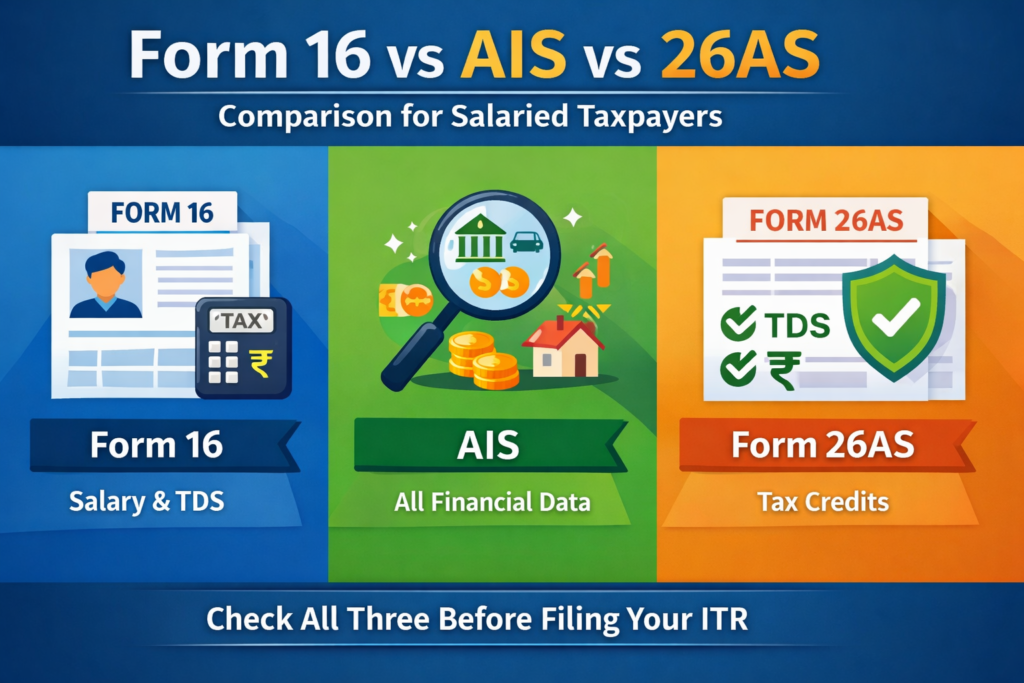
- Form 16 tells you about salary and employer TDS
- AIS gives a wider picture of income and reported information
- 26AS helps you verify tax credit
So, Form 16 vs AIS vs 26AS is not a question of choosing one and ignoring the others. Each serves a different purpose.
For salaried taxpayers, the safer approach is:
Form 16 + AIS + 26AS + your own records
That combination helps you file a more accurate return.
Conclusion
Form 16 is important, but it is not the whole picture. AIS and 26AS play different but equally important roles in income tax return filing.
If you file only on the basis of Form 16, you may miss additional income visible in AIS or overlook tax credit mismatch in 26AS. On the other hand, blindly relying on AIS without understanding the entries can also create errors.
Before filing your ITR, reconcile Form 16, AIS and 26AS properly. If you want help reviewing mismatches or filing your return accurately, contact eTaxMate.
FAQ’s
1. Is Form 16 enough for filing ITR?
Form 16 is the starting point for salaried taxpayers, but it may not include all other income. It is better to also check AIS and 26AS before filing.
2. What is the main difference between AIS and 26AS?
AIS is a broader financial information statement, while 26AS is mainly a tax credit statement used to verify TDS and tax payments.
3. Which is more important: Form 16, AIS, or 26AS?
All three are important, but for different reasons. Form 16 helps with salary reporting, AIS helps identify additional reported information, and 26AS helps verify tax credit.
4. Can AIS be wrong?
AIS may sometimes contain duplicate, incomplete, or confusing entries. It should be reviewed carefully and matched with actual records
5. Why is TDS showing in Form 16 but not in 26AS?
Possible reasons include delay in reporting by employer, PAN mismatch, or incorrect TDS filing. The issue should be checked before filing the return.
6. Should I match Form 16 with 26AS?
Yes. TDS claimed in your return should ideally be cross-checked with 26AS.
7. Does AIS show salary income?
AIS may reflect salary-related information, but salary details should still be verified primarily from Form 16 and supporting salary records.
8. What if I ignore AIS while filing ITR?
You may miss reporting some income, such as bank interest or dividend, which may later create mismatch issues.