
If you missed reporting some income, filed the wrong form, or skipped filing altogether for a past year, the updated return ITR-U is often the only door still open. It is also one of the most misunderstood tools in the Income Tax Act. Many taxpayers file it expecting a refund or assume it can fix any mistake — both wrong. Others avoid it out of fear of penalties, when in reality it can prevent far harsher consequences down the line. This post explains what an updated return actually does, when it is the right move, and the situations where filing it makes things worse, not better.
Quick answer
An updated return ITR-U lets you voluntarily declare missed income or correct under-reporting for up to 48 months from the end of the relevant assessment year, but only if it increases your tax liability — never to claim a refund or reduce tax. It is filed under Section 139(8A) of the Income Tax Act 1961 (Section 263(6)(a) of the Income Tax Act 2025), with an additional tax of 25% to 70% of the tax and interest owed.
Before filing, check:
- Does the correction increase your tax liability? If not, ITR-U is not the right route.
- Is there any pending assessment, reassessment, search, or survey for that year?
- How many months have passed since the end of the assessment year? The cost rises sharply with delay.
What an updated return actually is
An updated return ITR-U is a separate filing route created by the Finance Act 2022, sitting under Section 139(8A) of the Income Tax Act 1961. The Income Tax Act 2025, which renumbers most provisions, places the same rule under Section 263(6)(a). The substantive law has not changed in the renumbering — only the reference number.
The purpose is narrow: it lets a taxpayer come forward and voluntarily declare income that was missed, under-reported, or wrongly classified in an earlier return — or file a return for a year where none was filed at all. In exchange, the taxpayer pays the original tax, interest under Sections 234A, 234B, and 234C, and an additional tax that ranges from 25% to 70% depending on how late the filing is. Bajaj Finserv
Before the Finance Act 2025, the window was 24 months. The Finance Act 2025 amended Section 139(8A) to extend the window to 48 months from the end of the relevant assessment year, effective 1 April 2025. So a return for FY 2024-25 (AY 2025-26) can now be updated until 31 March 2030, four full years after the assessment year ends. Taxmann
The 48-month window runs from the end of the relevant assessment year — not the financial year. Here is how it lands in practice for the most recent years:
| Financial Year | Assessment Year | AY ends on | Last date to file ITR-U |
|---|---|---|---|
| FY 2021-22 | AY 2022-23 | 31 March 2023 | 31 March 2027 |
| FY 2022-23 | AY 2023-24 | 31 March 2024 | 31 March 2028 |
| FY 2023-24 | AY 2024-25 | 31 March 2025 | 31 March 2029 |
| FY 2024-25 | AY 2025-26 | 31 March 2026 | 31 March 2030 |
| FY 2025-26 | AY 2026-27 | 31 March 2027 | 31 March 2031 |
Belated vs revised vs updated return: which one applies to you
This is where most readers get stuck. The three are distinct legal routes, and only one of them fits any given situation.
Belated return — Section 139(4). Filed when the original due date is missed but you are still within the same assessment year. The deadline is 31 December of the relevant assessment year, or before the assessment is completed, whichever is earlier. A late fee under Section 234F applies — ₹1,000 if total income is up to ₹5 lakh, ₹5,000 if above. Business and capital losses cannot be carried forward in a belated return.
Revised return — Section 139(5). Filed when an already-filed return contains errors. The deadline is the same as belated: 31 December of the assessment year. A revised return can claim refunds, reduce tax, increase deductions, or correct any genuine mistake — there is no upward-only restriction.
Updated return ITR-U — Section 139(8A). Filed when both belated and revised windows have closed, or when a return was never filed at all. The window is 48 months from the end of the assessment year. The catch is the upward-only rule — ITR-U can only declare additional income or increase tax, never reduce it. Refunds cannot be claimed.
The practical sequence: revise if you can, file belated if you missed the original deadline, and use ITR-U only when both other routes are unavailable or when the correction simply increases tax.
When an updated return ITR-U genuinely helps
There are five situations where filing an updated return ITR-U is the right call.
1. You missed a high-value income source in an earlier return. A salaried professional who forgot to report freelance income shown in Form 26AS. A small business owner who missed reporting interest from a savings account or fixed deposit. An NRI who omitted Indian rental income. In all these cases, the income is already visible to the department through TDS data, AIS, and bank reporting — voluntary disclosure through ITR-U is far cheaper than waiting for a notice.
2. You did not file a return at all and the belated window has closed. This is the classic ITR-U use case. Take an example: Rahul earned ₹12 lakh in FY 2022-23 but never filed a return. The belated deadline of 31 December 2023 is long gone. Revising is not possible because there is nothing to revise. ITR-U under Section 139(8A) is the only legal route, and as of November 2026 he is in the third year of the window (24-36 months) — meaning 60% additional tax on the dues.
3. You filed under the wrong head of income. Business income reported as salary, capital gains misclassified as other income, professional income shown as business — all of these can be corrected through ITR-U if the correction increases tax.
4. You under-reported income or applied the wrong tax rate. A common scenario: a taxpayer claimed the Section 87A rebate when they were not entitled to it, or applied old regime slabs when they had locked into the new regime. Both can be fixed through ITR-U.
5. You want to pre-empt a Section 148 reassessment notice. Once a reassessment notice arrives, ITR-U is no longer available for that year. Filing voluntarily before the notice issues protects you from penalty for under-reporting and from the prosecution risk under Chapter XXII. greythr
The cost of filing rises sharply with delay. The additional tax is 25% within 12 months of the end of the assessment year, 50% between 12 and 24 months, 60% between 24 and 36 months, and 70% between 36 and 48 months. This is on top of the normal tax and interest. TaxBuddy
What ITR-U cannot do
Here is where most filings go wrong. The Income Tax Department has built specific guardrails into Section 139(8A) to stop ITR-U from becoming a tax-planning tool.
ITR-U cannot be used to:
- Claim or increase a refund. This is the single biggest misconception. If the correction would result in a refund, ITR-U is barred outright.
- Reduce the tax liability declared in the original, belated, or revised return.
- File a nil return or a return showing total income as a loss. The original Section 139(8A) prohibited this entirely; the Finance Act amendments now allow ITR-U to reduce a previously claimed loss (which increases future tax), but ITR-U still cannot be used to declare a fresh loss.
- Claim deductions you forgot to claim earlier. If you missed an 80C, HRA, or home loan interest deduction in your original return, ITR-U will not let you add it now.
There are also categories of taxpayer who cannot file ITR-U at all for a given year:
- Where a search has been initiated under Section 132 or assets requisitioned under Section 132A.
- Where a survey has been conducted under Section 133A (other than a TDS survey under Section 133A(2A)).
- Where any assessment, reassessment, revision, or recomputation is pending or completed for that year.
- Where a show-cause notice under Section 148A has been issued more than 36 months after the end of the assessment year (unless the order under Section 148A(3) holds it is not a fit case for reassessment).
- Where prosecution proceedings have been initiated for that year.
- Where information has been received under a tax treaty (Section 90/90A) and communicated to the taxpayer.
ITR-U is also a one-shot route — only one updated return can be filed per assessment year. There is no second chance.
How to decide whether to file ITR-U
If a correction is genuinely needed, the decision flow looks like this. Variations for specific situations follow the chart.
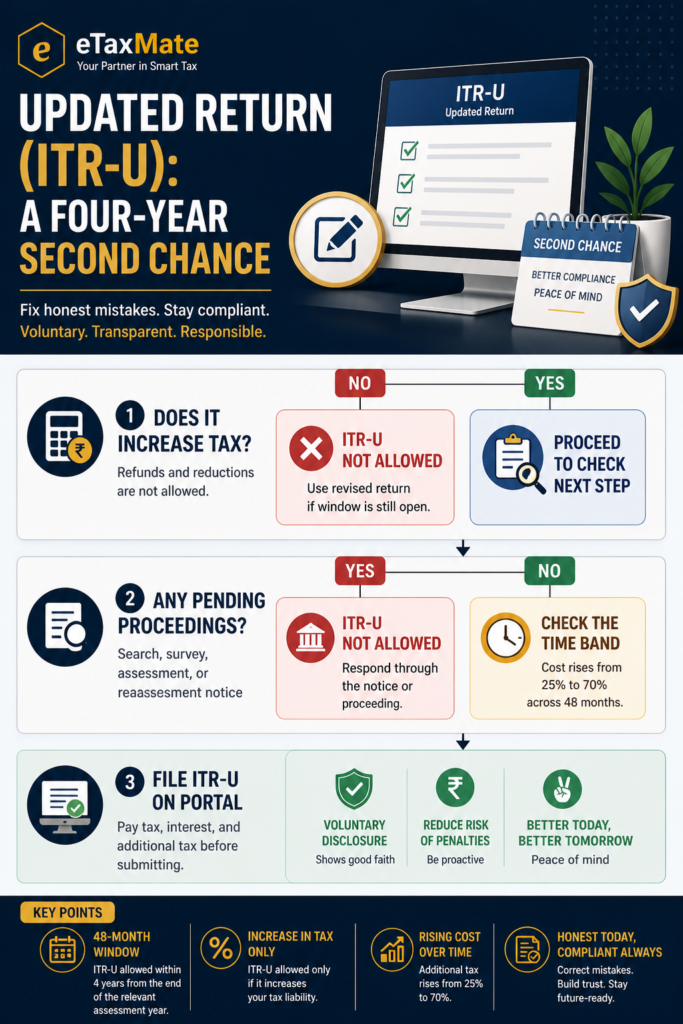
Variations on this main path
- If the belated or revised window is still open (before 31 December of the assessment year), use those routes instead — they are cheaper and more flexible than ITR-U.
- If a Section 148A show-cause notice has been issued more than 36 months after the AY ends, ITR-U is barred unless the notice is later dropped by an order under Section 148A(3).
- If your correction reduces a carried-forward loss, the recent amendments allow ITR-U for this purpose, but you must file ITR-U for every subsequent year affected by the reduced loss.
When you should not file an updated return ITR-U
There are situations where filing ITR-U is either pointless or actively harmful.
- The correction reduces tax or generates a refund. ITR-U is legally barred. Filing it anyway creates a defective return.
- The mistake is a missed deduction (80C, HRA, home loan interest). ITR-U cannot add deductions retrospectively. There is no remedy through this route — the deduction is lost.
- A reassessment notice or scrutiny notice has already arrived. Once Section 143(2), Section 148, or Section 148A(1) is invoked, ITR-U is no longer available for that year. Engage with the proceeding through your CA instead.
- The additional tax cost exceeds the litigation risk. In the third or fourth year of the window, the additional tax climbs to 60-70% of tax-plus-interest. For a small under-reporting that is unlikely to be detected, the expected cost of waiting may genuinely be lower — though this is a judgment call that should be made with professional input, not a blanket rule.
- The income is below the basic exemption limit. ITR-U requires payment of additional tax. If there is no additional tax payable because total income is below the basic exemption, ITR-U cannot be filed at all.
Documents and checks before filing
Before opening the ITR-U utility on the portal, keep these ready:
- The acknowledgement number, ITR form, and date of filing of the original return (if any was filed).
- Form 26AS, AIS, and TIS for the relevant year, reconciled against your records.
- Bank statements covering the relevant financial year, especially any account where unreported income may have flowed.
- Computation of additional income, recomputed tax, interest under Sections 234A, 234B, and 234C, and the additional tax under Section 140B.
- Challan 280 (using the correct minor head 300) for self-assessment tax payment, paid before filing.
- Digital signature certificate (mandatory for companies, LLPs, and tax-audit cases) or an EVC option for individuals.
The return is filed in the relevant ITR form (1 to 7) along with the additional schedules — Part A Gen 139(8A) and Part B ATI — that capture the reason for filing and the time band.
Final takeaway
Updated return ITR-U is a one-shot, upward-only correction window. It rewards early action and punishes delay. It is the right tool when you have genuinely missed declaring income and the regular routes have closed — but it is the wrong tool for missed deductions, refund claims, or when a notice has already arrived. Treat ITR-U as a last-mile compliance tool, not a planning tool: file early in the window if you must file at all, and never use it as a substitute for getting the original return right.
Confused about whether your situation calls for a belated, revised, or updated return ITR-U? eTaxMate can help you review your earlier filings, identify what applies to your year, and handle the filing correctly through the right section.
This blog post is for general information only and does not constitute professional advice. Tax laws are subject to change and their application depends on individual facts and circumstances. Readers should consult a qualified professional before taking any action based on this content. eTaxMate accepts no liability for any action taken based on the information in this post.
Frequently Asked Questions
1. Can I file ITR-U to claim a refund I missed?
No. ITR-U cannot be used to claim a refund or increase a refund already claimed. Section 139(8A) only allows updated returns that increase tax liability or report previously omitted income. If you missed claiming a refund and the belated and revised return windows have closed, that refund is generally lost — except in rare cases where condonation of delay can be applied for under Section 119(2)(b).
2. What is the difference between a revised return and an updated return ITR-U?
A revised return under Section 139(5) corrects errors in an already-filed return and can move tax up or down, including refund claims, but must be filed by 31 December of the assessment year. An updated return ITR-U under Section 139(8A) has a 48-month window but only allows corrections that increase tax. ITR-U also requires payment of an additional tax of 25% to 70%.
3. How is the additional tax on ITR-U calculated?
The additional tax under Section 140B is charged on the aggregate of tax and interest payable on the additional income. The rates are 25% if filed within 12 months of the end of the assessment year, 50% within 12-24 months, 60% within 24-36 months, and 70% within 36-48 months. This is over and above the regular tax and interest under Sections 234A, 234B, and 234C.
4. Can I file ITR-U if I never filed an original return for that year?
Yes. ITR-U can be filed even where no original, belated, or revised return was ever filed for the relevant assessment year. In this case, the late fee under Section 234F also applies in addition to the additional tax. Filing earlier in the 48-month window keeps the additional tax at the lower 25% or 50% slabs rather than 60% or 70%.
5. Can I file ITR-U to add a deduction I forgot to claim?
No, and this is one of the costliest misconceptions. ITR-U is restricted to corrections that increase tax — adding a forgotten Section 80C, HRA, or home loan interest deduction would reduce tax, which the law specifically prohibits. The only remedy for missed deductions is a revised return under Section 139(5), and that window closes on 31 December of the assessment year.
6. What happens if I receive a Section 148 notice after I have already filed ITR-U?
Once you have filed a valid ITR-U declaring the additional income, the Assessing Officer in a subsequent reassessment can only proceed with reference to that updated return for the income disclosed in it. No penalty for under-reporting or misreporting applies on the income covered by the ITR-U. This is a key reason to file ITR-U voluntarily before any notice arrives, rather than after.