
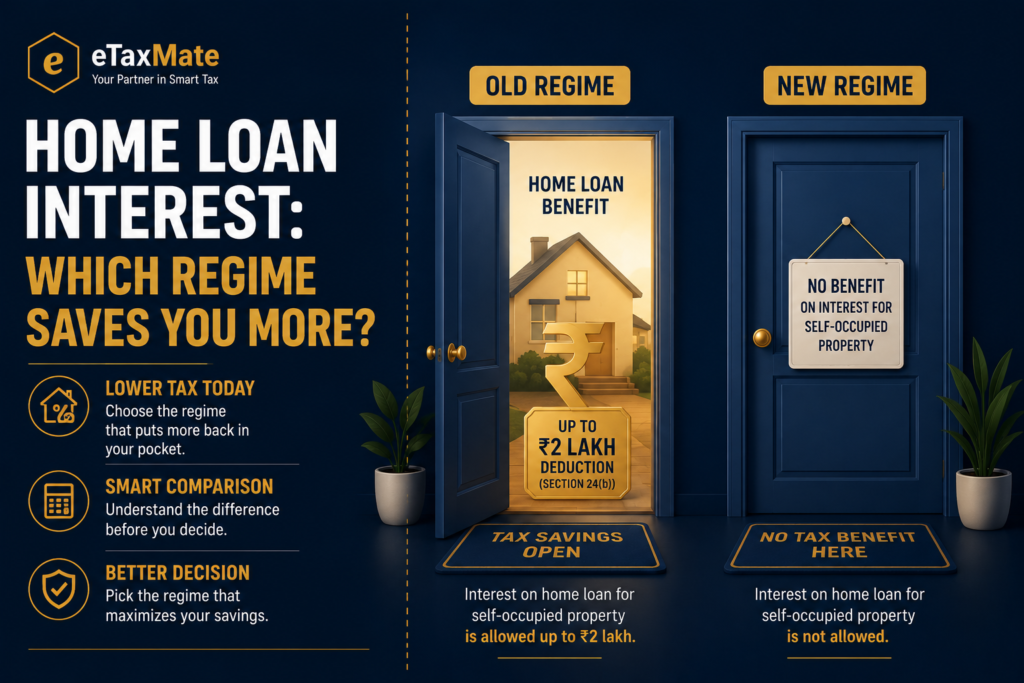
If you have a home loan and a salary, you are sitting on one of the most valuable deductions in Indian income tax — but only if you choose the right regime. The home loan interest deduction under Section 24(b) of the Income Tax Act 1961 lets you reduce taxable income by up to ₹2 lakh a year for a self-occupied property. The catch is that this benefit largely disappears the moment you opt for the new tax regime under Section 115BAC. For lakhs of salaried homeowners, the choice between the old vs new tax regime sits at the centre of the decision.
Quick answer
The home loan interest deduction for a self-occupied property is available only under the old regime, capped at ₹2 lakh. Under the new regime, this deduction is not allowed at all for self-occupied property — but it survives, without any cap, for let-out property.
Before deciding, check:
- Is the property self-occupied or let-out (rented)?
- What is your annual home loan interest outgo?
- Are you using other old-regime deductions (Section 80C, 80D, HRA) meaningfully, or is the home loan your main lever?
What Section 24(b) actually allows
Section 24(b) sits under the head “Income from House Property”. It allows you to claim a deduction for the interest component of your home loan EMI — not the principal. The principal repayment is handled separately under Section 80C deductions up to ₹1.5 lakh in the old regime.
The interest deduction has two distinct ceilings depending on how you use the property:
- Self-occupied property (you live in it, or it is treated as self-occupied under the law): up to ₹2 lakh per financial year. To get the full ₹2 lakh, the loan must be for purchase or construction, and the construction must be completed within 5 years from the end of the financial year in which the loan was taken. If completion is delayed, the cap drops to ₹30,000.
- Let-out property (rented out, or deemed let-out): the entire interest paid is allowed as a deduction against the rental income, with no upper limit on the deduction itself.
This much is true under the old regime. The new regime keeps only part of this picture intact.
Home loan interest deduction under the old regime
Under the old regime, the home loan interest deduction works as it always has. A salaried individual repaying a self-occupied home loan can claim up to ₹2 lakh a year. If interest paid exceeds the rental income on a let-out property, the resulting “loss from house property” can be set off against salary or other income, but only up to ₹2 lakh a year. Any remaining loss can be carried forward for 8 years and set off against future house property income.
This is where the old regime quietly outperforms for many homeowners: a person paying ₹3 lakh a year in home loan interest on a self-occupied flat takes the full ₹2 lakh deduction, gets standard deduction of ₹50,000 on salary, claims ₹1.5 lakh under Section 80C (which often includes the home loan principal itself), and possibly another ₹25,000 under Section 80D for health insurance. The total deduction stack can easily cross ₹4–5 lakh.
Home loan interest deduction under the new regime
The new regime under Section 115BAC, which became the default from FY 2023-24, was designed around lower tax rates and far fewer deductions. The home loan interest deduction is one of the casualties — but only partially.
For a self-occupied property, no deduction for home loan interest is allowed under the new regime. The ₹2 lakh limit simply does not exist here. If you opt for the new regime and try to claim it anyway, the deduction will be disallowed during processing.
For a let-out property, the interest deduction survives. You can still claim the full interest paid against the rental income with no upper cap. However, the new regime adds a sharp restriction: any resulting loss from house property cannot be set off against salary or other income, and it cannot be carried forward to future years either. So if your interest exceeds the rent, the excess loss is essentially wasted — the deduction is only useful up to the level of the rental income.
This is a quiet but expensive change. Under the old regime, a let-out property running at a loss gives you a real tax shield. Under the new regime, that shield is capped at the rent.
The standard deduction of ₹75,000 from salary continues under the new regime, but it does not compensate for the lost home loan benefit for most borrowers with material EMIs.
Why the deduction disappears in the new regime
The new regime’s design philosophy is simple: lower headline rates, fewer items to compute, fewer disputes. The trade-off is that almost every taxpayer-side deduction — HRA, LTA, Section 80C, 80D, education loan interest, and Section 24(b) for self-occupied property — is dropped. The government’s reasoning is that the lower slab rates and the higher ₹75,000 standard deduction together compensate the average salaried taxpayer.
For someone with no home loan, that math often works. For someone with a meaningful home loan, it usually does not — because the ₹2 lakh deduction at a 30% marginal rate is worth ₹60,000 in tax saved every year, plus another ₹45,000-odd from Section 80C principal repayment. That combined ₹1 lakh-plus saving is hard to recover from lower slab rates alone unless your income is well into the higher brackets.
It is also worth noting that under the new Income Tax Act 2025, which applies from the tax season starting April 2027, the new regime provisions move to Section 202 of the new Act. The substantive treatment of home loan interest does not change — the disallowance for self-occupied property continues — but the section reference shifts. For the current ITR season covering FY 2025-26, the relevant section is still 115BAC of the Income Tax Act 1961.
A quick example: Rahul’s ₹50 lakh home loan
Rahul, a 35-year-old salaried professional in Bengaluru, took a ₹50 lakh home loan in FY 2024-25 for a self-occupied flat. His annual interest outgo for FY 2025-26 is ₹3.6 lakh. His annual taxable salary is ₹18 lakh.
- Under the old regime: He claims the full ₹2 lakh under Section 24(b), ₹1.5 lakh under Section 80C (which includes ₹1.5 lakh of his home loan principal repayment), ₹50,000 standard deduction, and ₹25,000 under Section 80D. Total deductions: ₹4.25 lakh. Taxable income: ₹13.75 lakh.
- Under the new regime: He gets ₹75,000 standard deduction. No Section 24(b), no 80C, no 80D. Taxable income: ₹17.25 lakh.
The new regime applies lower slab rates to that higher taxable figure, and the old regime applies higher slab rates to a much smaller figure. For Rahul, the math typically tips toward the old regime by a meaningful margin once his home loan interest crosses ₹1.5–2 lakh a year. The exact crossover depends on his salary and which other deductions he genuinely uses — but the home loan alone is often the single biggest reason a salaried taxpayer should think twice before defaulting to the new regime.
If Rahul’s flat were let-out instead of self-occupied, the picture changes again. The new regime would still allow him to deduct interest against rental income, but only up to the rent received — any excess loss disappears. The old regime would let him use up to ₹2 lakh of that loss against salary in the same year and carry the rest forward.
How to decide which regime suits you
The decision is not about the regime in isolation. It is about the value of all your deductions stacked together versus the lower rates of the new regime.
Look at the visual below. It shows where the home loan interest deduction lives under each regime and what survives, what changes, and what disappears.s.
The pattern that emerges: the new regime is built for taxpayers who do not have a home loan, do not pay HRA, and do not invest meaningfully in 80C. If you tick any of those boxes, the old regime usually keeps more money in your pocket.
When you should not blindly stick to the old regime
Even with a home loan, the old regime is not automatically better. Step back if:
- Your home loan interest is small. If you took a top-up loan or a small home loan with annual interest under ₹50,000, the ₹2 lakh ceiling is not doing much for you. The new regime’s lower rates and ₹75,000 standard deduction may still come out ahead.
- You do not use other old-regime deductions. If you have no 80C investments, no health insurance under 80D, no HRA claim, and no education loan, the home loan alone may not justify staying in the old regime once your income crosses ₹15–18 lakh.
- Your property is purely let-out and the rent comfortably covers the interest. Then the loss-set-off restriction in the new regime does not bite, because there is no net loss to set off.
- You are switching jobs or have one-off income. Run the numbers for that specific year. The right regime can change year to year for salaried individuals.
The point is to compare both regimes every year using your actual figures, not to pick one out of habit.
Documents to keep ready
To claim the home loan interest deduction correctly, keep these on file:
- Interest certificate (sometimes called provisional certificate) from the bank or housing finance company, showing the principal-interest split for the year
- Loan sanction letter and EMI schedule
- Proof of property ownership (sale deed, allotment letter)
- Proof of self-occupation (utility bills, address records) or, for let-out property, the rental agreement
- Form 16 from the employer
- Annual Information Statement (AIS) from the income tax portal
- Choose the right ITR form — see the ITR-1 vs ITR-2 guide for which one applies to you, since owning more than one house typically pushes you out of ITR-1
- Form 10-IEA filed before the due date if you wish to opt out of the new regime (mandatory for those with business income; optional but advisable for salaried filers who want their choice on record)
Final takeaway
The home loan interest deduction is not just another line item — for most salaried homeowners, it is the single largest reason to stay in the old regime. Section 24(b) gives you up to ₹2 lakh on a self-occupied home and uncapped interest on a let-out one, plus a real loss-set-off against salary. The new regime keeps almost none of that for self-occupied property and quietly clips the let-out benefit too. Run the comparison every year using your actual interest outgo, and let the math, not the default, decide your regime.
Confused about which regime saves you more, or unsure how to claim the home loan interest deduction correctly in your ITR? eTaxMate can help you compare both regimes using your actual figures and file your return the right way.
This blog post is for general information only and does not constitute professional advice. Tax laws are subject to change and their application depends on individual facts and circumstances. Readers should consult a qualified professional before taking any action based on this content. eTaxMate accepts no liability for any action taken based on the information in this post.
Frequently Asked Questions
1. Can I claim home loan interest deduction in the new tax regime?
For a self-occupied property, no — the deduction under Section 24(b) is not allowed under the new tax regime. For a let-out (rented) property, the interest deduction is still allowed against rental income with no upper cap, but any resulting loss from house property cannot be set off against salary or other income, and it cannot be carried forward to future years.
2. What is the maximum home loan interest deduction under the old regime?
Up to ₹2 lakh per financial year for a self-occupied property, provided the construction is completed within 5 years from the end of the financial year in which the loan was taken. If completion is delayed beyond 5 years, the cap drops to ₹30,000. For a let-out property, the entire interest paid is deductible against rental income with no upper limit.
3. Does the home loan principal repayment qualify for any tax benefit?
Yes, but only under the old regime. The principal repayment portion of your EMI qualifies for deduction under Section 80C, up to ₹1.5 lakh in a financial year, combined with other 80C items like PPF, ELSS, and life insurance premiums. Under the new regime, Section 80C is not available, so principal repayment gives no separate tax benefit.
4. I have a let-out property where interest exceeds the rent. Can I claim the loss in the new regime?
You can claim the full interest as a deduction against the rental income, which can bring the house property income down to zero or a loss. However, under the new regime, that loss cannot be set off against salary or any other income head in the same year, and it cannot be carried forward. The deduction is effectively useful only up to the level of rent received.
5. Do I need to file Form 10-IEA to claim Section 24(b) deduction?
If you have business or professional income and want to opt out of the default new regime to claim Section 24(b), you must file Form 10-IEA before the ITR due date. For pure salaried filers without business income, opting for the old regime can be done directly within the ITR utility, though filing Form 10-IEA is still advisable to keep the choice on record for that year.
6. When does the home loan interest deduction become a bad reason to stay in the old regime?
When your annual interest outgo is small, when you do not use other old-regime deductions like Section 80C, 80D, or HRA, and when your taxable income is in a band where the new regime’s lower slab rates plus the ₹75,000 standard deduction outweigh the ₹2 lakh deduction. Always compare both regimes with your actual numbers every year before defaulting to either.