
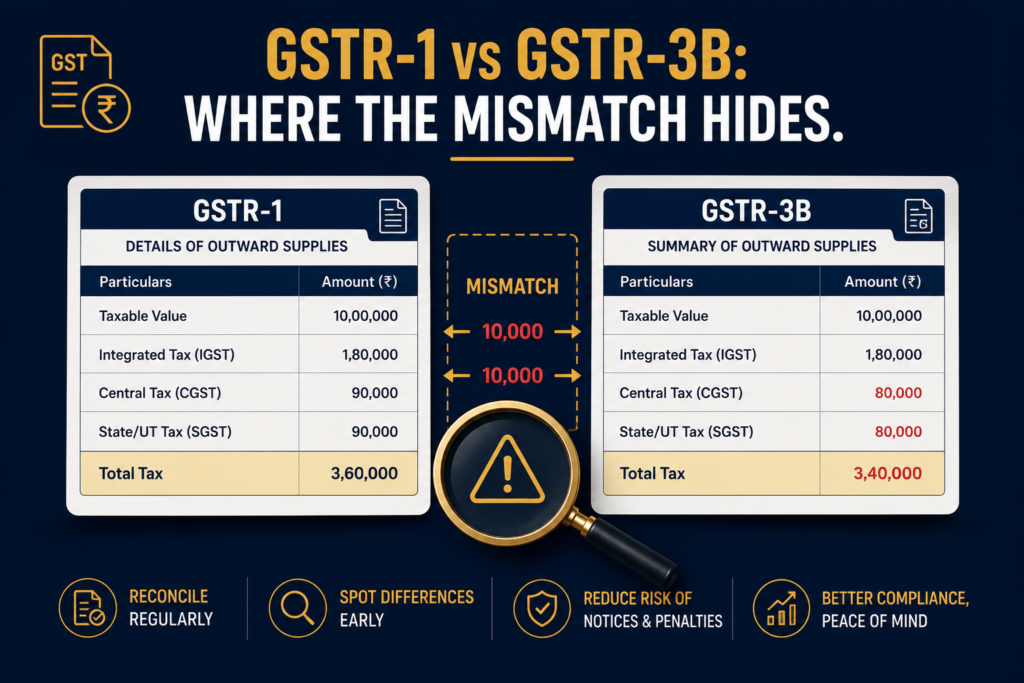
If you have just filed your GSTR-3B and noticed that the figures do not tie up with the GSTR-1 you filed earlier, you are not alone. A GSTR-1 vs GSTR-3B mismatch is one of the most common compliance issues for Indian businesses, and the GST portal now flags significant gaps automatically. Most mismatches are not fraud — they are timing differences, clerical errors, or amendments made after one return was filed. The problem is that the system does not care why; once the gap crosses a threshold, an intimation in Form DRC-01B lands in your inbox with a 7-day clock. This post explains why these mismatches happen, what the system does about them, and how to fix the gap cleanly before it escalates.
Quick answer
A GSTR-1 vs GSTR-3B mismatch occurs when the tax liability declared in GSTR-1 (or the IFF) differs from the tax actually paid through GSTR-3B for the same period. Where the GSTR-1 figure exceeds the GSTR-3B payment by a notified threshold, the portal issues an automated intimation in Form DRC-01B under Rule 88C, giving you 7 days to pay the differential or explain the gap.
Before assuming the mismatch is a problem, check:
- Is it a timing difference (invoice in GSTR-1 of one month, tax paid in GSTR-3B of the next)?
- Is it a clerical error in either return that needs rectification through GSTR-1A?
- Is the gap large enough to trigger DRC-01B, or small enough to fix in the next return cycle?
What GSTR-1 and GSTR-3B actually report
The two returns serve different purposes, and confusion about that is the root of most mismatches.
GSTR-1 is the invoice-level outward supply return. You report every sales invoice — buyer-wise, rate-wise, with invoice numbers and dates. GSTR-1 does not involve any payment; it is purely a declaration of what you sold and at what tax rate. The data flows automatically into your buyer’s GSTR-2B, which is where they pick up their input tax credit (the GST your buyer paid on purchases from you, which they offset against their own GST liability).
GSTR-3B is the summary return where you actually pay tax. You declare total taxable turnover, total tax payable, ITC claimed, and net cash payment. The portal now auto-populates much of GSTR-3B from your GSTR-1 and GSTR-2B, but several fields remain editable, which is where many mismatches creep in.
In a perfectly reconciled month, the outward tax in GSTR-3B equals the outward tax shown in GSTR-1. In practice, the two figures often drift apart by small amounts. The system tolerates small drifts and acts only when the gap crosses the prescribed threshold under Rule 88C.
Why a GSTR-1 vs GSTR-3B mismatch happens
Most mismatches fall into a handful of recurring patterns. Recognising the pattern helps you fix it without panic.
Forgotten invoices in GSTR-3B. A Pune-based logistics startup raises a tax invoice for ₹12 lakh on the last day of the month. The invoice gets reported in GSTR-1, but the GSTR-3B is filed using the previous month’s spreadsheet, missing the late invoice. GSTR-1 shows ₹2.16 lakh more tax than GSTR-3B paid.
Timing differences across months. A Bengaluru SaaS company invoices a client in October but receives a request to amend the invoice in November. The GSTR-1 of October still shows the original invoice, while the company adjusts and pays in November’s GSTR-3B. The October period shows a gap; the November period balances out. This is the most common — and most defensible — reason behind a DRC-01B intimation.
Clerical errors in GSTR-1. A Mumbai distributor types ₹50,00,000 instead of ₹5,00,000 in a GSTR-1 entry. The tax declared inflates by nearly ₹9 lakh against the GSTR-3B payment. The Gauhati High Court has held that bona fide clerical errors of this kind cannot be mechanically treated as self-assessed tax — but the taxpayer must still respond to the DRC-01B and rectify through GSTR-1A.
Amendments after GSTR-1 filing. Sales returns, credit notes, or rate corrections processed after the GSTR-1 was filed but before GSTR-3B was paid create a gap that resolves only over two return cycles.
Wrong tax head — IGST vs CGST/SGST. A Hyderabad business reports an interstate sale as IGST in GSTR-1 but pays as CGST plus SGST in GSTR-3B (or vice versa). The total tax may match, but the head-wise comparison fails the system check.
Non-payment of self-declared tax. This is the only category that is genuinely problematic. The taxpayer reports the supply in GSTR-1, picks up cash flow against it from the customer, but does not pay the tax in GSTR-3B. This is what Rule 88C was specifically introduced to catch.
The first five categories are reconcilable with documentation. The last is what the department is hunting.
What follows a mismatch — Rule 88C and Form DRC-01B
Rule 88C of the CGST Rules 2017 was inserted by Notification No. 26/2022-Central Tax dated 26 December 2022, on the recommendation of the 48th GST Council meeting. It allows the GST portal to automatically intimate a taxpayer when the GSTR-1 liability exceeds the GSTR-3B tax paid by a prescribed amount and percentage. The intimation is issued in Part A of Form DRC-01B and lands in the taxpayer’s registered email and on the portal under Services > Returns > Return Compliance.
The 7-day clock starts the moment Part A is uploaded. The taxpayer has two paths: pay the differential (with interest at 18% per annum from the original due date) using Form DRC-03, then declare it in Part B of DRC-01B; or, if the gap is genuinely explainable, file Part B with reasons and supporting evidence — invoice timing schedule, GSTR-1A rectification, credit note workings, or whatever documents the situation requires. This is the same family of compliance triggers covered in the broader GST notice workflow, and the same point-wise reply discipline applies.
Failure to act has three escalating consequences. First, the next period’s GSTR-1 and IFF (Invoice Furnishing Facility) are automatically blocked under Rule 59(6)(d) — meaning you cannot report new outward supplies until the DRC-01B is resolved, which freezes your customers’ input tax credit pipeline. Second, recovery proceedings can begin directly under Section 79 of the CGST Act, without a separate show cause notice under Section 73 or 74, treating the GSTR-1 liability as self-assessed tax. Third, in extreme cases, the registration itself can be flagged for cancellation.
The infographic below maps the full mismatch-to-resolution flow at a glance — useful to print or pin in your accounts team’s workspace.
How to fix a GSTR-1 vs GSTR-3B mismatch
The fix depends on the direction of the mismatch and the period in which it sits.
If GSTR-1 shows more than GSTR-3B paid (the Rule 88C trigger). Reconcile invoice-by-invoice for the period. Identify whether the gap is a forgotten invoice, a rate error, a head error (IGST vs CGST/SGST), or a timing difference resolved in a later month. If tax is genuinely short-paid, pay the differential along with interest under Section 50 through Form DRC-03, and report it in Part B of DRC-01B within 7 days. If the gap is explainable, file Part B with the reconciliation worksheet and supporting documents — invoice register, credit note schedule, GSTR-1A correction, or the GSTR-3B of the next month showing the offsetting entry.
If GSTR-1 has wrong figures (clerical errors, wrong rates, wrong heads). Use Form GSTR-1A — introduced specifically for amending GSTR-1 entries before the GSTR-3B of the same period is filed. After GSTR-3B is filed, errors flow into the next period’s GSTR-1 amendment table.
If GSTR-3B was short-paid. Report the shortfall in the next GSTR-3B under the correct tax heads, paying interest at 18% per annum from the original due date, or pay through DRC-03 outside the regular cycle. The latter is recommended if a DRC-01B intimation is already in the inbox.
If GSTR-3B was over-paid. Adjust the excess in the next GSTR-3B under “Adjustment of tax paid earlier.” A refund route is available but slower, and most businesses prefer to absorb minor over-payments through the next cycle.
The portal path for the DRC-01B reply is Services > Returns > Return Compliance > Liability Mismatch (DRC-01B). Reply must be submitted using DSC (for companies and LLPs) or EVC (for proprietors and individuals).
When you should not just pay and move on
Paying through DRC-03 is the path of least resistance, but it is not always the right move. Step back in these situations:
- The mismatch is a clerical error, not an actual short-payment. Paying differential tax that is not genuinely owed creates a refund problem later and an audit trail that suggests the original GSTR-1 was correct. The Gauhati High Court has held that bona fide clerical errors must be allowed to be rectified, not converted into recovery. File Part B with the rectification through GSTR-1A.
- The gap is purely a timing difference resolved in the next month. A short prose explanation in Part B with the next month’s GSTR-3B working is sufficient. Paying again would mean paying twice for the same supply.
- The mismatch is on the head (IGST vs CGST/SGST), not the total. The total tax may already be paid; the rectification is in the head allocation. A payment route here just compounds the head error.
- The differential involves disputed transactions. Sales returns, contested credit notes, or transactions where the customer disputes the rate applicable. Paying first and arguing later weakens your position.
- You are on the receiving end of repeated DRC-01B intimations. This is a process problem in your filing team, and the fix is reconciliation discipline, not repeated DRC-03 payments.
- The DRC-01B itself is flawed — wrong period, wrong amount, or based on a GSTR-1 that has already been amended through GSTR-1A. A reply on facts, not a payment, is the right response.
A tax audit team or a CA can usually tell within an hour which bucket your mismatch falls into.
Reconciliation checklist before every GSTR-3B
Run these checks every month before filing GSTR-3B. Most DRC-01B intimations are preventable:
- Match GSTR-1 outward tax (rate-wise and head-wise) against your sales register
- Reconcile GSTR-2B against your purchase register for ITC eligibility
- Verify auto-populated GSTR-3B fields against your books, particularly the outward supply tables
- Check for credit notes and amendments issued in the period
- Reconcile interstate vs intrastate sales for IGST vs CGST/SGST head accuracy
- Identify any invoices issued late in the month that may have missed either return
- Cross-check reverse charge entries — both inward (your liability) and outward (customer’s liability)
- Save the reconciliation worksheet for at least 6 years; it is the first document the officer will ask for
Final takeaway
A GSTR-1 vs GSTR-3B mismatch is rarely fatal, but it is rarely free either. The system flags significant gaps automatically, and the 7-day window under Rule 88C does not wait. Reconcile every month, fix small drifts in the next return cycle, and keep a rectification trail through GSTR-1A. When a DRC-01B intimation does arrive, treat it as a question with a deadline — pay if the tax is genuinely owed, explain with documents if it is not, and never let it sit. The cost of a 7-day silence is a blocked GSTR-1 and a recovery proceeding under Section 79; the cost of a clean reply is an afternoon of reconciliation.
GSTR-1 vs GSTR-3B mismatch confusion or need expert help with a DRC-01B intimation? eTaxMate can help you reconcile your returns, identify the root cause of the mismatch, draft the Part B reply, and handle GSTR-1A rectifications correctly within the deadline.
This blog post is for general information only and does not constitute professional advice. Tax laws are subject to change and their application depends on individual facts and circumstances. Readers should consult a qualified professional before taking any action based on this content. eTaxMate accepts no liability for any action taken based on the information in this post.
Frequently Asked Questions
1. What causes a GSTR-1 vs GSTR-3B mismatch?
The most common causes are timing differences (invoice in GSTR-1 of one month, tax paid in GSTR-3B of the next), clerical errors in either return, forgotten invoices, post-filing amendments through credit notes or sales returns, and wrong tax-head allocation between IGST and CGST/SGST. Genuine non-payment of declared tax is the rarer but more serious cause that Rule 88C is designed to catch. Most mismatches are reconcilable with documentation, not fraud.
2. How long do I have to reply to a DRC-01B intimation?
7 days from the date the intimation is uploaded on the GST portal under Services > Returns > Return Compliance. Within this window you must either pay the differential tax (with interest at 18% per annum) using Form DRC-03 and declare it in Part B, or file Part B with reasons explaining the gap, supported by reconciliation evidence. There is no automatic extension, and ignoring it triggers automatic blocking of your next GSTR-1 or IFF filing.
3. What happens if I ignore a DRC-01B notice?
Three things follow. Your next GSTR-1 and IFF filing is automatically blocked under Rule 59(6)(d), freezing your customers’ input tax credit pipeline. Recovery proceedings can begin directly under Section 79 of the CGST Act, treating the GSTR-1 liability as self-assessed tax — without a separate show cause notice under Section 73 or 74. In persistent cases, your GSTIN can be flagged for cancellation. The 7-day silence is more expensive than any reasonable reply.
4. Can I correct a GSTR-1 error after filing?
Yes, through Form GSTR-1A — a rectification mechanism specifically for amending GSTR-1 entries before the corresponding GSTR-3B of the same period is filed. After the GSTR-3B is filed, corrections move into the next period’s GSTR-1 amendment table. The Gauhati High Court has held that bona fide clerical errors in GSTR-1 cannot be mechanically treated as self-assessed tax — rectification is the right route, not direct recovery.
5. Is interest payable on a GSTR-1 vs GSTR-3B mismatch?
Interest at 18% per annum under Section 50 is payable only on tax that was genuinely short-paid, calculated from the original due date of the GSTR-3B until the date of payment. If the mismatch is a clerical error or a head allocation issue with no actual tax shortfall, no interest applies — but you must explain this clearly in Part B of DRC-01B. Paying interest on a non-existent shortfall creates a refund claim later.
6. Will a GSTR-1 vs GSTR-3B mismatch lead to GST registration cancellation?
A single mismatch will not. Persistent non-response to DRC-01B intimations, repeated blocking of GSTR-1 filings, and unaddressed recovery proceedings under Section 79 can together lead to GSTIN cancellation under Section 29. The trigger is not the mismatch itself but the pattern of non-compliance. A timely Part B reply — even one that explains the gap rather than pays it — keeps the registration safe.