
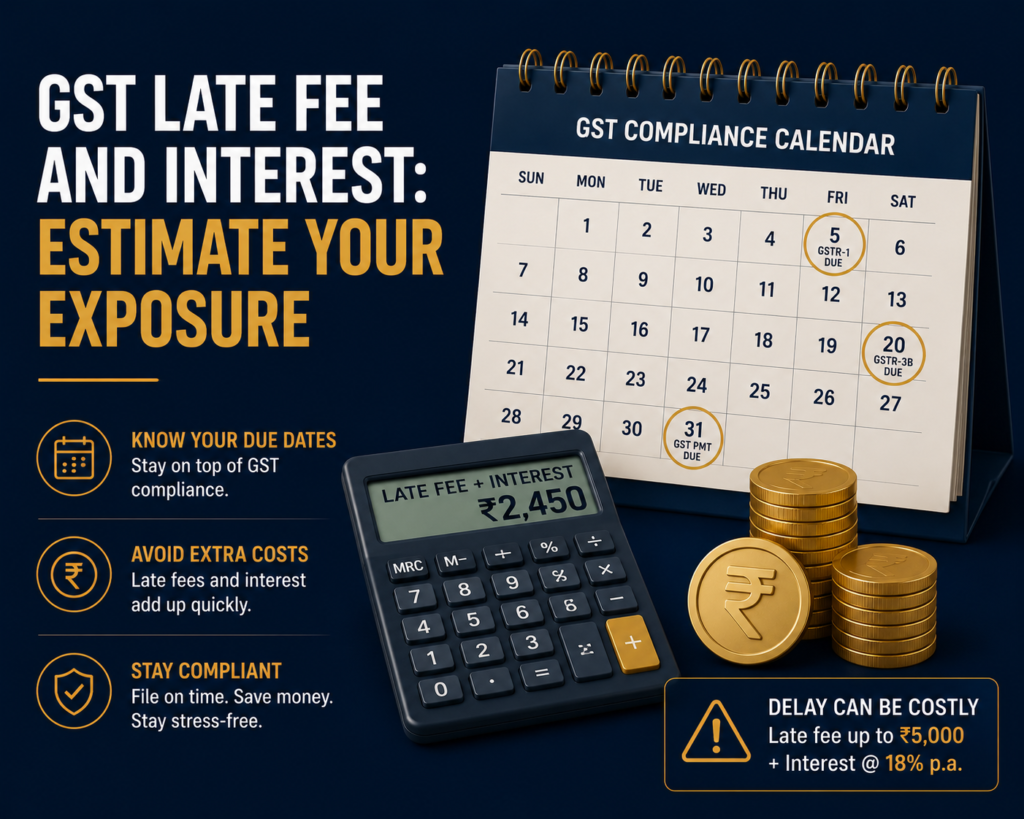
If your startup has missed a GSTR-1 or GSTR-3B deadline, the first instinct is usually to panic and assume the worst. The actual exposure is rarely as bad as the rumour mill suggests, and it is almost always smaller than the cost of doing nothing. A reliable GST late fee calculator gives you two numbers — the fixed daily late fee and the 18% interest on unpaid tax — and once you understand how each is built, you can estimate your exposure in under five minutes. This post walks through the rules, the math, and three worked examples for a typical startup.
Quick answer
For GSTR-1 and GSTR-3B with tax liability, the late fee is ₹50 per day (₹25 CGST + ₹25 SGST), capped at ₹5,000 per return. For nil returns, it is ₹20 per day (capped at ₹500). Interest on unpaid tax is 18% per annum on the net cash liability.
Before estimating, check three things:
- Is your return a nil return or a return with tax liability? The daily rate is different.
- Do you have unpaid output tax for the period, or is it a pure filing delay with no tax due?
- How much input tax credit is available against the output liability? Interest applies only to the cash portion.
The two costs you are estimating
When a GST return is filed late, the cost has two distinct components, and confusing them is the most common mistake startups make.
The late fee under Section 47 of the CGST Act 2017 is a fixed daily charge for filing the return itself after the due date. It applies whether or not any tax is due. A nil return filed 30 days late still attracts a late fee.
The interest under Section 50 of the CGST Act 2017 is a charge on the unpaid tax for the period of delay. It applies only if there is actual tax payable. A nil return — by definition — has no interest exposure because there is no unpaid tax.
These two are stacked, not alternative. A late GSTR-3B with tax due attracts both the daily late fee under Section 47 and 18% annual interest under Section 50 on the cash portion of the tax. Any GST late fee calculator worth using will return both numbers separately.
How the GST late fee calculator works in practice
The late fee math is straightforward arithmetic — but the cap is where most calculators add value, because the daily clock keeps ticking until the cap is hit.
For GSTR-1 and GSTR-3B with tax liability, the per-day rate is ₹50 (₹25 CGST + ₹25 SGST), capped at ₹5,000 per return. The daily rate for nil returns is ₹20 per day (₹10 CGST + ₹10 SGST), capped at ₹500. For the annual return GSTR-9, the daily rate is tiered by turnover — ₹50/day for AATO up to ₹5 crore, ₹100/day for ₹5–20 crore, ₹200/day for above ₹20 crore, with a cap linked to a percentage of state turnover.
Two practical points the calculator screens often miss:
- Late fees must be paid through the electronic cash ledger and cannot be adjusted against ITC. So if you have a healthy credit balance, that does not help with the late fee — you still need cash. GST Calculator
- The GST portal auto-populates the late fee once the return is filed late. The figure your private calculator shows should match the portal’s number — if it does not, double-check whether you have applied the correct daily rate (nil vs regular) and the right cap. Cleartax
If you are not sure whether your business needs GST registration at all, read our explainer on the GST registration threshold before reading further.
How GST interest is calculated under Section 50
Interest is the larger of the two costs once tax dues are involved, and it is also the one most often miscalculated.
The headline rate under Section 50(1) is 18% per annum on the unpaid tax, calculated from the day after the due date until the day the tax is actually paid. For wrongly availed and utilised input tax credit, Section 50(3) charges 24% per annum. Cleartax
The critical relief is the proviso to Section 50(1), effective from 1 September 2020. The proviso to Section 50(1) allows interest to be charged only on the tax actually paid in cash, after input tax credit is set off — a critical relief that many taxpayers miss when estimating exposure. Where there is a delay in payment of tax and filing of return for a tax period, interest is payable on the net tax liability discharged by debiting the electronic cash ledger, not on the gross output tax. TaxGuru
One catch worth knowing: the net-cash-liability benefit applies only when supplies made during a tax period are declared in that same period’s return filed late. If supplies from an earlier period are declared in a later period’s return, interest is calculated on the gross amount. Practically — file each period’s correct return for that period, even if late, rather than rolling old supplies into the next month’s GSTR-3B. Bizsolindia
The formula your calculator should apply:
Interest = (Net cash tax liability × 18% × Days of delay) ÷ 365
Three worked examples for a typical startup
These three scenarios cover most situations a startup will face. Numbers are kept simple for clarity.
Example 1 — Rahul, SaaS founder, nil GSTR-3B filed 30 days late. Rahul’s startup had no sales in May 2026 but is GST-registered. The May GSTR-3B was due on 20 June and filed on 20 July (30 days late).
- Late fee: ₹20 × 30 = ₹600. Cap is ₹500, so payable late fee = ₹500.
- Interest: nil (no tax due).
- Total exposure: ₹500.
Example 2 — Priya’s e-commerce business, regular GSTR-3B filed 10 days late, with tax due. Priya’s business owed ₹80,000 in output GST for August 2026, with ₹50,000 of input tax credit available. The return was due on 20 September and filed on 30 September (10 days late).
- Late fee: ₹50 × 10 = ₹500.
- Net cash liability = ₹80,000 − ₹50,000 = ₹30,000.
- Interest: (30,000 × 18% × 10) ÷ 365 = ₹148.
- Total exposure: ₹648.
Example 3 — A Bengaluru-based startup, GSTR-3B filed 90 days late, ₹2 lakh tax due, no ITC. The startup owed ₹2,00,000 in output GST and had no input credit. The return was due on 20 July 2026 and filed on 18 October (90 days late).
- Late fee: ₹50 × 90 = ₹4,500. Below the ₹5,000 cap, so payable = ₹4,500.
- Interest: (2,00,000 × 18% × 90) ÷ 365 = ₹8,877.
- Total exposure: ₹13,377.
Notice how the late fee is largely cosmetic at scale — once tax dues enter the picture, interest dominates exposure. A startup with ₹2 lakh in unpaid tax is paying roughly 66% of its total cost as interest, not late fee.
How to estimate your own exposure step by step
The infographic below shows the build-up of total exposure for the three most common startup scenarios — pure delay, mid-tax delay, and high-tax delay. Use it to anchor your own numbers before opening any calculator.
The five-step estimation process:
- Identify the return type (GSTR-1, GSTR-3B, GSTR-9) and whether it is nil or regular.
- Count days of delay — from the day after the due date to the actual filing date, inclusive.
- Apply the daily late fee rate and check against the cap.
- Compute the net cash tax liability: gross output GST minus available input tax credit for that period.
- Apply the formula: net cash × 18% × days ÷ 365.
When you should not delay further
Some situations turn from inconvenient to expensive very quickly.
- You have unfiled GSTR-1 for more than one month. Customers cannot claim input tax credit until you file GSTR-1, which puts your client relationships at risk regardless of the late fee. Cleartax
- GSTR-3B is pending for two or more months. The portal blocks sequential filings — you cannot file the current month until earlier months are filed. The longer you wait, the more periods stack up.
- Cash flow is tight and you are tempted to skip a nil filing. A nil return costs ₹500 maximum. Not filing risks suspension of GSTIN, which costs far more in lost business than ₹500.
- You are approaching the three-year mark. From July 2025, returns cannot be filed after three years from the original due date — the portal permanently blocks the submission. Beyond this point, the liability does not disappear; it becomes a department demand instead. Aiaccountant
- You have crossed the late fee cap. Once the ₹5,000 cap is hit, interest is the only cost still growing. Every additional day is pure interest exposure on unpaid tax.
Quarterly filers under the composition scheme follow a different return cycle, but the same interest and late fee logic applies once a deadline is missed.
Documents and data to keep ready
Before running any GST late fee calculator or contacting a professional, have these handy:
- The exact due date and intended filing date for the return in question
- Whether the return is nil or has tax liability
- Net output GST liability for the period (CGST, SGST/UTGST, IGST split)
- Input tax credit available for that period from GSTR-2B
- Aggregate annual turnover (relevant only for GSTR-9 caps)
- State of registration (for the late fee cap on annual returns)
- Any prior late fee already paid for the same return — to avoid double-counting
- Electronic cash ledger balance, since late fees and interest must be paid in cash
Final takeaway
A GST late fee calculator is genuinely useful, but only if you feed it the right inputs. The late fee is the small, capped, fixed cost — usually ₹500 to ₹5,000 per return. The interest is the open-ended cost — 18% per annum on the cash portion of unpaid tax, compounding daily until paid. For startups, the rule of thumb is simple: file even if you cannot pay the tax, because the late fee stops at the cap while interest keeps running. Filing first reduces ongoing exposure even when full payment must wait.
Confused about how late fees and interest are calculated for your specific GST returns, or worried about how much your exposure has grown? eTaxMate can help you assess the position, file pending returns correctly, and bring your GST compliance back on track.
This blog post is for general information only and does not constitute professional advice. Tax laws are subject to change and their application depends on individual facts and circumstances. Readers should consult a qualified professional before taking any action based on this content. eTaxMate accepts no liability for any action taken based on the information in this post.
Frequently Asked Questions
1. What is the current late fee for filing GSTR-3B late?
For GSTR-3B with tax liability, the late fee is ₹50 per day, split equally between CGST and SGST at ₹25 each. For nil returns, it is ₹20 per day. The maximum cap is ₹5,000 per return for regular filings and ₹500 for nil returns. The fee starts accumulating from the day after the due date and must be paid in cash through the electronic cash ledger.
2. Can I pay GST late fee or interest using input tax credit?
No. Both late fee and interest must be paid in cash through the electronic cash ledger. Input tax credit available in the electronic credit ledger cannot be used to settle these amounts. This is a common surprise for businesses with healthy ITC balances — they must still arrange separate cash to clear late fees and interest before the portal will accept the return.
3. How is GST interest calculated on delayed payment?
Interest is charged at 18% per annum under Section 50 of the CGST Act. The formula is: net cash tax liability multiplied by 18%, multiplied by days of delay, divided by 365. Interest is calculated only on the cash portion of tax — after input tax credit is set off — provided the supplies relate to the same period as the late-filed return. For wrongly availed ITC, the rate is 24% per annum.
4. Do I have to pay a late fee if I file a nil GST return late?
Yes. A late fee applies even for nil returns. The rate is ₹20 per day, capped at ₹500 per return. There is no interest exposure because there is no unpaid tax, but the late fee itself cannot be avoided. Filing nil returns on time costs nothing — the smallest possible compliance discipline avoids unnecessary penalties for businesses with no monthly activity.
5. What is the maximum late fee for late filing of GSTR-3B?
The maximum late fee is capped at ₹5,000 per return for GSTR-3B with tax liability and ₹500 for nil returns. Once the cap is hit, the late fee stops increasing, but interest on unpaid tax continues to grow daily at 18% per annum until the tax is fully paid. For GSTR-9, the cap is calculated as a percentage of state turnover rather than a fixed rupee amount.
6. Can I file a GST return that is more than three years old?
No. From July 2025, the GST portal permanently blocks the filing of any return more than three years past its original due date. The underlying tax liability does not disappear — it converts into a departmental demand recovered through assessment proceedings. If you have very old pending returns, address them well before this three-year window closes, since recovery through assessment is far more expensive than a normal late filing.
Very useful guide on GST late fees and interest. The point about calculating interest only on the net cash tax liability after ITC is especially helpful, as this can make a big difference in the final amount. The worked examples also make the calculation easy to understand.