
Many business owners treat GST return filing as a once-a-year chore handled by “the accountant.” That assumption is exactly what produces late fees, blocked input tax credit, and the dreaded mismatch notice. The reality is that GST is a continuous monthly or quarterly cycle of returns, each one feeding the next, and a single skipped filing can freeze your ability to file the rest. This post breaks down the returns that actually matter for a normal business, when each is due in 2026, and the specific mistakes that quietly cost you money.
Quick answer
For a regular business, GST return filing revolves around three returns: GSTR-1 (your sales), GSTR-3B (your tax payment), and GSTR-9 (the annual summary). Smaller businesses under ₹5 crore turnover can file the first two quarterly under the QRMP scheme instead of monthly. Annual return GSTR-9 is mandatory once turnover crosses ₹2 crore.
Before you file, check:
- Whether you are a regular taxpayer or a composition dealer (they file completely different returns).
- Whether you are monthly or under the QRMP quarterly scheme.
- Whether last period’s return is filed, because you cannot file the current one until then.
The main GST returns every business should know
GST has many return forms, but most have nothing to do with an ordinary trading or service business. Three matter for almost everyone, and a few others apply in specific situations.
GSTR-1 is your statement of outward supplies — every sales invoice you raised, reported at invoice level. This is what allows your business customers to see and claim input tax credit (the GST they paid on purchases from you, which they set off against their own GST). If you sell to other GST-registered businesses, your GSTR-1 directly affects whether they can claim their credit.
GSTR-3B is the summary return where you declare your total tax, claim your own input tax credit, and actually pay the net tax due. In 2026 it is largely auto-populated from your GSTR-1 and GSTR-2B data, which is convenient until the auto-fill pulls in a figure you never checked.
GSTR-9 is the annual return — a consolidated summary of everything you filed across the year. For FY 2025-26, filing GSTR-9 is mandatory if aggregate turnover exceeds ₹2 crore, and businesses whose annual turnover exceeds ₹5 crore must also file GSTR-9C, the reconciliation statement. CleartaxBajaj Finserv
Composition dealers — small businesses that pay a flat turnover-based rate under the [composition scheme] — do not touch these. They file CMP-08 each quarter and an annual GSTR-4 instead. Whether you are even required to be in this system at all comes back to the [GST registration threshold], which decides who must register in the first place.
Due dates: monthly, quarterly, and annual
This is where most penalties originate. Miss a date and the late fee starts ticking automatically.
For a monthly filer (turnover above ₹5 crore, or anyone not in QRMP):
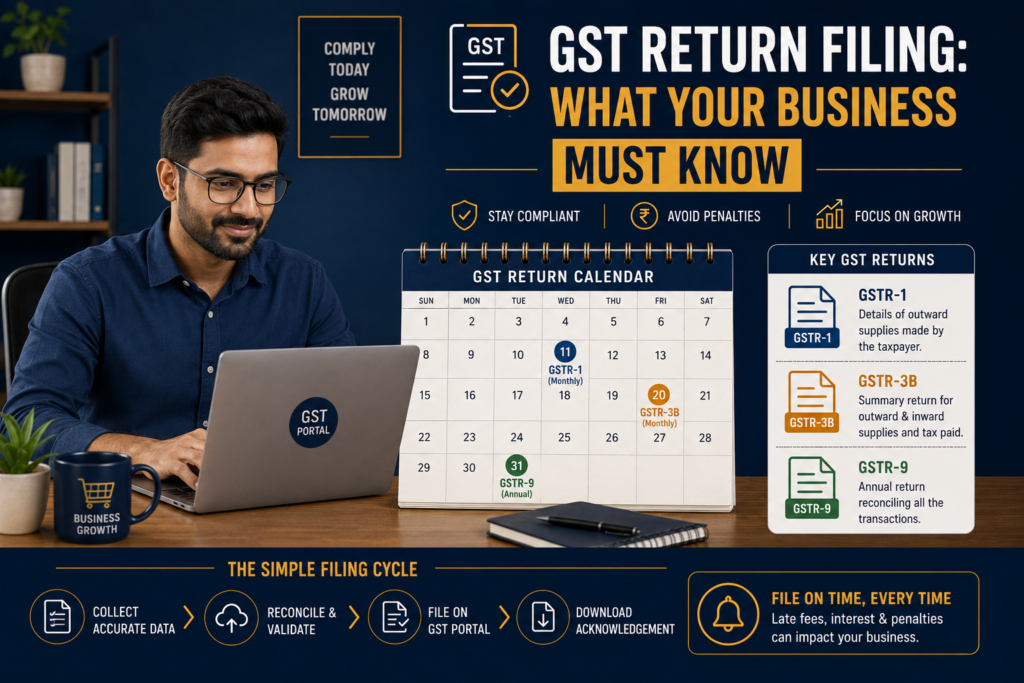
- GSTR-1 is due by the 11th of the following month.
- GSTR-3B is due by the 20th of the following month. This is the date your tax actually has to be paid.
For the annual return, GSTR-9 for FY 2025-26 must be filed by 31 December 2026, along with GSTR-9C where applicable. Take a Pune-based electronics trader with ₹8 crore turnover: they file GSTR-1 by the 11th and GSTR-3B by the 20th every single month, then close the year with GSTR-9 and GSTR-9C by 31 December. Legal Suvidha
The late fee is not trivial over time. For the annual return, a delay attracts a late fee of ₹200 per day, capped at 0.25% of turnover. On top of any late fee, interest at 18% per annum runs on unpaid tax until you clear it. Cleartax
The QRMP scheme: who it suits and who it traps
The Quarterly Return Monthly Payment (QRMP) scheme is built for small businesses. It allows businesses with annual turnover up to ₹5 crore to file GST returns every quarter instead of monthly. You still pay tax monthly through a simple challan (PMT-06), but the returns themselves are quarterly. DMI Finance
Under QRMP, GSTR-1 is due on the 13th of the month following the quarter, and GSTR-3B is due on the 22nd or 24th, depending on the state your business is registered in. DMI Finance
Here is the trap. QRMP filers can use the Invoice Furnishing Facility (IFF) to upload B2B invoices in the first two months of the quarter. If you skip IFF, your B2B buyers will not see those invoices in their GSTR-2B until the quarter ends, which delays their input tax credit and strains the relationship. Take Priya, who runs a small Bengaluru design studio billing corporate clients. If she opts for QRMP to reduce paperwork but forgets IFF, her clients wait up to two months to claim credit on her invoices — a quiet way to annoy the customers she depends on. QRMP suits businesses selling mostly to consumers; it can backfire for those with credit-sensitive B2B buyers. KDK Software Blog
How to file GST returns without errors
Filing is entirely online. The process is straightforward once you treat it as a sequence rather than a scramble.
- Reconcile before you file. Match your sales register to your GSTR-1 and your purchase register to your GSTR-2B. Catch mismatches here, not after filing.
- File GSTR-1 first, ideally before or alongside GSTR-3B, so your buyers’ credit and your own summary line up.
- Review the auto-populated GSTR-3B, do not just accept it. Verify your [input tax credit] figures against GSTR-2B, because claiming credit that does not appear there invites a reversal with interest.
- Pay the net tax through your electronic cash or credit ledger and submit.
- File even a Nil return for periods with no transactions. A skipped return blocks the next one.
The infographic below maps the three core returns to who files them and when.
Common GST return filing mistakes that invite notices
GST return filing errors are rarely dramatic. They are small, repeated slips that surface months later as a notice. Step carefully around these.
The most common is reporting a B2B sale as B2C — leaving out your registered buyer’s GSTIN. The invoice then never reaches their GSTR-2B, and they cannot claim credit. Another is wrong HSN or SAC codes (the classification codes for goods and services), which cause mismatches at annual reconciliation. Forgetting credit notes in GSTR-1 means you overstate your own tax liability. Claiming input tax credit that is not in your GSTR-2B is a fast route to a reversal with interest, because the system now matches credit automatically. And skipping a period entirely — even a Nil month — blocks every return that follows it.
A subtler trap is the turnover mismatch between GST and income tax. The departments now cross-check the turnover you declare in GSTR-9 against the turnover in your income tax return. If the two do not reconcile, expect a query. Treat consistency across both filings as part of the same job, not two separate ones.
Documents and checks before you file
📋 Keep these ready for every filing cycle:
- Your sales register, matched to invoices raised in the period
- Your purchase register and the auto-drafted GSTR-2B from the portal
- Debit and credit notes issued during the period
- Correct GSTINs for all B2B customers
- HSN/SAC codes for your goods and services
- Confirmation that the previous period’s return is already filed
- Sufficient balance in your electronic cash or credit ledger to pay the net tax
Final takeaway
GST return filing is a cycle, not an event. For a normal business it comes down to GSTR-1 for your sales, GSTR-3B for your tax, and GSTR-9 once a year if you cross ₹2 crore — filed in sequence, on time, every period without exception. The penalties for slipping are automatic, and the mismatches surface long after the mistake. Get the monthly rhythm right and reconcile before you file, and the annual return becomes a formality rather than a fire drill.
GST return filing confusion, or unsure whether QRMP suits your business and how to handle annual reconciliation? eTaxMate can help you review your filing position, identify what applies to you, and handle your returns and compliance correctly.
This blog post is for general information only and does not constitute professional advice. Tax laws are subject to change and their application depends on individual facts and circumstances. Readers should consult a qualified professional before taking any action based on this content. eTaxMate accepts no liability for any action taken based on the information in this post.
Frequently Asked Questions
1. Which GST returns does a normal business need to file?
For most regular businesses, three returns matter. GSTR-1 reports your sales at invoice level, GSTR-3B is the summary return where you pay your net tax, and GSTR-9 is the annual consolidated return. Composition dealers are different — they file CMP-08 each quarter and an annual GSTR-4 instead of these.
2. What are the GST return due dates for a monthly filer?
A monthly filer must submit GSTR-1 by the 11th of the following month and GSTR-3B by the 20th, which is also when the tax is paid. The annual return, GSTR-9, is due by 31 December of the following financial year. Under the QRMP scheme, GSTR-1 moves to the 13th after the quarter and GSTR-3B to the 22nd or 24th.
3. Is GSTR-9 mandatory for every business?
No. The annual return GSTR-9 becomes mandatory only once your aggregate turnover crosses ₹2 crore in the financial year. Below that, it is optional. Separately, if turnover exceeds ₹5 crore, you must also file GSTR-9C, a self-certified reconciliation statement, alongside GSTR-9.
4. What happens if I skip a GST return for a month with no sales?
You still have to file a Nil return. The GST system does not let you file the current period’s return until the previous period is filed, so one skipped month — even with zero transactions — blocks every return that follows. This is a frequent and entirely avoidable cause of late fees.
5. Should my small business opt for the QRMP scheme?
QRMP lets businesses under ₹5 crore turnover file quarterly instead of monthly, which reduces paperwork. It suits businesses selling mainly to consumers. If you sell to GST-registered businesses, remember to use the Invoice Furnishing Facility, or your buyers cannot claim input tax credit on your invoices until the quarter ends.
6. Why did I get a GST mismatch notice after filing correctly?
Most mismatch notices come from inconsistencies the system catches automatically — input tax credit claimed that is not in your GSTR-2B, a B2B sale reported as B2C, or turnover in your GSTR-9 not matching your income tax return. The filing can look “complete” while still carrying these mismatches, which surface months later.