
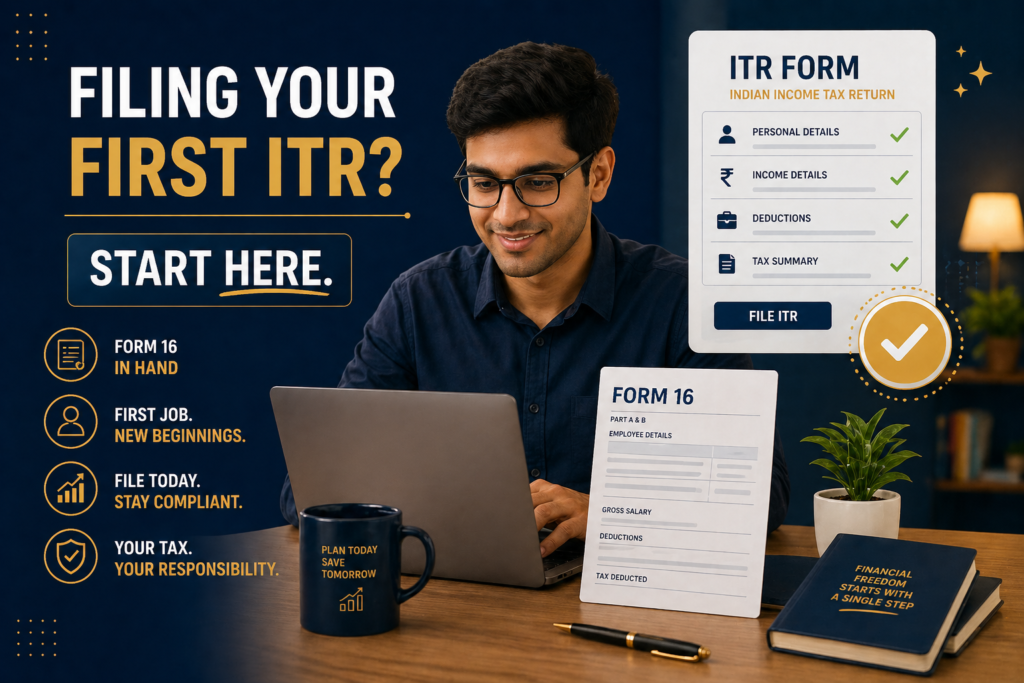
If this is your first salary year and you are sitting with a Form 16 wondering what to do next, do not panic. First time ITR filing feels intimidating mostly because of the jargon, not the process itself. The actual filing, for a typical salaried employee with one employer and a savings account, takes about 30 minutes on the e-filing portal once your documents are in order. The trouble usually starts when people skip the preparation step, pick the wrong form, or miss income that has already been reported to the tax department in their name. This post walks you through what to gather, which form to use, and how to file cleanly the first time.
Quick answer
Most first-time salaried filers can file ITR-1 (Sahaj) on the e-filing portal using their Form 16, AIS, and bank details, and the deadline for AY 2026-27 is 31 July 2026 unless extended. The single biggest mistake is filing before downloading the AIS, because that is where the department lists income from interest, dividends, and other sources that you may have forgotten.
Before you start, check:
- Has your employer issued Form 16 (usually by 15 June)?
- Have you downloaded your AIS and Form 26AS from the e-filing portal?
- Have you decided between the old and new tax regimes?
Why first time ITR filing matters even when TDS is fully deducted
A common belief among first-year earners is: “My employer has already deducted TDS. Why do I need to file?” The answer is that TDS deduction and ITR filing are two different things. Tax Deducted at Source (TDS) is your employer’s job — they deposit a portion of your salary as tax on your behalf. Filing the Income Tax Return (ITR) is your job — it is your formal declaration to the Income Tax Department of what you earned, what tax was paid, and whether anything more is owed or refundable.
Filing matters even when TDS exactly matches your tax liability, for three practical reasons. First, if you had any other income — savings account interest, fixed deposit interest, mutual fund dividends — your total tax liability may differ from what your employer calculated. Second, an ITR is the standard income proof for visa applications, home loans, credit cards above a certain limit, and government tenders. Third, you cannot claim a refund of excess TDS without filing.
There is also a legal trigger: under the Income Tax Act, filing is mandatory once your total income before deductions crosses the basic exemption limit. For most salaried employees in their first job, this threshold is comfortably crossed.
Documents to keep ready before you start
The single biggest cause of errors in first time ITR filing is starting the form before the paperwork is ready. Gather these first:
- Form 16 from your employer — Part A shows TDS deposited, Part B shows your salary breakup and deductions claimed.
- AIS (Annual Information Statement) — downloaded from the e-filing portal. This shows every financial transaction reported in your PAN: salary, interest, dividends, mutual fund redemptions, share trades, large purchases.
- Form 26AS — the consolidated tax credit statement. Your TDS in Form 16 must match Form 26AS.
- Bank account statements for the financial year — to identify interest credited.
- Investment proofs if claiming deductions under the old regime — LIC premium receipts, ELSS statements, PPF passbook, home loan interest certificate, health insurance receipts, donation receipts.
- PAN, Aadhaar, and a pre-validated bank account on the e-filing portal — refunds are credited only to a pre-validated account.
- Login credentials for the Income Tax e-filing portal.
A useful habit: open the AIS and tick off each entry mentally. If anything looks unfamiliar, raise feedback through the AIS portal before filing — once filed, fixing mismatches becomes paperwork.
Choosing the right ITR form
For first time ITR filing, picking the wrong form is the most common technical error. The two relevant forms for most salaried beginners are:
ITR-1 Sahaj — for resident individuals with total income up to ₹50 lakh, where income comes from salary, one house property, family pension, agricultural income up to ₹5,000, and other sources like interest. This is the simplest form and fits the vast majority of first-year salaried employees.
ITR-2 — for individuals with income above ₹50 lakh, capital gains, more than one house property, foreign income or assets, or who are directors in a company. If you sold mutual funds, shares, or crypto during the year, you generally cannot use ITR-1.
Do not assume ITR-1 by default. Check whether you had any capital gains transaction — even a single redemption of a debt mutual fund or a small sale of listed shares — because that pushes you to ITR-2.
Confused in selecting which ITR form is applicable to you? Refer our blog post on ITR Form selector for accurate filing of ITR Form.
Old vs new tax regime: the choice that changes your refund
This is the single decision that affects how much tax you actually pay. From AY 2024-25 onwards, the new tax regime is the default. If you do not actively choose the old regime, the system files you under the new one.
The new regime offers lower slab rates and a higher rebate threshold under Section 87A but allows almost no deductions or exemptions. The old regime has higher slab rates but allows the full set of common deductions: Section 80C (PPF, ELSS, LIC, principal on home loan, up to ₹1.5 lakh), Section 80D (health insurance), HRA exemption, home loan interest under Section 24(b), Section 80CCD(1B) for NPS (₹50,000 extra), and several others.
The practical rule of thumb: if your total deductions and exemptions add up to a meaningful amount — typically ₹2.5 lakh or more for a salaried employee — the old regime usually works out better. If you have minimal deductions, the new regime almost always wins. The e-filing portal lets you compute tax under both regimes before you file, so use that comparator. Salaried employees can switch between regimes year on year. Business or professional income filers cannot switch as freely — that is a stricter rule under the Act.
A quick note on the law: the rules referenced here are under the Income Tax Act 1961, which governs filings for AY 2026-27. The Income Tax Act 2025 takes effect from 1 April 2026 onwards and will apply to filings from AY 2027-28 — the structure of regimes and most salary-related provisions broadly carry forward, but specific deduction limits and section numbers should be checked at the time of filing in future years.
How to file your first ITR step by step
The actual filing flows in a predictable order on the e-filing portal. Here is the path most first-timers should follow.
The portal pre-fills most of your salary, TDS, and AIS data once you log in and select the assessment year. Your job is to verify each pre-filled number against your own documents, fill in anything missing (like savings account interest, which is rarely pre-filled fully), claim the right deductions, choose your regime, and submit. After submission, you must e-verify within 30 days using Aadhaar OTP, net banking, or a pre-validated bank account — an unverified return is treated as never filed.
When you should not rush to file
Speed is not a virtue here. Hold off and review carefully if any of the following apply:
- Your Form 16 is not yet issued. Filing from payslips alone often produces mismatches, because Form 16 is the official figure the department has on record.
- Your AIS shows entries you do not recognise. This sometimes happens because of PAN reporting errors by banks or brokers. Raise feedback in the AIS portal before filing.
- You changed jobs during the year. You need Form 16 from each employer, and your taxable income must be recomputed combining both — the second employer often does not have visibility of income from the first.
- You earned capital gains, even small ones. ITR-1 is not the right form. Filing the wrong form means refiling later as a revised return.
- You are unsure whether you are a resident under tax law. If you spent significant time abroad, residency status affects what you must declare.
In each case, fixing a wrongly filed return takes more effort than waiting a week to file correctly the first time.
Quick checklist before you hit submit
- PAN linked with Aadhaar
- Form 16 from every employer for the year
- AIS and Form 26AS downloaded and reviewed
- Bank account pre-validated on e-filing portal
- Interest income from all savings accounts and FDs added
- Deductions supported by proofs (if old regime)
- Regime choice confirmed
- Correct ITR form selected
- Tax computed under both regimes for comparison
- E-verification method ready (Aadhaar OTP is fastest)
Final takeaway
First time ITR filing is less about technical skill and more about preparation. If you gather Form 16, AIS, and 26AS upfront, pick the right form, and compare both regimes before submitting, the actual filing is straightforward. The mistakes that cause notices and refund delays almost always trace back to skipped preparation — missing AIS entries, wrong form, or unverified returns. File once, file correctly, and e-verify within 30 days.
First time ITR filing confusion or unsure which regime and form fit your situation? eTaxMate can help you review your Form 16 and AIS, choose the right approach, and file your return accurately.
This blog post is for general information only and does not constitute professional advice. Tax laws are subject to change and their application depends on individual facts and circumstances. Readers should consult a qualified professional before taking any action based on this content. eTaxMate accepts no liability for any action taken based on the information in this post.
Frequently Asked Questions
1. Do I need to file ITR if my employer has already deducted TDS?
Yes, in most cases. TDS deduction and ITR filing are separate obligations. TDS is the tax your employer deposits on your behalf, while the ITR is your formal declaration to the department. Filing is required once your total income crosses the basic exemption limit, and it is also the only way to claim a refund of excess TDS or use the return as income proof for loans and visas.
2. Which ITR form should a first-time salaried filer use?
Most first-time salaried employees can use ITR-1 Sahaj, which covers salary income, one house property, and other sources like interest, with total income up to ₹50 lakh. However, if you sold shares, mutual funds, or crypto during the year, even a small transaction makes you ineligible for ITR-1, and ITR-2 is the correct form.
3. Is the old tax regime or new tax regime better for a first job?
It depends on your deductions. The new regime is the default and offers lower slab rates with almost no deductions. The old regime has higher rates but allows Section 80C, 80D, HRA, home loan interest, and others. As a rough rule, if your total deductions and exemptions exceed roughly ₹2.5 lakh, the old regime usually saves more tax. The portal lets you compare both before filing.
4. What is the deadline for first time ITR filing for AY 2026-27?
The standard due date for salaried individuals not subject to tax audit is 31 July 2026 for AY 2026-27, unless the government extends it. Filing after the due date attracts a late fee under the Act and may restrict your ability to carry forward certain losses. E-verification must be completed within 30 days of submission, otherwise the return is treated as not filed.
5.What happens if I file ITR-1 but I had a small mutual fund sale?
Filing ITR-1 when you had any capital gains transaction — even a small redemption — is technically incorrect. The department may flag it as a defective return under the Act, requiring you to file a revised return using ITR-2. The cleaner approach is to identify capital gains entries from your AIS before filing and select ITR-2 from the start.
6. What is AIS and why is it important before filing?
AIS, the Annual Information Statement, is a consolidated record on the e-filing portal of every financial transaction reported against your PAN — salary, interest, dividends, mutual fund redemptions, share trades, and large purchases. Reviewing AIS before filing prevents underreporting income that the department already knows about, which is one of the most common triggers for notices to first-time filers.