
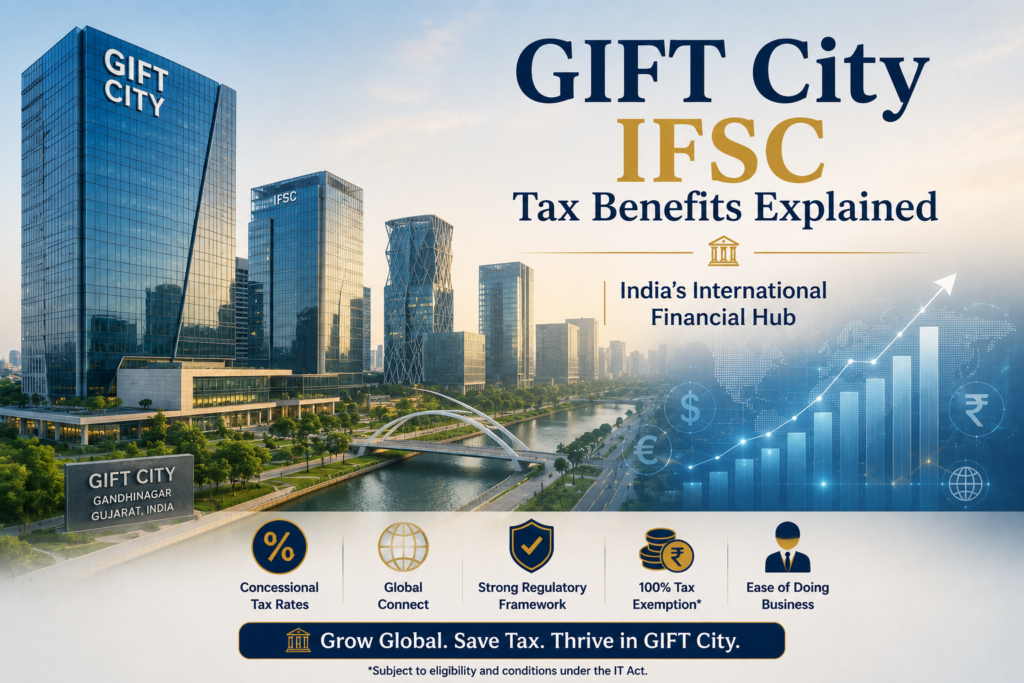
India’s GIFT City — Gujarat International Finance Tech-City — has moved firmly from pilot project to serious structuring option. The GIFT City IFSC tax benefits are legislated, in force, and broader in scope than most businesses realise. If you are a fund manager, financial services firm, or startup considering IFSC, the question is not whether the incentives are real — they are — but whether your specific business qualifies, and whether the setup cost justifies the tax saving.
This post sets out exactly what is on offer, who it applies to, and where the limits are.
Quick answer
GIFT City IFSC offers eligible financial services entities a 100% profit deduction for up to 10 years, reduced MAT at 9%, STT and CTT exemptions, and capital gains relief for non-resident investors — all under Section 80LA and related provisions of the Income Tax Act 1961.
Before acting, check:
- Whether your activity qualifies as a permitted “financial product or financial service” under the IFSCA Act 2019.
- Whether your primary clients are non-residents — many IFSC exemptions apply specifically to cross-border transactions.
- Whether your compliance infrastructure (CA certification, IFSCA reporting, foreign-currency accounting) can sustain the ongoing obligations.
What Is GIFT City IFSC?
GIFT City is a planned financial services district in Gandhinagar, Gujarat. Within it, the International Financial Services Centre (IFSC) is a separately notified zone governed by the International Financial Services Centres Authority Act 2019 (IFSCA Act). The IFSCA is the single unified regulator covering all financial activity within IFSC — banking, insurance, capital markets, and fund management — replacing the earlier patchwork of sectoral regulators.
What makes IFSC distinct from a regular Indian business location is its ring-fenced character: transactions are denominated in foreign currency, the client base is primarily non-resident or offshore, and the regulatory and tax framework is designed explicitly for cross-border finance. Think of it as a financial zone inside India that operates by rules built for international markets.
The Core GIFT City IFSC Tax Benefits
1. The 10-year profit deduction — Section 80LA
Section 80LA of the Income Tax Act 1961 is the central benefit. An IFSC unit can deduct 100% of its profits from eligible operations for any 10 consecutive assessment years out of its first 15 assessment years of operation.
This is a full deduction, not a rate reduction. In the years the deduction applies, the unit’s taxable income from IFSC operations is effectively zero.
To claim it, the unit must:
- Be set up in an IFSC notified by the Central Government.
- Derive income from an eligible business as defined under IFSC regulations.
- File a report from a Chartered Accountant in the form prescribed by the Central Board of Direct Taxes (CBDT) along with the return of income for that year.
The deduction window must be actively elected. Once you choose which 10 years to claim, that choice stands. Most units defer the election until profit levels make the deduction meaningful — there is no point burning a year of the window on a loss-making period.
Under the Income Tax Act 2025, which applies from AY 2026-27 onward, the IFSC incentives have been preserved. The section references under the 2025 Act should be confirmed against the current published bare Act, as several provisions have been renumbered. Unlike personal income tax deductions that depend on whether an individual chooses the old or new tax regime, Section 80LA operates at the entity level and is not affected by the individual regime choice.
2. Reduced MAT
For companies in IFSC, Minimum Alternate Tax (MAT) under Section 115JB of the Income Tax Act 1961 applies at 9% of book profits, compared to the standard rate of 15%. For LLPs and other non-corporate entities, the Alternative Minimum Tax (AMT) equivalent is similarly reduced.
This matters even in years when Section 80LA eliminates normal tax: MAT is computed on book profits, not taxable income. The reduced 9% rate ensures that entities making accounting profits do not face a disproportionate minimum tax outgo during the deduction period.
3. STT and CTT exemptions
Securities Transaction Tax (STT) and Commodity Transaction Tax (CTT) do not apply to transactions carried out on recognised stock exchanges operating within the IFSC. For fund managers, broking firms, and proprietary trading desks where transaction volumes are high, the absence of STT and CTT is a material reduction in operating costs.
Capital Gains and Income Exemptions for Non-Residents
Section 10(4D) of the Income Tax Act 1961 provides an exemption on specified income earned by certain Category III Alternative Investment Funds (AIFs) registered with the IFSCA. Section 10(4E) provides an exemption on income earned by non-resident investors from offshore derivative instruments and foreign exchange assets traded on IFSC exchanges.
These provisions target non-resident investors and offshore funds accessing Indian markets through an IFSC vehicle. If your investor base is Indian residents, most of these exemptions will not apply to their returns.
Under the Income Tax Act 2025, the capital gains exemptions for IFSC structures have been carried forward. Section references should be verified against the current bare Act.
On GST: IFSC is treated as a Special Economic Zone (SEZ). Services exported from an IFSC unit to customers outside India are zero-rated — no GST is payable and input tax credit on inputs can be claimed. Services provided by an IFSC unit to Indian-resident clients outside IFSC attract standard GST rates.
How to Evaluate Whether IFSC Is Right for Your Business
The decision to set up in GIFT City IFSC is not just a tax decision. It involves regulatory licensing, foreign-currency operations, and an ongoing compliance relationship with the IFSCA. Follow this sequence before committing.
- Confirm activity eligibility. Check the IFSCA’s permitted activity list for your sector. Fund management, broking, insurance intermediation, banking, and certain fintech activities qualify. Manufacturing, software services, and general consulting do not.
- Map your client base. Review what share of expected revenues will come from non-resident clients. If the answer is primarily domestic, the GIFT City IFSC tax benefit math changes significantly.
- Model the compliance costs. IFSC operations require CA-certified filings for Section 80LA, IFSCA-specific annual reports, foreign currency accounts, and sector-specific audits. Build these into your cost projections.
- Plan the deduction window. Work with a CA to project when your IFSC entity is likely to reach meaningful profit levels, then elect the 10-year window accordingly.
- Register with IFSCA. Incorporate the entity or open a branch in IFSC, obtain the Letter of Approval (LOA) from IFSCA, open foreign currency accounts with an IFSC-licensed bank, and begin sector-specific compliance filing.
When You Should Not Rush Into IFSC
Your activity does not qualify. The IFSCA Act 2019 defines permitted financial products and services precisely. If your business is a software company, a trading firm handling physical goods, or a general consulting practice, no amount of restructuring will bring you within the IFSC regime. The permitted activity check is the starting point, not a formality.
Your revenues are primarily domestic. Most IFSC GIFT City tax benefits — particularly the capital gains and income exemptions under Section 10(4D) and 10(4E) — apply to non-resident investors and cross-border transactions. An IFSC unit earning rupee income from Indian-resident clients will find its domestic revenues taxed under normal rules, and the IFSC structure may add overhead without matching benefit.
Your compliance budget is limited. IFSC units carry above-average compliance costs: CA certification for Section 80LA, IFSCA-specific annual filings, foreign currency accounting, and sector-specific audits. For an early-stage entity with modest revenue, these costs can exceed the tax saving in early years.
You plan to repatriate funds to India quickly. Moving profits from an IFSC entity to an Indian parent or partner entity can trigger withholding tax and FEMA scrutiny. The IFSC structure works best when cross-border flow is the primary operational model, not a transitional arrangement.
Documents and Steps to Keep Ready
- ✅ IFSCA Letter of Approval (LOA) or Certificate of Registration
- ✅ Memorandum and Articles of Association showing IFSC as the registered address
- ✅ Foreign currency bank account statements with a bank licensed within IFSC
- ✅ IFSCA annual compliance filings for the relevant assessment year
- ✅ CA certificate in the CBDT-prescribed form for the Section 80LA deduction claim
- ✅ Computation statement showing eligible IFSC income vs. total income
- ✅ Documentation of the 10-year deduction window elected, with start year recorded
- ✅ Board resolution or equivalent authorising IFSC operations
Final Takeaway
GIFT City IFSC is a genuine, legislated tax advantage for financial services businesses that have the right activity profile, a cross-border client base, and the compliance infrastructure to sustain the regime. The 10-year profit deduction, reduced MAT, STT and CTT exemptions, and non-resident investor reliefs add up to a meaningful benefit — but only for businesses structured for cross-border finance, not for those seeking a domestic tax shelter. Validate your activity eligibility and client profile before committing to the structure.
Considering GIFT City structuring or need help assessing whether your business qualifies for IFSC tax benefits? eTaxMate can review your activity eligibility, walk through the Section 80LA deduction planning, and handle the CA certification and compliance filings correctly.
This blog post is for general information only and does not constitute professional advice. Tax laws are subject to change and their application depends on individual facts and circumstances. Readers should consult a qualified professional before taking any action based on this content. eTaxMate accepts no liability for any action taken based on the information in this post.
Frequently Asked Questions
1. What is GIFT City IFSC and who can set up there?
GIFT City IFSC is India’s only International Financial Services Centre, located in Gandhinagar, Gujarat, and regulated by the IFSCA. It is open to financial services businesses — fund managers, brokers, insurers, and banks — whose activities qualify as a “financial product” or “financial service” under the IFSCA Act 2019. Non-financial businesses, software companies, and general trading firms cannot use the IFSC regime.
2. How does the 10-year tax holiday at GIFT City IFSC work?
Under Section 80LA of the Income Tax Act 1961, an IFSC unit can deduct 100% of its profits from eligible operations for any 10 consecutive assessment years within its first 15 years of operation. The deduction is claimed by filing a CA-certified report with the annual income tax return. The 10-year window must be elected carefully — it cannot be changed once chosen, so timing the election to coincide with profitable years is important.
3. What is the MAT rate for companies in GIFT City IFSC?
Companies in IFSC pay Minimum Alternate Tax (MAT) at 9% of book profits, compared to the standard 15% for other companies. This reduced rate applies even when the Section 80LA deduction brings normal taxable income to zero, so entities showing accounting profits still pay a lower minimum tax floor compared to companies outside IFSC.
4. Do GIFT City IFSC benefits apply if my clients are Indian residents?
Partially. The 10-year profit deduction under Section 80LA and the MAT reduction apply regardless of whether clients are residents or non-residents, provided the income is from eligible IFSC activities. However, the capital gains and income exemptions under Section 10(4D) and 10(4E) are specifically designed for non-resident investors. If your client base is primarily Indian residents, many of the headline IFSC tax benefits will not apply to their returns.
5. Is GST charged on services provided from a GIFT City IFSC unit?
Services exported from an IFSC unit to customers outside India are zero-rated under GST — no GST is payable and input tax credit can be claimed. But if the IFSC unit provides services to Indian-resident clients outside IFSC, standard GST rates apply. The zero-rating benefit depends on the cross-border nature of the service, not just the provider’s location within IFSC.
6. What is the most common mistake businesses make when evaluating GIFT City IFSC?
Assuming any startup or technology company can use IFSC for the tax benefits. The IFSCA Act 2019 limits the regime to financial products and financial services. A SaaS company, a B2B software business, or a general professional services firm does not qualify, regardless of how the entity is structured. Confirming activity eligibility against the IFSCA permitted list must be the first step — not an afterthought.