
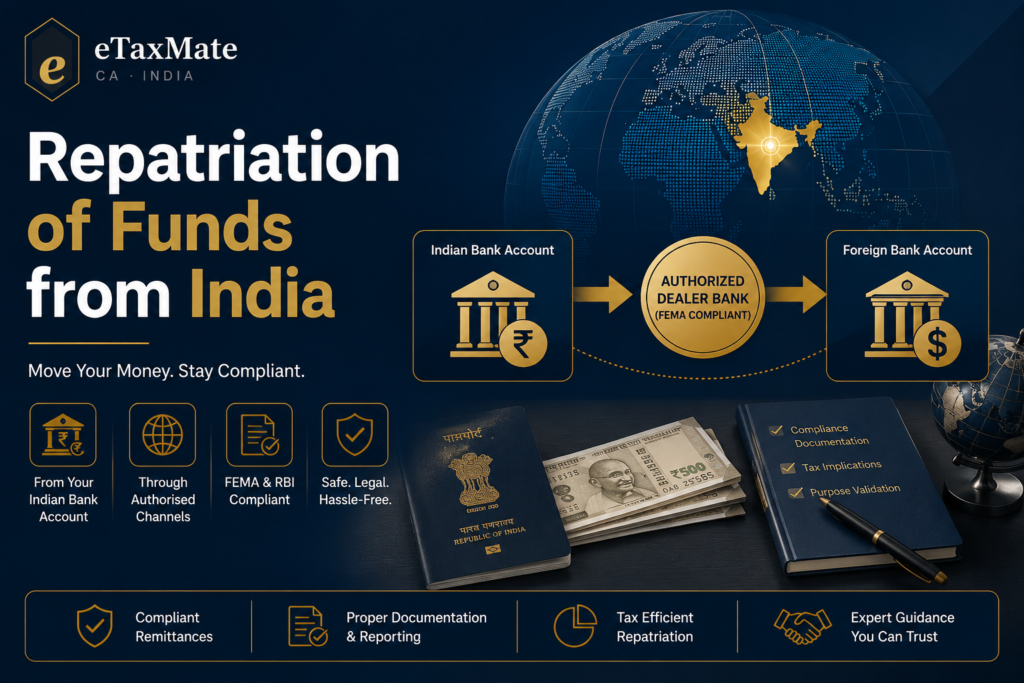
NRIs frequently assume that because the money is theirs — earned in India, taxed in India — they can move it abroad whenever they want. In practice, repatriation of funds from India is a regulated process under FEMA, and the account type, the source of funds, and whether Indian taxes have been settled all determine what paperwork is required and how much can go out in a year. Miss a step and the bank will hold the transfer until the documentation is in order. This post explains repatriation of funds from India, the limits, the forms, and the process — in the order you will actually encounter them.
Quick answer
NRE and FCNR(B) account balances are freely and fully repatriable — no limit, no forms required. Funds in NRO accounts are repatriable up to USD 1 million per financial year, but only after taxes have been paid and Form 15CA/Form 15CB documentation is submitted to the bank.
Before initiating a repatriation from an NRO account, check:
- That TDS has been deducted or advance tax paid on all India-source income in the NRO account.
- Whether your remittance for the year will exceed Rs 5 lakh — if so, you need a CA’s Form 15CB before filing Form 15CA.
- That the source of funds (interest, rent, sale proceeds) is clearly identifiable and documented.
- That you have not already used the USD 1 million limit for the current financial year.
NRE versus NRO: the repatriation difference
The account type determines everything about ease of repatriation.
NRE (Non-Resident External) account: Funded by remittances from abroad and income earned outside India. Both the principal and the interest are freely repatriable without any limit, without any forms, and without any tax clearance. The bank processes a standard overseas transfer. Interest is exempt from Indian income tax under Section 10(4)(ii) of the Income Tax Act 1961.
FCNR(B) (Foreign Currency Non-Resident Bank) account: Foreign currency deposits held in India. Freely repatriable — principal, interest, and maturity proceeds — in the same currency or any other freely convertible currency. No upper limit, no documentation requirements beyond the bank’s own KYC.
NRO (Non-Resident Ordinary) account: Funded by India-source income — rental income, dividends, pension, sale proceeds of Indian assets. Repatriation is permitted but regulated: up to USD 1 million per financial year, subject to taxes being paid and formal documentation submitted to the bank. This is where most NRIs encounter the Form 15CA/15CB requirement.
The USD 1 million limit: what it covers and what it does not
The USD 1 million annual limit for NRO repatriation applies per NRI per financial year (April–March). It is an aggregate across all repatriations in the year — not a per-transaction limit. Repatriating USD 600,000 in June and USD 500,000 in December would breach the limit; the second transfer would require RBI approval.
The limit covers:
- Interest income and current earnings in the NRO account
- Maturity proceeds of NRO fixed deposits
- Sale proceeds from equity, mutual funds, or bonds held in India
- Sale proceeds from immovable property (with the additional conditions below)
- Rental income accumulated in the NRO account
Property sale proceeds have an additional constraint: up to two residential properties can have their sale proceeds repatriated during the lifetime of the NRI — not per year. Sale proceeds from more than two properties require RBI approval regardless of the USD 1 million headroom available in any given year.
Agricultural land is further restricted. Sale proceeds from agricultural land, plantation property, or farmhouses require specific RBI permission and cannot be repatriated under the standard USD 1 million facility.
Amounts above USD 1 million in a year — or proceeds from restricted categories — require a fresh remittance application to the RBI, which is a separate process with its own documentation requirements and processing timelines.
Form 15CA and Form 15CB: why they exist and when you need them
The Income Tax Act 1961 requires any person responsible for making a payment to a non-resident to deduct TDS and, in most cases, to report the remittance. Rule 37BB (framed under Section 195(6) of the ITA 1961) implements this through Form 15CA, a declaration filed by the remitter on the income tax portal, and Form 15CB, a certificate issued by a Chartered Accountant confirming that taxes have been correctly computed and either paid or accounted for.
Under the Income Tax Act 2025, the withholding framework for payments to non-residents is carried forward from the 1961 Act. The exact provision reference in the 2025 Act should be confirmed against the current text — section numbers have been renumbered — but the substantive obligation (and the Rule 37BB reporting mechanism) remains in force.
Which part of Form 15CA applies?
Form 15CA has four parts, and the correct part depends on the taxability and size of the remittance:
- Part A: Taxable remittance where the aggregate for the financial year does not exceed Rs 5 lakh. Filed by the NRI (or their authorised representative); no CA certificate required.
- Part B: Taxable remittance covered by an order or certificate under Section 195(2), 195(3), or 197 of the ITA 1961 — for example, a lower-deduction certificate from the Assessing Officer. Less common in routine NRO repatriation.
- Part C: All other taxable remittances — the most common category for NRO repatriation above Rs 5 lakh. Requires Form 15CB from a CA before Part C can be filed.
- Part D: Remittances that are not chargeable to tax in India. Applies, for example, to NRE account transfers, where the interest is exempt. No CA certificate needed.
For a typical NRO repatriation of more than Rs 5 lakh — sale proceeds, rental income, FD maturity — you will need Form 15CB from a CA and then Form 15CA Part C filed online.
Step-by-step repatriation from an NRO account
Step 1 — Confirm taxes are paid. Ensure TDS has been deducted on all NRO income (banks deduct at 30% on interest; brokers on equity gains) or that advance tax/self-assessment tax has been paid. Unpaid taxes will surface when the CA prepares Form 15CB.
Step 2 — Engage a CA for Form 15CB. Give the CA details of the amount to be remitted, the source of funds, TDS deducted, any DTAA claimed, and your PAN. The CA verifies the tax position and issues Form 15CB. This is a signed, professional certificate — not a formality.
Step 3 — File Form 15CA Part C online. Using your PAN credentials on the income tax portal (eportal.incometax.gov.in), file Form 15CA Part C, referencing the acknowledgement number of Form 15CB. Download the filed Form 15CA.
Step 4 — Submit documents to the authorised dealer bank. Give the bank: Form 15CA, Form 15CB, your passport copy, KYC documents, and source-of-funds evidence (FD maturity advice, sale deed extract, rental agreement). The bank reviews the documents, checks KYC, and processes the overseas transfer.
Step 5 — Retain copies. Keep copies of both forms, the bank’s outward remittance advice (A2 form), and the source-of-funds documents. These will be needed if the remittance is ever questioned in an ITR proceeding or income tax notice.
Flowchart: NRO repatriation — which forms do you need?
For NRE account transfers — where the interest is exempt and the balance is freely repatriable — neither Form 15CA nor Form 15CB is required. The bank processes the transfer on the basis of a standard A2 form (the RBI’s outward remittance declaration). Confirm with your bank before assuming this applies; some banks still ask for self-declarations.
What cannot be repatriated without RBI permission
Not every rupee in an NRO account can go abroad under the standard facility. The following require RBI approval and cannot be remitted simply by filing Form 15CA/CB:
Amounts above USD 1 million per financial year. Once you cross the limit, any further repatriation in the same year requires an application to the RBI’s Foreign Exchange Department.
Proceeds from more than two residential properties. The two-property lifetime ceiling applies regardless of timing. On the third sale, RBI approval is mandatory before the proceeds can leave India.
Agricultural land and farmhouse proceeds. These are specially restricted under FEMA and require case-specific RBI approval.
Amounts subject to ongoing tax proceedings or litigation. If an income tax notice is pending or an assessment is in progress for the years during which the income was earned, repatriation of those proceeds before resolution carries risk and should be discussed with a professional.
Gifts received in India. Gifts from residents to NRIs are subject to separate FEMA provisions; repatriation of gifted amounts has conditions that depend on the relationship between the donor and the recipient and the amount involved.
Common mistakes
Repatriating before taxes are settled. The CA cannot issue Form 15CB if TDS is unpaid or if the income tax computation is unresolved. Arrange the tax position before approaching the bank.
Treating the USD 1 million limit as a per-transaction allowance. The limit is annual and aggregate. Many NRIs discover mid-year that they have already used their allowance with an earlier transfer.
Filing Form 15CA before Form 15CB. Part C of Form 15CA requires the Form 15CB acknowledgement number. The CA certificate must come first.
Using the wrong Part of Form 15CA. Filing Part A when Part C is required (because the remittance exceeds Rs 5 lakh) is a compliance error. The bank may reject the transfer or ask for corrected documentation.
Not retaining the outward remittance advice. The bank’s A2 form is the proof of transfer for FEMA purposes. Keep it with the Form 15CA, 15CB, and source-of-funds documents permanently — they may be needed years later in an ITR or FEMA inquiry.
Repatriation checklist
📋 Before repatriating from an NRO account:
- Confirm the total repatriation for the year will not exceed USD 1 million
- Verify that TDS has been deducted on all NRO income (or advance tax paid)
- Identify and document the source of funds (FD maturity advice, sale deed, rent receipts)
- Engage a CA to prepare Form 15CB; provide PAN, remittance details, and TDS evidence
- File Form 15CA Part C (or Part A if aggregate ≤ Rs 5 lakh) on eportal.incometax.gov.in
- Submit Form 15CA, Form 15CB, passport copy, and KYC to your authorised dealer bank
- Obtain and retain the bank’s outward remittance advice (A2 form)
- For property proceeds: confirm how many properties have been repatriated in your lifetime; apply to RBI if a third property is involved
Final takeaway
Repatriation of funds from India is not blocked for NRIs — the mechanism exists, the limits are generous for most cases, and the forms are manageable with CA support. The key is preparation: know your account type, know the annual limit you have available, and settle the tax position before you approach the bank. Trying to do this in reverse — initiating the transfer and then running the tax paperwork — causes delays and sometimes penalties.
Repatriation question or need Form 15CA/15CB support before your next transfer? eTaxMate can review your NRO account position, coordinate the CA certificate, handle the portal filing, and ensure the bank receives what it needs to process your remittance without delay.
This blog post is for general information only and does not constitute professional advice. FEMA regulations and income tax rules are subject to amendment; their application depends on individual facts and circumstances. Readers should consult a qualified professional before initiating any repatriation. eTaxMate accepts no liability for any action taken based on this content.
Frequently Asked Questions
1. How much money can an NRI repatriate from India per year?
NRIs can repatriate up to USD 1 million per financial year (April to March) from their NRO accounts. This is an aggregate limit across all transfers in the year, not a per-transaction cap. Amounts above USD 1 million require RBI approval. There is no cap on repatriation from NRE or FCNR(B) accounts — those balances are freely repatriable without any annual limit.
2. What is Form 15CB and who issues it?
Form 15CB is a certificate issued by a Chartered Accountant confirming that the applicable taxes on the amount being repatriated have been correctly computed and either paid or deducted at source. It is required when the taxable remittance from an NRO account exceeds Rs 5 lakh in a financial year. The CA reviews the source of funds, TDS records, and tax position before signing the certificate.
3. Do NRIs need Form 15CA and 15CB for NRE account transfers?
No. NRE account balances — both principal and interest — are freely repatriable and do not require Form 15CA or Form 15CB. The bank processes an NRE remittance through a standard A2 form (outward remittance declaration). The exemption exists because NRE interest is exempt from Indian income tax and the account is funded by foreign remittances.
4. Can an NRI repatriate the full sale proceeds from selling property in India?
Sale proceeds from up to two residential properties can be repatriated under the USD 1 million annual facility, provided taxes have been paid and Form 15CA/15CB documentation is submitted. Proceeds from a third or subsequent property require separate RBI approval. Agricultural land proceeds are specially restricted and also require RBI permission regardless of the amount.
5. What is the difference between Form 15CA Part A and Part C?
Form 15CA Part A applies when the taxable remittance does not exceed Rs 5 lakh in aggregate for the financial year — it is a self-declaration filed by the NRI without a CA certificate. Form 15CA Part C applies to all other taxable remittances above Rs 5 lakh and must be filed after obtaining Form 15CB from a Chartered Accountant. Filing the wrong part — for example, Part A when the year’s total remittance exceeds Rs 5 lakh — is a compliance error that the bank may flag.
6. What documents must be submitted to the bank for NRO repatriation?
The standard documentation package for an NRO repatriation includes: Form 15CA (the relevant Part), Form 15CB (for remittances above Rs 5 lakh), a copy of the NRI’s passport, KYC documents, and evidence of the source of funds — such as a fixed deposit maturity advice, rental agreements, or a property sale deed extract. Some banks have additional internal requirements; confirm the checklist with your authorised dealer branch before visiting.