
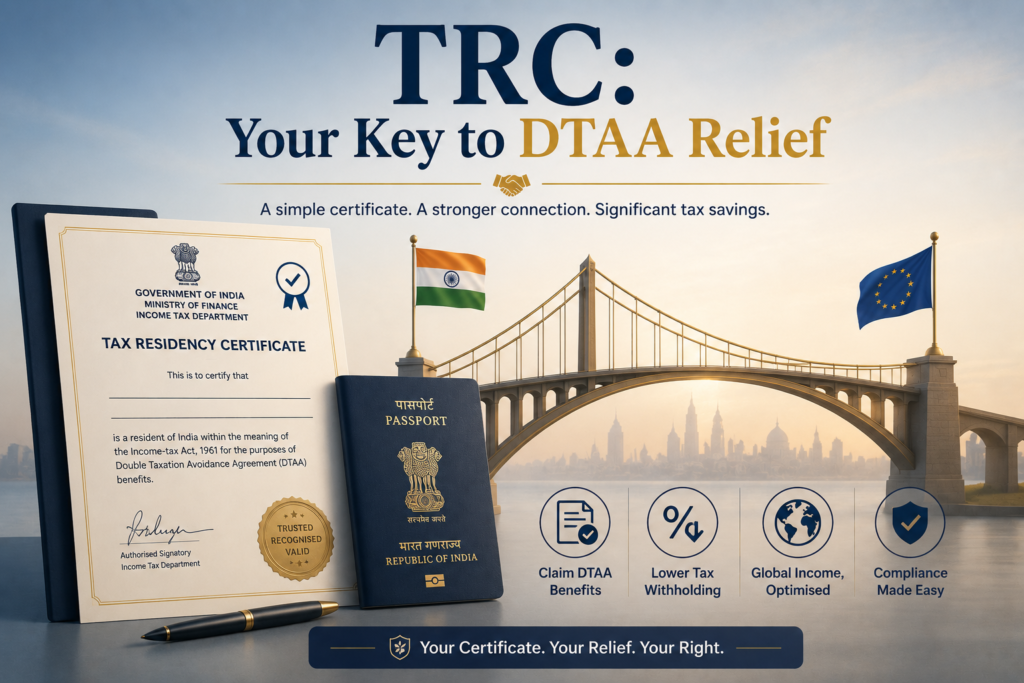
If you are an NRI expecting to pay less tax in India because of a treaty between India and your country of residence, there is one document standing between you and that benefit. A tax residency certificate NRI investors often hear about — but rarely understand — is not optional paperwork. It is the legal precondition for claiming relief under a Double Taxation Avoidance Agreement (DTAA), the treaty that stops the same income from being taxed twice. Without it, the Indian tax system simply treats you as if no treaty exists. This post explains what the certificate is, why it matters so much, and how to use it correctly.
Quick answer
No TRC, no DTAA benefit — it is that simple. A tax residency certificate proves you are a tax resident of the country you claim to live in, and it is the gateway to lower treaty rates on Indian income such as interest, dividends, or capital gains.
Before acting, check:
- That the TRC is issued by your country of residence, not requested from India.
- That it covers the relevant financial year.
- Whether you also need to file Form 10F in India alongside it.
What a tax residency certificate actually is
A tax residency certificate, or TRC, is a document issued by the tax authority of the country where you live, confirming that you are a tax resident there for a given period. DTAA, the Double Taxation Avoidance Agreement, is a treaty India signs with other countries so the same income is not taxed twice. The TRC is the proof that connects you to a specific treaty.
The logic is straightforward. A treaty between India and, say, the UAE only helps you if you can show you are genuinely a tax resident of the UAE. The TRC is that evidence. India’s tax law requires a non-resident claiming treaty relief to obtain a TRC from the other country’s government.
Consider Arjun, an NRI working in Singapore who earns interest on an Indian fixed deposit. The India–Singapore treaty caps the tax on that interest at a lower rate than India’s domestic rate. But Arjun can only claim that lower rate if he holds a TRC from the Singapore tax authority confirming his residence there.
Why no TRC means no DTAA benefit
This is the point most NRIs miss until a higher tax is already deducted. The treaty rate is not automatic. The default is the domestic Indian rate, and the treaty rate applies only when you produce the proof.
Take a concrete example. Meera, an NRI in the UK, sells a property in India and faces tax on the capital gain. The bank or buyer deducting tax at source (TDS) will apply the domestic rate unless Meera furnishes a valid TRC and supporting documents establishing her UK residence and treaty eligibility. With the TRC, the lower treaty position can be claimed. Without it, the higher domestic deduction stands, and recovering the excess later means filing a return and waiting for a refund.
So the TRC is not a formality you sort out afterwards. It is what you put in front of the payer before the income is paid, so the correct rate is applied at the source. If you are dealing with a payer who must withhold tax, you may find it useful to read more about TDS on payments made to non-residents, because the payer’s obligation and your TRC are two sides of the same transaction.
The tax residency certificate NRI checklist: TRC and Form 10F together
A TRC alone is sometimes not enough. Indian tax law requires that the TRC contain certain particulars — your name, status, nationality, country of residence, tax identification number there, and the period covered.
If your TRC does not contain all the prescribed particulars, you must file Form 10F, a self-declaration in India that supplies the missing details. In practice, many NRIs file Form 10F regardless, because foreign TRCs frequently omit one or more of the required fields.
Form 10F is filed electronically on the Income Tax e-filing portal. This means an NRI claiming treaty relief typically needs two things working together: the TRC issued abroad, and Form 10F filed in India. The TRC establishes residence; Form 10F fills the gaps and formalises the claim within the Indian system. For the bigger picture on how treaty relief and credit for taxes paid abroad fit together, see how DTAA relief and foreign tax credit work.
Old Act, new Act, and which regime applies
The TRC requirement is a procedural condition for claiming treaty benefit, not a deduction, so the choice between the old and new tax regime does not change whether you need it. Both regimes affect only how your taxable Indian income is taxed; neither removes the TRC precondition for accessing a treaty rate.
On the law itself: the requirement that a non-resident obtain a TRC to claim treaty relief, and the Form 10F mechanism, exist under the Income Tax Act 1961 and continue in substance under the Income Tax Act 2025. The framework — that treaty access depends on proving foreign residence — has been carried forward. The exact section and rule numbering under the 2025 Act should be confirmed against the current bare Act before relying on a specific reference, rather than assumed to be unchanged.
One related point worth flagging: holding a TRC does not by itself settle whether you are a non-resident under Indian law. Your Indian residential status is decided by the day-count tests, separately from your foreign TRC. The two are different questions, and you can read more about determining your residential status as an NRI if you are unsure which side of the line you fall on.
How to obtain and use your TRC
The practical sequence is to secure the certificate abroad first, then formalise the claim in India before the income is paid.
In short: request the certificate from your resident-country tax office well before you expect Indian income, file Form 10F online to supply any missing particulars, and hand both to the bank, buyer, or company deducting tax so the treaty rate is applied at source rather than recovered later.
When a tax residency certificate NRI relief will not apply
A TRC is powerful, but it is not a universal shield. Step back in these situations.
If the income in question is not covered by the relevant treaty, or the treaty does not actually offer a lower rate for that income type, the TRC changes nothing — there is no benefit to unlock.
If your TRC is for the wrong period — for instance, it covers a different financial year than the one in which the income arose — it will not support the claim. TRCs are time-bound, and a stale certificate is treated as no certificate.
If you cannot genuinely establish that you are a tax resident of the other country, obtaining a TRC by overstating your position invites scrutiny. Treaty benefit rests on real residence, not paperwork alone, and anti-abuse provisions can deny relief where the arrangement lacks substance.
Finally, a TRC does not exempt you from filing an Indian return where one is otherwise required. Claiming the treaty rate and meeting your filing obligations are separate duties.
Quick checklist for claiming DTAA relief
📋 Keep these ready:
- A valid TRC from your country of residence, covering the correct financial year.
- Form 10F, filed on the Income Tax e-filing portal, supplying any particulars missing from the TRC.
- Your foreign tax identification number and proof of foreign residence.
- Details of the Indian income and the treaty article you are relying on.
- A copy furnished to the payer (bank, buyer, or company) before the income is paid out.
Final takeaway
The single idea to carry away is that the treaty rate is never automatic — it is unlocked by proof. For an NRI, that proof is the tax residency certificate, usually paired with Form 10F. Secure both before the income is paid, match the TRC to the right financial year, and hand them to whoever is deducting tax. Treat the TRC as a precondition you arrange in advance, not a document you scramble for after a higher tax has already been withheld.
TRC or DTAA-related confusion, or need expert help establishing your treaty eligibility and filing Form 10F correctly? eTaxMate can help you review your situation, identify what applies to you, and handle filing or compliance correctly.
This blog post is for general information only and does not constitute professional advice. Tax laws are subject to change and their application depends on individual facts and circumstances. Readers should consult a qualified professional before taking any action based on this content. eTaxMate accepts no liability for any action taken based on the information in this post.
Frequently Asked Questions
1. What is a tax residency certificate and why does an NRI need it?
A tax residency certificate, or TRC, is a document from your country of residence confirming you are a tax resident there. An NRI needs it to claim relief under a Double Taxation Avoidance Agreement. Without a valid TRC, India applies its domestic tax rate and the lower treaty rate cannot be claimed on Indian income.
2. Can an NRI claim DTAA benefit without a TRC?
No. The TRC is a legal precondition for treaty relief. Without it, the payer deducting tax in India will apply the domestic rate, not the treaty rate. You may be able to recover excess tax later by filing a return, but that means waiting for a refund instead of paying the correct rate upfront.
3. Do I need Form 10F if I already have a TRC?
Often, yes. Indian law requires the TRC to contain specific particulars such as your tax identification number, status, and period of residence. If your foreign TRC omits any of these, you must file Form 10F on the Income Tax e-filing portal to supply them. Many NRIs file Form 10F regardless, since foreign certificates frequently miss a required field.
4. Does a TRC decide whether I am an NRI under Indian law?
No. Your residential status in India is determined by the day-count tests, separately from any foreign TRC. A TRC proves you are a tax resident abroad for treaty purposes, but it does not by itself settle your status under Indian tax law. These are two distinct questions and should be checked independently.
5. How long is a TRC valid for claiming treaty relief?
A TRC is time-bound and covers a specific period, usually a financial year. A certificate for one year does not automatically cover the next. If your TRC covers the wrong period for the income you earned, it will not support the claim, so you need a valid certificate matching each year you seek treaty relief.
6. Does choosing the old or new tax regime affect the TRC requirement?
No. The TRC is a procedural condition for accessing a treaty rate, not a deduction. The regime choice affects only how your taxable Indian income is taxed. Neither the old nor the new regime removes the need for a valid TRC to claim DTAA relief on Indian income such as interest, dividends, or capital gains.