
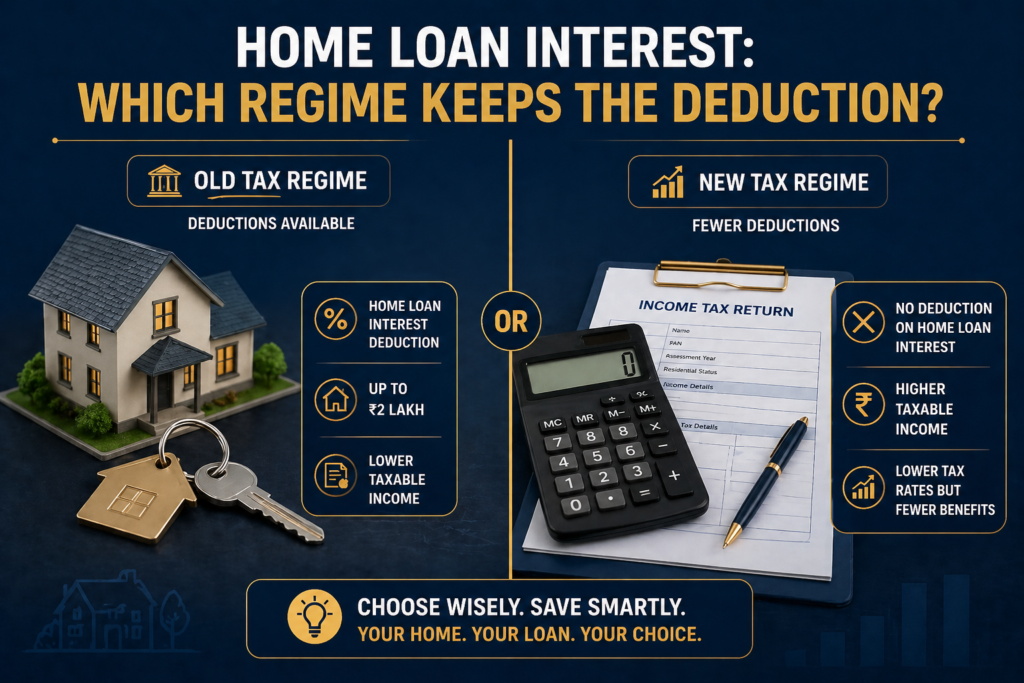
If you took a home loan expecting the interest to give you a tax break, the answer now depends entirely on which regime you pick. Many salaried borrowers still believe the home loan interest deduction is automatic — pay the EMI, claim the interest, save tax. That stopped being true the moment the new tax regime became the default. The deduction has not been deleted from the law; it has been quietly narrowed depending on which regime you choose and what kind of property you own. This post sorts out exactly what is left.
Quick answer
Under the old regime you can claim up to ₹2 lakh of home loan interest on a self-occupied house. Under the new regime that deduction is gone for self-occupied property — but interest on a let-out property is still allowed against rental income.
Before deciding, check:
- Is the property self-occupied or let out?
- Which regime are you currently in for this financial year?
- Are you also claiming Section 80C, HRA, or 80EEA — because the regime affects all of them together?
How the home loan interest deduction works under Section 24(b)
The home loan interest deduction sits under Section 24(b) of the Income Tax Act 1961. It allows you to reduce your taxable income by the interest you pay on a loan taken to buy, build, repair, or reconstruct a residential property. The principal repayment is a separate matter and falls under Section 80C — that is a different deduction with its own limit.
For a self-occupied house — the one you actually live in — the maximum interest you can claim is ₹2 lakh in a financial year, provided the construction is completed within 5 years from the end of the financial year in which the loan was taken. If construction takes longer, the cap drops to ₹30,000.
For a let-out house — one that you rent out — there was historically no cap on interest deduction against rental income. That changed in 2017. Now, the loss from house property that you can set off against your other income (like salary) in a given year is capped at ₹2 lakh, with the unabsorbed loss carried forward for up to 8 years.
What changes in the new tax regime
This is where the big shift happens, and where most readers get caught out. The new tax regime under Section 115BAC — which became the default option from FY 2023-24 onwards — strips out most of the deductions and exemptions in exchange for lower slab rates. The home loan interest deduction is one of the biggest casualties.
Under the new regime:
- For a self-occupied property, the home loan interest deduction is not available. Zero. The ₹2 lakh limit under Section 24(b) does not apply.
- For a let-out property, interest is still deductible against rental income, but with a critical restriction — the loss from house property cannot be set off against salary or other heads of income in the new regime. It can only be carried forward.
The old regime, by contrast, retains the full Section 24(b) benefit for both self-occupied and let-out property, and allows the ₹2 lakh house-property loss set-off against salary income.
So the headline question — does the home loan interest deduction survive the new regime? — has a two-part answer. For self-occupied property, no. For let-out property, partly — the deduction exists but the set-off mechanics are crippled.
The let-out property carve-out that most people miss
This is the nuance that changes the regime calculation for landlords and investor-buyers. If you own a second home and have rented it out, the new regime still permits you to deduct interest paid on the loan for that property — but only against the rental income from that same property.
Picture a Pune-based salaried professional, Priya, with a self-occupied flat (loan interest ₹1.8 lakh) and a let-out flat (loan interest ₹3.5 lakh, rent ₹1.8 lakh). Under the old regime she gets a full ₹2 lakh deduction on the self-occupied flat, plus a house-property loss from the let-out flat that she can use to reduce her salary income (capped at ₹2 lakh). Under the new regime she loses the ₹2 lakh self-occupied deduction entirely, and the let-out loss cannot be set off against salary — only carried forward to be set against future rental income.
The let-out interest deduction therefore exists on paper in the new regime, but its practical value is far lower because it cannot reduce your salary tax in the year you incur it.
Section 80EE and 80EEA: the additional deductions
Two additional deductions historically helped first-time and affordable-housing buyers:
- Section 80EE allowed up to ₹50,000 of additional interest deduction for first-time homebuyers, subject to loan and property value caps. It was time-bound and applied to loans sanctioned in specific earlier windows.
- Section 80EEA allowed up to ₹1.5 lakh of additional interest deduction for affordable-housing buyers, on loans sanctioned between 1 April 2019 and 31 March 2022.
Both are available only under the old regime. Both are closed for new loans — but if your loan was sanctioned in the eligible window, you continue to claim under the original section as long as you remain in the old regime. Switching to the new regime ends the benefit immediately.
How to decide between old and new regime when you have a home loan
The decision is not just about the home loan. It is about your full deduction stack — and the broader old vs new tax regime comparison covers how every deduction interacts with the slab rates. The home loan is one input among many. Here is the practical decision path.
Variations on this main path
- Under-construction property: Pre-construction interest is deductible in 5 equal instalments starting from the year construction is completed — but only in the old regime for self-occupied use.
- Joint home loan: Each co-borrower who is also a co-owner can claim the deduction separately, up to ₹2 lakh each in the old regime, on the interest they actually pay.
- Loan from family or friends: Section 24(b) allows interest paid to any lender, but you must have a written loan agreement and a certificate showing interest paid. Section 80C principal deduction, however, is limited to loans from specified institutions only.
When you should not assume the old regime is automatically better
A home loan does not automatically tilt the math toward the old regime. Several situations flip the answer:
- Your total deductions are modest. If your home loan interest is ₹1 lakh, your Section 80C is ₹1 lakh, and you have no HRA or NPS, the new regime’s lower slabs may still give a lower overall tax than the old regime even after losing the home loan deduction.
- You are in a higher slab and have significant other deductions. Here the old regime usually wins, but only after running the numbers — not by assumption.
- Your home loan is in the final years. The interest component of the EMI shrinks every year. A loan in its 18th year may have less than ₹50,000 of interest, which barely moves the needle in either regime.
- The property is fully let out and you cannot use the loss against salary. In the new regime the carry-forward of house-property loss has limited value if you do not expect strong rental income in future years.
- You are switching jobs or claiming HRA. HRA is also unavailable in the new regime. If you are claiming both home loan interest (for a property in your home town) and HRA (for the city you work in), the old regime is generally the only way to claim both.
Documents to keep ready
- Home loan interest certificate from the lender, showing principal and interest split for the financial year
- Loan sanction letter and EMI schedule
- Possession certificate or completion certificate (for the 5-year construction window check)
- Property ownership documents (sale deed, allotment letter)
- Co-borrower and co-owner details, if claiming jointly
- Rent agreement and rental receipts, if the property is let out
- Form 16 from your employer reflecting the regime opted for and any deductions already considered
- Previous year’s return, to verify regime continuity and any carried-forward house-property loss
Final takeaway
The home loan interest deduction has not vanished, but it has become regime-sensitive in a way that catches most salaried borrowers off guard. Self-occupied interest is fully alive in the old regime and fully gone in the new regime. Let-out interest survives in both regimes, but the set-off against salary is restricted under the new one. The right answer is never “old regime because I have a home loan” — it is the regime that wins after totalling every deduction you actually claim against the slab savings the new regime offers.
Confused about whether your home loan interest is worth keeping the old regime for, or unsure how the let-out property carve-out applies to your situation? eTaxMate can help you compare both regimes on your actual numbers and file correctly.
This blog post is for general information only and does not constitute professional advice. Tax laws are subject to change and their application depends on individual facts and circumstances. Readers should consult a qualified professional before taking any action based on this content. eTaxMate accepts no liability for any action taken based on the information in this post.
Frequently Asked Questions
1. Is home loan interest deduction available in the new tax regime?
For a self-occupied property, no — the Section 24(b) deduction of up to ₹2 lakh is not available in the new regime. For a let-out property, interest is still deductible against rental income, but any resulting house-property loss cannot be set off against salary in the new regime. It can only be carried forward to future years to be adjusted against rental income.
2. How much home loan interest can I claim in the old regime?
Up to ₹2 lakh per financial year for a self-occupied property under Section 24(b), provided construction is completed within 5 years from the end of the financial year in which the loan was taken. If construction takes longer, the limit drops to ₹30,000. For a let-out property, the full interest is deductible against rental income, with the resulting loss capped at ₹2 lakh for set-off against salary.
3. Can both husband and wife claim home loan interest separately?
Yes, if both are co-borrowers on the loan and co-owners of the property. Each can claim the interest they actually pay, up to ₹2 lakh per person in the old regime for a self-occupied house. The deduction is based on actual interest paid by each person, supported by the lender’s interest certificate. This effectively doubles the family-level deduction to ₹4 lakh.
4. Does Section 80EEA still work in the new regime?
No. Section 80EEA, which gave first-time affordable-housing buyers an additional ₹1.5 lakh interest deduction, is available only in the old regime. The benefit is also closed for new loans — only borrowers whose loans were sanctioned between 1 April 2019 and 31 March 2022 can continue to claim, and only as long as they stay in the old regime. Switching to the new regime ends the benefit.
5. Can I switch between old and new regime every year if I have a home loan?
Salaried taxpayers without business income can choose the regime each financial year. Taxpayers with business or professional income face restrictions on switching back to the new regime once they opt out. A home loan does not by itself lock you into either regime, but the regime you pick changes whether you can claim the home loan interest deduction that year.
6. What happens to the home loan interest deduction for an under-construction property?
Interest paid during the construction period — pre-construction interest — is not deductible in the year it is paid. It is aggregated and allowed in 5 equal annual instalments starting from the financial year in which construction is completed. This benefit is available only in the old regime for self-occupied property. The total claim, including current-year interest, still cannot exceed ₹2 lakh per year for a self-occupied house.