
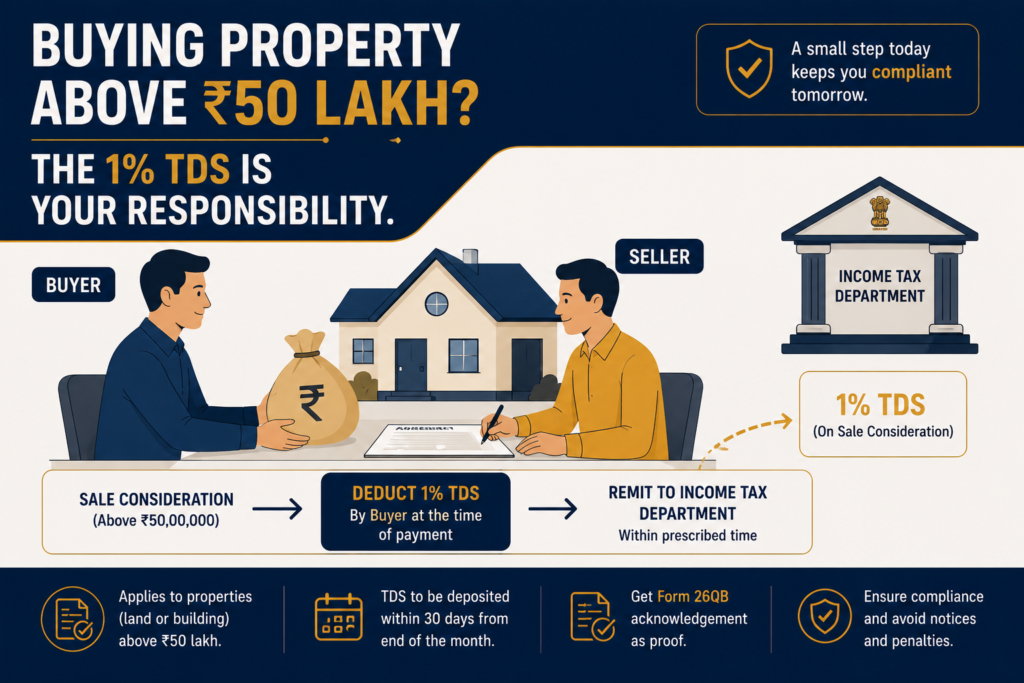
Buying a property above ₹50 lakh in India assigns a tax compliance task directly to you, the buyer. The seller receives less than the full consideration — you pay the difference to the government. That obligation is Section 194IA TDS on property of the Income Tax Act 1961. Missing it does not remove the liability — it grows it, with interest and penalties that can exceed ₹1 lakh on a single transaction.
Quick answer
Under Section 194IA, the buyer of immovable property (other than agricultural land) valued at ₹50 lakh or more must deduct 1% TDS from each payment to the seller and deposit it using Form 26QB within 30 days from the end of the month of deduction. No TAN needed — the buyer’s PAN is used. Form 16B (the TDS certificate) must reach the seller within 15 days of the Form 26QB due date.
Before acting, check:
- Is the total consideration, or the stamp duty value, ₹50 lakh or more? Both must be compared.
- Is the seller a resident of India? If not, Section 195 applies — not Section 194IA.
- Is the purchase in instalments? TDS applies on each payment, including the first token.
What Section 194IA requires the buyer to do
Section 194IA requires the buyer — the deductor — to deduct TDS from each payment to the seller, deposit it with the government, file Form 26QB for each payment, and issue Form 16B to the seller. This sits entirely with the buyer. The seller, builder, and sub-registrar play no part in it.
One feature that makes this section distinctive: no TAN is needed. It is the only TDS provision where the buyer’s own PAN is used in Form 26QB.
A note on the Income Tax Act 2025: For transactions where first payment or credit occurred on or before 31 March 2026, Section 194IA, Form 26QB, and Form 16B apply. From 1 April 2026, the equivalent provision is Section 393(1) of the Income Tax Act 2025 — Form 141 (Schedule B) and Form 132. The mechanics are identical: 1% deduction, 30-day deposit, 15-day certificate. This post uses Section 194IA / Form 26QB language throughout.
When exactly does the 1% TDS apply
Three conditions determine whether Section 194IA is triggered.
Total transaction value above ₹50 lakh. The threshold applies to the aggregate consideration for the property. Two joint buyers each paying ₹30 lakh on a ₹60 lakh property must still deduct TDS — the total crosses ₹50 lakh. The per-buyer share is irrelevant.
Property other than agricultural land. Flats, houses, plots, commercial units, and under-construction property are covered. Agricultural land as defined under the Income Tax Act is excluded.
Seller is a resident of India. If the seller is an NRI, Section 194IA does not apply.
TDS must be deducted at the time of payment or credit to the seller, whichever is earlier. In instalment-based purchases — including under-construction flats with stage-linked payments — TDS applies on every instalment. The token advance paid at booking is also part of the consideration: if total value exceeds ₹50 lakh, TDS must be deducted from that first payment too.
Calculating the right TDS amount: the stamp duty rule
Since the Finance Act 2022, the TDS base is the higher of:
- The actual sale consideration (the agreement amount), or
- The stamp duty value of the property (the state government’s assessed value)
If the agreement says ₹55 lakh but the stamp duty value is ₹70 lakh, TDS is deducted on ₹70 lakh — giving TDS of ₹70,000 rather than ₹55,000. Always obtain and compare both figures before making the first payment.
The rate is a flat 1%, with no cess or surcharge. All buyer types — individuals, HUFs, companies — use the same rate.
One critical exception: if the seller does not furnish a valid PAN, the rate rises to 20% under Section 206AA. On a ₹70 lakh property that means ₹14 lakh in TDS instead of ₹70,000. Confirm the seller’s PAN is active and correctly linked to their name before any payment is made.
What Vikram and Sunita’s case shows you
Vikram and Sunita are purchasing a flat in Pune for ₹85 lakh from one resident seller. Stamp duty value: ₹78 lakh. TDS base is ₹85 lakh (the higher of the two). Total TDS: ₹85,000.
The builder’s payment schedule: ₹20 lakh at booking, ₹40 lakh at slab level, ₹25 lakh at possession. Two joint buyers, one seller → two Form 26QBs per instalment. Six Form 26QB filings in total.
At booking: each deducts ₹10,000 (1% of their ₹20 lakh share) and files Form 26QB within 30 days from month-end. Same at slab level (₹20,000 each) and possession (₹12,500 each). After each filing, they download Form 16B from TRACES and hand it to the seller within 15 days of the Form 26QB due date. Total TDS deposited: ₹85,000, across six filings.
Each instalment has its own 30-day Form 26QB window. Missing even one attracts ₹200 per day under Section 234E — the timing discipline applies to every stage payment, not just registration.
The three-step compliance process: deduct, deposit, certify
Step 1 — Deduct TDS at the time of each payment. On the payment date, retain 1% from the consideration. Do not pay the seller the full amount.
Step 2 — Deposit using Form 26QB within 30 days from end of the month. Log in to the income tax e-filing portal (e-File → e-Pay Tax → TDS on Sale of Property). You will need: both parties’ PAN, property details, payment amount, and stamp duty value. Pay by net banking or debit card — a challan with a CIN is generated. In a joint purchase, each buyer files a separate Form 26QB for each seller.
Step 3 — Issue Form 16B to the seller within 15 days of the Form 26QB due date. After TDS reflects in the system (typically 2–5 working days), log in to TRACES and download Form 16B. Hand it to the seller. Without it, TDS credit does not appear in the seller’s Form 26AS, and they cannot claim it in their ITR.
Key compliance facts at a glance
Here is a reference infographic covering the critical parameters of Section 194IA compliance in one view.
When Section 194IA does not apply — and what does instead
The seller is an NRI. Section 194IA applies only to resident sellers. If the seller is an NRI, Section 195 governs — TDS rates are 20%–30% on capital gains (before surcharge and cess), TAN is mandatory for the buyer, and the filing route is Form 27Q. Get the seller’s residential status declaration in writing before signing any agreement.
If the seller is an NRI, the compliance framework is entirely different — our post on NRI selling property in India covers the Section 195 rules and why you need a TAN before any payment.
The property is agricultural land. Section 194IA explicitly excludes agricultural land. Verify the classification before assuming exemption.
The transaction value is below ₹50 lakh. No TDS obligation. However, property purchases above ₹30 lakh are reported to the department by the sub-registrar as a Specified Financial Transaction — our post on high-value transactions and AIS explains how that reporting works.
Common mistakes buyers make
Not deducting TDS on the token advance. TDS applies from the first payment once total consideration exceeds ₹50 lakh. A ₹5 lakh token on an ₹80 lakh flat requires ₹5,000 TDS at booking, with Form 26QB filed within 30 days of that month-end.
Using sale consideration instead of stamp duty value. Post Finance Act 2022, TDS is computed on the higher of the two. Buyers who ignore a higher stamp duty value under-deduct and face interest and penalty on the shortfall.
Filing one Form 26QB for joint ownership. Each buyer must file a separate Form 26QB for each seller. Two buyers from a husband-and-wife joint sale = four Form 26QBs per instalment.
Missing the 30-day deadline on an intermediate instalment. Each instalment has its own window. Missing one triggers ₹200/day under Section 234E for that specific filing.
Not handing Form 16B to the seller. Without it, the seller cannot claim TDS credit in their ITR.
The seller’s side involves computing capital gains — our post on capital gains on property sale covers how that calculation works and which exemptions apply.
Documents to keep ready
- Sale agreement and registration deed showing the agreed consideration
- Stamp duty valuation certificate from the state authority (for the TDS base comparison)
- Seller’s PAN card copy — verified against the PAN database before payment
- Seller’s residential status declaration (resident or NRI) in writing
- Challan receipts (CIN numbers) for each Form 26QB filing
- Form 16B downloaded from TRACES for each payment — one per filing, given to the seller
- Bank transaction records showing the exact date and amount of each payment to the seller
Final takeaway
Section 194IA is a buyer obligation that cannot be delegated. The 1% rate is modest — the penalties for ignoring it are not. On an ₹80 lakh property, missing TDS entirely can cost ₹80,000 under Section 271C plus interest from the date of the first payment. The compliance sequence is clear: confirm seller residency, compare sale consideration against stamp duty value, deduct on each instalment from the token onwards, file Form 26QB within 30 days per instalment, and issue Form 16B to the seller within 15 days. Getting this sequence right protects both the buyer’s tax record and the seller’s ability to claim TDS credit.
Buying property above ₹50 lakh and unsure whether your Form 26QB is correctly filed, or whether your TDS base accounts for the stamp duty rule? eTaxMate can verify your calculation, file Form 26QB for each instalment, and ensure Form 16B reaches the seller on time.
This blog post is for general information only and does not constitute professional advice. Tax laws are subject to change and their application depends on individual facts and circumstances. Readers should consult a qualified professional before taking any action based on this content. eTaxMate accepts no liability for any action taken based on the information in this post.
Frequently Asked Questions
1. Who is responsible for deducting TDS when buying property in India?
The buyer is fully responsible for deducting TDS under Section 194IA. The seller, builder, and sub-registrar have no obligation to deduct it on the buyer’s behalf. The buyer must also file Form 26QB and issue Form 16B to the seller — both tasks fall entirely on the buyer. Failure to comply attracts interest, late fees, and a penalty under Section 271C equal to 100% of the TDS amount.
2. Do I need a TAN to deduct TDS on property purchase?
No. Section 194IA is the only TDS provision in India where the deductor does not need a Tax Deduction Account Number. The buyer uses their own PAN while filing Form 26QB on the income tax e-filing portal. However, if the seller is an NRI — which shifts the applicable section to Section 195 — a TAN becomes mandatory for the buyer.
3. When must I deduct TDS if I am buying property in instalments?
TDS must be deducted on each instalment at the time of payment, not just at final payment or registration. If the total consideration is above Rs 50 lakh, even the token advance paid at booking requires TDS deduction. A separate Form 26QB must be filed for each instalment within 30 days from the end of the month in which that payment was made.
4. What is the TDS rate under Section 194IA?
The rate is 1% of the TDS base — flat, with no cess or surcharge. The TDS base is the higher of the actual sale consideration or the stamp duty value of the property. This comparison rule was introduced by the Finance Act 2022. If the seller does not provide a valid PAN, the rate rises to 20% under Section 206AA.
5. Does Section 194IA apply if the seller is an NRI?
No. Section 194IA applies only when the seller is a resident of India. When buying from an NRI, Section 195 applies — the TDS rates are significantly higher (20%–30% on capital gains, before surcharge and cess), a TAN is mandatory, and a different form (Form 27Q) is used. Misidentifying an NRI seller as a resident is one of the most costly errors in property transactions.
6. We are two joint buyers purchasing from one seller. How many Form 26QBs do we file?
Each buyer must file a separate Form 26QB for each seller. With two joint buyers and one seller, that is two Form 26QBs per instalment — one for each buyer’s proportionate share. With two buyers and two sellers (for example, a husband-and-wife joint ownership), that becomes four Form 26QBs per instalment. The Rs 50 lakh threshold is tested on the total transaction value, not on each buyer’s individual share.