
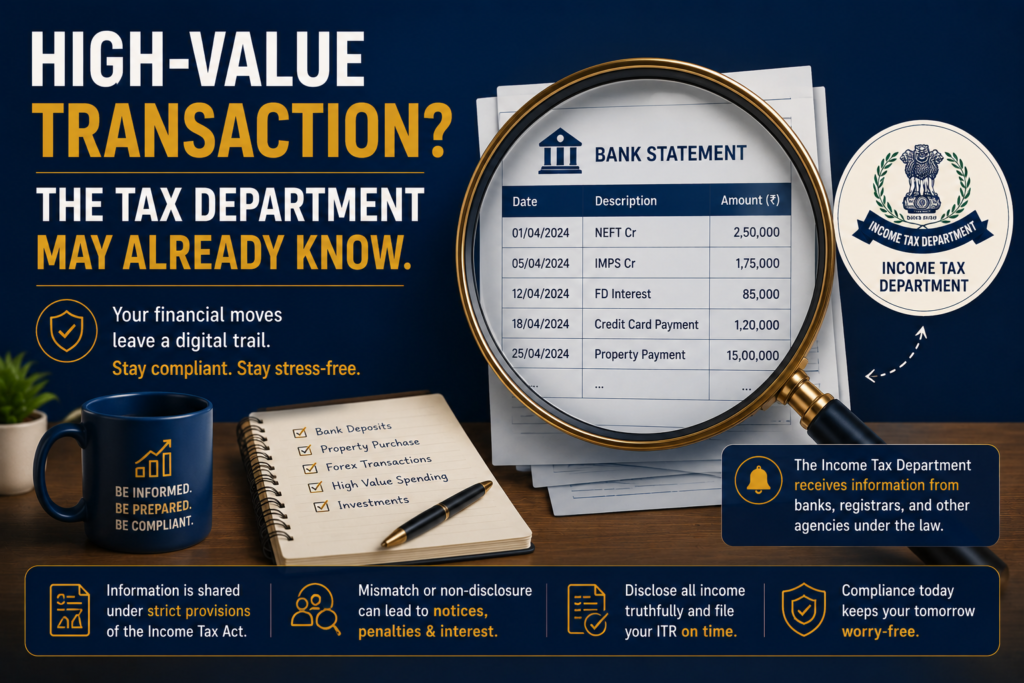
If you have made a high value transaction this year — sold property, made a big cash deposit, invested heavily in mutual funds, or spent heavily on a credit card — the Income Tax Department may already have that data. Not from anything you filed, but from what your bank, registrar, or broker filed about you. This post explains which transactions trigger that reporting, what the department does with mismatches, and how to get ahead of a notice before one arrives.
Quick answer
Transactions above specified thresholds are reported to the Income Tax Department by banks, registrars, mutual fund houses, and others under Section 285BA of the Income Tax Act 1961. This data appears in your Annual Information Statement (AIS). A mismatch between the AIS and your ITR triggers an e-campaign advisory, and escalates to a notice under Section 133(6) or Section 143(2) if left unaddressed.
Before acting, check:
- Have you downloaded your AIS and matched every entry against your ITR?
- Are any entries wrong or mislinked? Submit AIS feedback before filing.
- If income linked to a large transaction was not declared, is the ITR still within the revision window?
The system already knows: how the department tracks transactions
The Statement of Financial Transactions (SFT) is a mandatory reporting mechanism under Section 285BA of the Income Tax Act 1961, administered through Rule 114E. Banks, post offices, registrars, mutual fund houses, stock exchanges, and other specified entities file details of high-value transactions in Form 61A by 31 May of the following financial year. That data feeds directly into your Annual Information Statement (AIS), accessible on the income tax e-filing portal under Services → Annual Information Statement.
The starting point for any taxpayer worried about high-value transactions is the AIS itself — our post on how to read and use your AIS explains what each section shows and how to cross-check it before filing.
The core implication: the department does not wait for you to volunteer information about a large transaction. The reporting entity already filed it. A mismatch between the AIS and your ITR is a data comparison the system runs automatically.
Which transactions cross the reporting threshold
Not every financial transaction is reported — only those above prescribed thresholds. The current thresholds under Rule 114E include the following. All thresholds are aggregated across all accounts under the same PAN at the reporting entity.
Here is a quick-reference infographic of the key thresholds, with the reporter for each.
Two things worth noting about this table. First, the thresholds are aggregated by PAN — meaning two savings accounts at the same bank, each with ₹6 lakh in cash deposits, together cross the ₹10 lakh trigger. Second, dividends, capital gains distributions, and interest income have no minimum threshold — every rupee is reported. This means even a modest mutual fund redemption appears in your AIS.
What a high value transaction notice actually is
“High value transaction notice” is not a single statutory type — it is shorthand for several notices that can follow an AIS-ITR mismatch. The escalation path:
E-campaign advisory: A system-generated email or SMS from the compliance portal flagging a potential mismatch. Not a formal notice. No penalty. An invitation to correct voluntarily.
Section 133(6): A formal request for information or documents. Typically follows when an e-campaign advisory goes unanswered, or the mismatch needs documentary proof to resolve.
Section 143(2): A scrutiny notice selecting your return for detailed examination. Issued within three months from the end of the financial year in which the return was filed. Can lead to income additions if the assessing officer is not satisfied.
Section 148A / 148: A reassessment notice for cases where income is believed to have escaped assessment — usually involving large undisclosed transactions in prior years. Section 148A requires the department to hear you before issuing the formal 148 notice.
Responding at the e-campaign stage almost always closes the matter. Ignoring it escalates it.
What Rahul’s case shows you
Rahul is a 42-year-old government employee in Lucknow earning ₹11 lakh per year. His father passed away in FY 2024-25, and Rahul received ₹18 lakh from the family property sale. He deposited ₹12 lakh in his savings account and invested ₹8 lakh in mutual funds.
Both cross SFT thresholds. His bank reports the ₹12 lakh cash deposit. His mutual fund house reports the ₹8 lakh investment. Both entries appear in his AIS.
Rahul files his ITR declaring only his salary — he assumes inherited proceeds are “not income.” The system compares: AIS shows ₹20 lakh in activity beyond salary; ITR shows nothing. Mismatch flagged.
The correct position: inherited property is not taxable income, but a property sale above ₹30 lakh is SFT-reported by the registrar, and capital gains on the sale must be declared in Schedule CG. The deposit source must be reconcilable, and the mutual fund investment traced to legitimate funds. All manageable — but only if addressed at filing time rather than in response to a notice.
The AIS feedback loop: your first line of response
Before responding to any notice, check whether the AIS entry itself is accurate. SFT data is filed by third parties, and errors occur — duplicate entries, wrong PAN linkages, amounts in the wrong year.
The AIS portal offers four feedback options for each entry: “Information is correct”, “Information is not related to me”, “Information is partially correct”, and “Duplicate information.” Submitting feedback records your version with the department and typically updates the Taxpayer Information Summary (TIS) — the modified AIS view that feeds into pre-filled ITR data.
If the entry is correct and the income was not declared, the cleaner path is a revised return under Section 139(5) if the revision deadline has not passed. Voluntary correction at this stage usually avoids formal notice proceedings.
Cryptocurrency transactions now appear in AIS through 1% TDS under Section 194S and, from AY 2026-27, through mandatory SFT reporting — our post on crypto tax reporting covers how to disclose these in your ITR.
What happens after a notice arrives
Section 133(6): Respond through the e-Proceedings tab on the income tax portal (e-File → e-Proceedings → View Notices). Attach the relevant documents — bank statements, property sale agreement, mutual fund statements, gift deed, inheritance documents. Respond within the deadline stated in the notice.
Section 143(2): Respond with a full explanation of the transaction — source of funds, nature of income, and how it was treated in the return. If income was not disclosed, consider whether an updated return under Section 139(8A) (the ITR-U mechanism) applies. Under-reporting can attract tax, interest under Sections 234A/234B/234C, and penalty under Section 270A.
Section 148A: Respond to the show-cause notice with documented evidence before the order is passed. If the department issues a Section 148 notice despite the response, a fresh return for that year will need to be filed.
All notices can be verified for authenticity on the income tax portal under the e-Proceedings or notice-tracking section. Do not respond to notices received only by email without portal verification.
When a transaction is genuinely large but fully explainable
Receiving an e-campaign advisory or a Section 133(6) notice does not mean something is wrong. What the system flags is an AIS-ITR mismatch — not a legal judgment. Many large transactions are entirely legitimate, provided they are disclosed.
Common situations where SFT-reported transactions create no tax liability if correctly declared:
- Inherited or gifted money deposited in a bank: Not taxable, but the deposit triggers an SFT entry. Disclose the source with a gift deed or will. Any property sale above ₹30 lakh must separately appear in Schedule CG.
- Mutual fund redemptions within the exemption limit: AIS shows full redemption value. The ITR must show the capital gain computation, even where the gain is within the ₹1.25 lakh long-term exemption under Section 112A.
- Property sale with Section 54 reinvestment: The gain may be exempt, but the transaction must be declared. The registrar files an SFT entry regardless.
- Salary deposits aggregating above ₹10 lakh: Already covered by Form 16 and the ITR. The AIS entry is consistent with the return — no additional action needed.
A notice that causes a revised return or tax demand can also delay a pending refund — our post on income tax refund delays explains what to do.
Documents to keep ready
- AIS and TIS downloaded from the e-filing portal for the current and prior financial years
- Bank statements covering the full financial year, cross-checked against AIS entries
- Property sale agreement, registration deed, and capital gains computation for property transactions
- Mutual fund statement of account and broker contract notes for equity transactions
- Gift deed or will extract for any inherited or gifted amounts deposited
- Forex purchase receipts or travel card statements if foreign exchange was transacted
- Any prior e-campaign advisories or compliance portal communications received
Final takeaway
The SFT and AIS framework means large financial transactions are already visible to the income tax department before you file your return. The high value transaction notice path starts with a data mismatch, not with wrongdoing. For most taxpayers, the answer is straightforward: download the AIS, check every entry, submit AIS feedback on errors, and ensure the ITR accounts for everything visible there. A transaction that is disclosed and explained — even a large one — is not a problem. A transaction visible in the AIS but missing from the ITR is.
Concerned about a high-value transaction in your AIS, or received an e-campaign advisory or formal notice? eTaxMate can review your AIS against your ITR, identify what needs correction, and handle your response to the department.
This blog post is for general information only and does not constitute professional advice. Tax laws are subject to change and their application depends on individual facts and circumstances. Readers should consult a qualified professional before taking any action based on this content. eTaxMate accepts no liability for any action taken based on the information in this post.
Frequently Asked Questions
1. What is a high value transaction notice from the income tax department?
A high value transaction notice is issued when the Income Tax Department detects a mismatch between large financial transactions reported in your Annual Information Statement (AIS) by banks and institutions, and the income declared in your ITR. It is not a single notice type — it can appear as an e-campaign advisory, a Section 133(6) information request, or a Section 143(2) scrutiny notice, depending on severity.
2. Which transactions does the income tax department track automatically?
Under Section 285BA, banks, registrars, mutual fund houses, and other institutions must report transactions above specified thresholds. Key ones: cash deposits above Rs 10 lakh in savings accounts per year, property purchases or sales above Rs 30 lakh, fixed deposits or mutual fund investments above Rs 10 lakh per year, credit card payments above Rs 10 lakh, and foreign exchange transactions above Rs 10 lakh. Dividends, capital gains, and interest have no minimum — every rupee is reported.
3. I deposited a large amount in my bank account. Will I get a notice?
Not automatically. A deposit triggers an SFT entry in your AIS, but a notice follows only if the deposit does not match your declared income. If the deposit is from a salary, a property sale already declared, an inheritance, or a gift — and those sources are reflected in your ITR or explained in the AIS feedback — the entry resolves without a notice. The trigger is unexplained mismatch, not the deposit itself.
4. What should I do if I see a wrong entry in my AIS?
Use the AIS feedback tool on the income tax e-filing portal. For each entry, you can mark it as “Information is correct”, “Information is not related to me”, “Information is partially correct”, or “Duplicate information.” This records your version with the department and updates the Taxpayer Information Summary (TIS). If the entry is yours but was not reported in your ITR, consider filing a revised return under Section 139(5) if the deadline has not passed.
5. What happens if I ignore an e-campaign advisory about high value transactions?
An e-campaign advisory is a pre-notice communication — ignoring it typically results in escalation to a formal notice under Section 133(6) requesting documents, or a scrutiny notice under Section 143(2). If income is eventually found to have been under-reported, the department can add income, levy interest under Sections 234A, 234B, and 234C, and impose penalty under Section 270A. Responding at the advisory stage is almost always less costly than responding after a formal notice.
6. I sold property and got more than Rs 30 lakh. Does the tax department know?
Yes. The sub-registrar who registers the property transaction is a mandatory SFT reporting entity. Any property purchase or sale above Rs 30 lakh is reported to the department in Form 61A. The entry will appear in both buyer’s and seller’s AIS. The seller must declare the sale in Schedule CG of the ITR, compute capital gains, and claim any applicable exemption — whether or not they received a notice asking for it.