
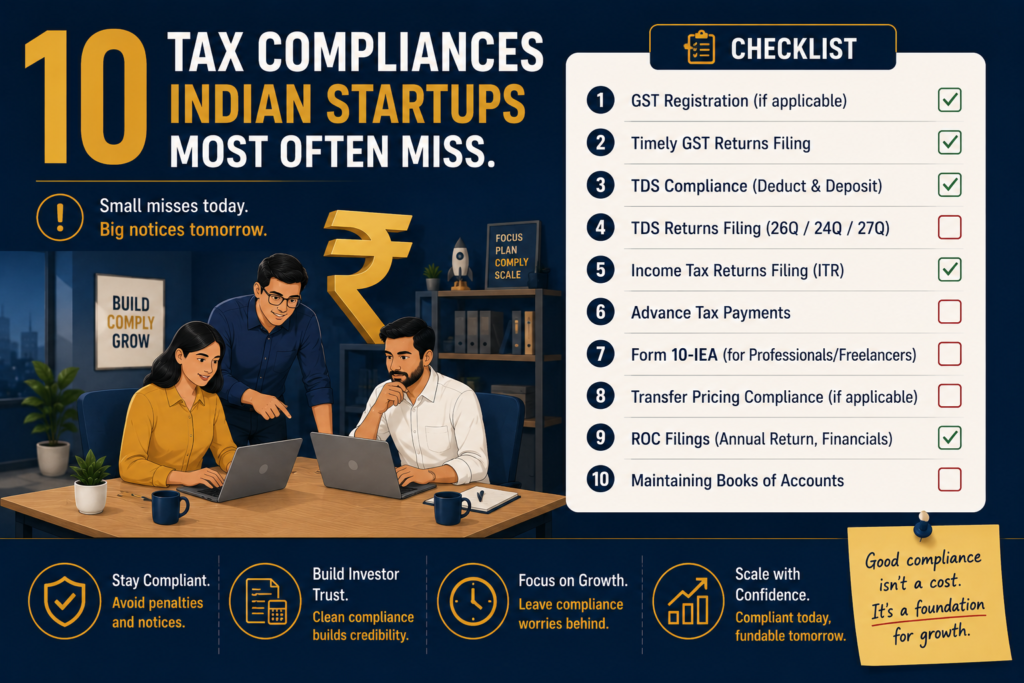
Running a business in India means managing income tax and GST simultaneously — along with labour contributions, MSME payment obligations, and a calendar full of quarterly and annual deadlines. Most startup founders know about ITR filing. Fewer know about advance tax instalments, GSTR-2B reconciliation, or what happens when they pay an MSME vendor 50 days after the invoice. Each missed obligation compounds. This post covers the 10 compliance obligations small businesses most often miss — and what the consequences look like.
Quick answer
Small business tax compliance in India spans income tax (advance tax, ITR, TDS), GST (GSTR-1, GSTR-3B, ITC reconciliation, LUT renewal for exporters), books of accounts, and labour contributions (PF, ESI). The department’s AIS and SFT systems cross-check GST, TDS, and ITR data automatically — mismatches are flagged without human intervention.
Before reading:
- Are you tracking turnover against every applicable threshold — GST registration, tax audit, advance tax?
- Are you reconciling your purchase register against GSTR-2B every month?
- Do you have a compliance calendar with all quarterly and annual due dates?
Why small businesses miss compliance — and why it compounds
The pattern is consistent: a startup files the first ITR on time and gradually falls behind on less-visible obligations. TDS not deducted because the founder did not know the vendor relationship qualified. Advance tax not paid because profitability came late in the year. ITC not reconciled monthly, so unmatched credit expired.
Interest under Section 234B/C runs at 1% per month. TDS defaults attract 1%–1.5% per month. ITC mismatches can become permanent write-offs.
GST, TDS, and ITR data are cross-checked automatically. A business that thinks everything is filed can still receive a notice months later because a supplier failed to file GSTR-1, creating an ITC mismatch in the buyer’s return.
Our post on high-value transactions and income tax notices explains how AIS-ITR mismatches trigger compliance queries.
The 10 compliance obligations most startups miss
1. Advance tax: the quarterly payment most founders forget
Advance tax applies when total tax liability for the year exceeds ₹10,000 after TDS. It is paid in four quarterly instalments — 15% by 15 June, 45% by 15 September, 75% by 15 December, and 100% by 15 March.
Missing or underpaying attracts interest at 1% per month under Sections 234B and 234C from each instalment’s due date — not from year-end.
Startups with lumpy revenue often miscalculate. A business earning 80% of income in Q4 and making no earlier advance tax payments faces interest from June onwards, even if the final payment is correct by March 15.
The right approach: estimate annual profit conservatively by May, compute the liability, pay the first instalment on time. Underpayment is correctable in later instalments — paying nothing at all is what triggers the maximum interest.
2. TDS deduction and filing
Common TDS triggers for small businesses: contractors under Section 194C (1%–2%), professional fees under Section 194J (10%), rent above ₹50,000/month under Section 194IB (5%), commission under Section 194H (5%).
Mechanics: deduct when paying, deposit by the 7th of the following month (30 April for March), file quarterly TDS returns (Form 24Q for salary, Form 26Q for non-salary), and issue Form 16A to vendors.
Missing deduction: 1% per month interest from payment date. Late deposit: 1.5% per month.
One early-stage detail: you need a TAN (Tax Deduction Account Number) to file TDS returns. Apply before making any qualifying payment — many founders discover this only after the first large vendor invoice.
3. GST return filing: monthly rhythm, permanent consequences
For GST-registered businesses, the minimum obligation is GSTR-1 (outward supplies, due 11th of the following month or quarterly under QRMP) and GSTR-3B (summary return with tax payment, due 20th). Missing these filings triggers late fees of ₹50 per day per return (₹20 for nil returns), plus interest at 18% per annum on unpaid tax.
What most founders underestimate: ITC for FY 2025-26 can only be claimed until the September 2026 GSTR-3B filing. After that, it is permanently lost. If your supplier failed to file GSTR-1 for a March 2026 transaction and does not correct it before September 2026, you lose the ITC on that purchase.
Your GSTR-1 filing also affects your customers. Delays in reporting your outward supplies directly block the ITC claims of the businesses you supply.
Before any GST items on this list become relevant, the business must be registered — our post on the GST registration threshold explains when registration is mandatory and what counts toward aggregate turnover.
4. Annual ITR in the right form
Filing the wrong ITR form results in a defective return notice. For business income:
- ITR-4 (Sugam): Individuals, HUFs, and firms (not LLPs) using Section 44AD or 44ADA presumptive taxation, within the applicable limits and no tax audit required.
- ITR-3: Individuals and HUFs with business or professional income that does not qualify for ITR-4 — above the audit threshold, with capital gains alongside business income, or opting out of presumptive schemes.
- ITR-5 / ITR-6: Firms/LLPs/AOPs, and companies respectively.
The ITR due dates for FY 2025-26 (AY 2026-27): non-audit business/profession cases — 31 August 2026 (extended from 31 July under Finance Act 2026). Tax audit cases — 31 October 2026.
Once turnover crosses ₹1 crore, the ITR must be accompanied by a tax audit under Section 44AB — our post on tax audit applicability explains the thresholds, forms, and what happens if the September deadline is missed.
5. Section 43B(h): the MSME payment rule no one reads until it hurts
Effective from April 1, 2024, Section 43B(h) makes timely payment to MSMEs a condition for the tax deduction: amounts payable to Micro or Small Enterprises not paid within the statutory timeline are deductible only in the year of actual payment.
The timeline: without a written agreement — 15 days from delivery. With a written agreement — maximum 45 days. No agreement can extend this beyond 45 days.
Meenakshi’s trading business buys ₹40 lakh in goods from MSME vendors in February 2026 under a written 45-day agreement. She pays on Day 50. All ₹40 lakh is disallowed in FY 2025-26. At 25% tax rate, the timing difference costs ₹10 lakh in immediate extra tax — recovered next year when paid, but the cash impact is now.
Unlike other Section 43B items, clause (h) does not permit deduction on an accrual basis even if paid before the ITR due date. The statutory timeline is absolute.
Practically: verify whether vendors hold Udyam registration. If they are Micro or Small enterprises, flag their invoices for payment within 15 or 45 days.
6. GST registration milestones and LUT renewal
Two GST-specific events most startups manage poorly:
Threshold monitoring: When aggregate turnover approaches ₹20 lakh (for services) or ₹40 lakh (for goods), registration must be applied for before crossing — not after. An unregistered business that crosses the limit has a liability gap for the period between crossing and registration. Track monthly.
LUT renewal: If your startup exports goods or services, the Letter of Undertaking (LUT) filed in Form RFD-11 expires every 31 March and must be renewed before the first export invoice of the new financial year. An export invoice raised without a valid LUT is taxable — IGST becomes immediately due.
If your startup exports services or goods, item 6 on this list specifically includes the LUT that must be filed before every export invoice — our post on LUT under GST covers the filing process and the cash-flow case for doing it before the first export.
7. Books of accounts under Section 44AA
Section 44AA of the Income Tax Act requires specified professions and businesses to maintain prescribed books of accounts. For businesses, the obligation arises when income exceeds ₹1.2 lakh or turnover exceeds ₹10 lakh in any of the three preceding years. For specified professionals (doctors, lawyers, architects, accountants), the obligation is independent of turnover once the profession is carried on.
The books required include cash book, journal, ledger, and copies of bills. For businesses subject to tax audit under Section 44AB, the requirement is more detailed.
What startups often miss: the book-keeping obligation applies even if the business is on the presumptive scheme under Section 44AD — you may not need to file detailed accounts, but you must maintain them if the threshold is crossed. When a tax audit is triggered (including through the presumptive scheme trap), auditors need to access properly maintained records.
8. PF and ESI: the thresholds that sneak up on growing teams
Provident Fund (PF): Registration with EPFO is mandatory for businesses employing 20 or more employees. Both employer and employee contribute 12% of basic salary (subject to the ₹15,000 wage ceiling for mandatory calculations). Monthly challan must be deposited by the 15th of the following month. Monthly ECR (Electronic Challan-cum-Return) must be filed.
ESI (Employees’ State Insurance): Mandatory for businesses with 10 or more employees where wages are up to ₹21,000 per month. Employer contributes 3.25% of wages; employee contributes 0.75%. Due by 15th of the following month.
Startups cross the 10-employee or 20-employee threshold and continue running payroll informally, not realising the registration obligation triggered at crossing. The consequence is retrospective liability — contributions owed from the month the threshold was first crossed, with interest and damages.
9. ITC reconciliation: unclaimed credit is permanent loss
Input Tax Credit (ITC) on purchases is claimable only if the supplier has filed their GSTR-1 and the credit appears in your GSTR-2B (the auto-populated statement of available ITC). If the credit does not appear in GSTR-2B, you cannot claim it in GSTR-3B — and after the September cutoff of the following financial year, the credit is permanently lost.
The monthly discipline: before filing GSTR-3B each month, reconcile your purchase register (all GST invoices received) against GSTR-2B (what suppliers have reported). Follow up with any supplier whose invoices are missing from GSTR-2B. Do not file GSTR-3B with unreconciled ITC and hope it resolves.
The compounding effect: a startup with ₹2 lakh in monthly purchases at 18% GST has ₹36,000 in potential monthly ITC. If three months of reconciliation are ignored and some suppliers are non-compliant, the lost ITC can easily reach ₹50,000–₹1 lakh in a financial year — a real cash cost.
10. Portal and digital signature upkeep
This sounds administrative, but it stops ITR and GST filings in their tracks:
DSC renewal: Authorised signatories for company, LLP, and firm filings must have a valid Digital Signature Certificate. DSCs are typically valid for two years. An expired DSC discovered on 28 October — two days before the audit-case ITR deadline — is a genuine emergency.
PAN-Aadhaar linking: The Income Tax Department has been strict about PAN inoperability when Aadhaar is not linked. An inoperative PAN can prevent e-filing, ITR processing, and TDS credit allocation. Verify status.
GST portal authorisation: New directors, partners, or authorised signatories must be updated on the GST portal. A signatory who has left the company but is still listed can create authentication issues.
E-invoicing threshold compliance: Businesses with aggregate turnover above ₹5 crore must generate e-invoices through the IRP (Invoice Registration Portal) for B2B transactions. Missing this creates GST invoice compliance issues regardless of whether GSTR-1 is filed.
Compliance calendar: when everything is due
Here is a quick-reference infographic consolidating the key deadlines for FY 2025-26 / AY 2026-27.
Final takeaway
Small business tax compliance in India is not one filing per year — it is a continuous calendar of monthly, quarterly, and annual obligations spanning two tax systems, labour law, and specific provisions like the MSME payment rule. The consequences of missing them are not limited to late fees: permanent ITC loss, carry-forward restrictions, disallowed deductions, and automated system notices months later. The businesses that stay clean are the ones with a compliance calendar and a CA who tracks deadlines before they lapse.
Overwhelmed by the volume of compliance obligations, or unsure whether you are current on advance tax, TDS, or GST returns? eTaxMate can assess your full compliance position, identify what is overdue, and handle filings across income tax and GST.
This blog post is for general information only and does not constitute professional advice. Tax laws are subject to change and their application depends on individual facts and circumstances. Readers should consult a qualified professional before taking any action based on this content. eTaxMate accepts no liability for any action taken based on the information in this post.
Frequently Asked Questions
1. What are the main tax compliance obligations for small businesses in India?
Small businesses in India must manage income tax (advance tax instalments, ITR filing, TDS deduction and filing) and GST (GSTR-1 and GSTR-3B monthly or quarterly, ITC reconciliation, LUT renewal for exporters). Labour contributions — PF for 20 or more employees and ESI for 10 or more — are also mandatory. Section 43B(h) requires payments to MSME vendors within 15 or 45 days or the deduction is deferred.
2. What is advance tax and when must small businesses pay it?
Advance tax applies when total tax liability for the year exceeds Rs 10,000 after TDS credit. It is paid in four instalments: 15% by 15 June, 45% by 15 September, 75% by 15 December, and 100% by 15 March. Missing an instalment attracts interest at 1% per month under Sections 234B and 234C from the instalment due date, not from the year-end. Even businesses with uneven quarterly revenue must pay advance tax in the earlier quarters based on their best estimate.
3. When is the ITR due date for small businesses in India for FY 2025-26?
For FY 2025-26 (AY 2026-27), the ITR due date for business and professional income filers not subject to tax audit is 31 August 2026 — extended by one month from the previous 31 July deadline under Finance Act 2026. For audit cases (turnover above Rs 1 crore, or professional receipts above Rs 50 lakh), the ITR due date is 31 October 2026. Missing the original due date denies the ability to carry forward business losses.
4. What is the MSME 45-day payment rule and how does it affect my tax deductions?
Under Section 43B(h) of the Income Tax Act, payments to Micro or Small Enterprise vendors must be made within 15 days (if no written agreement exists) or 45 days (with a written agreement) of delivery. If payment is delayed beyond these limits, the expense is not deductible in the year incurred — it moves to the year of actual payment. Unlike most other items in Section 43B, paying before the ITR due date does not rescue the deduction once the statutory timeline is missed.
5. Can Input Tax Credit be claimed if I missed filing GSTR-3B on time?
ITC can be claimed in a subsequent GSTR-3B filing even if it was not claimed in the month of the purchase — but only until the September filing deadline of the following financial year. For FY 2025-26, all ITC must be claimed by the GSTR-3B filing for September 2026. After that, the credit is permanently lost. Additionally, ITC is only available if your supplier has filed their GSTR-1 and the credit appears in your GSTR-2B — supplier non-compliance can cost you credit even if you follow the process.
6. Does a small business need a tax audit under Section 44AB?
A business with gross turnover above Rs 1 crore must get a tax audit. The threshold rises to Rs 10 crore if both cash receipts and cash payments are each 5% or less of total transactions. Professionals with gross receipts above Rs 50 lakh also require an audit. Additionally, businesses on the Section 44AD presumptive scheme who want to declare income below 8% (or 6%) of turnover must also get audited, even if their turnover is below Rs 1 crore. The audit report must be filed by 30 September 2026 for FY 2025-26.