
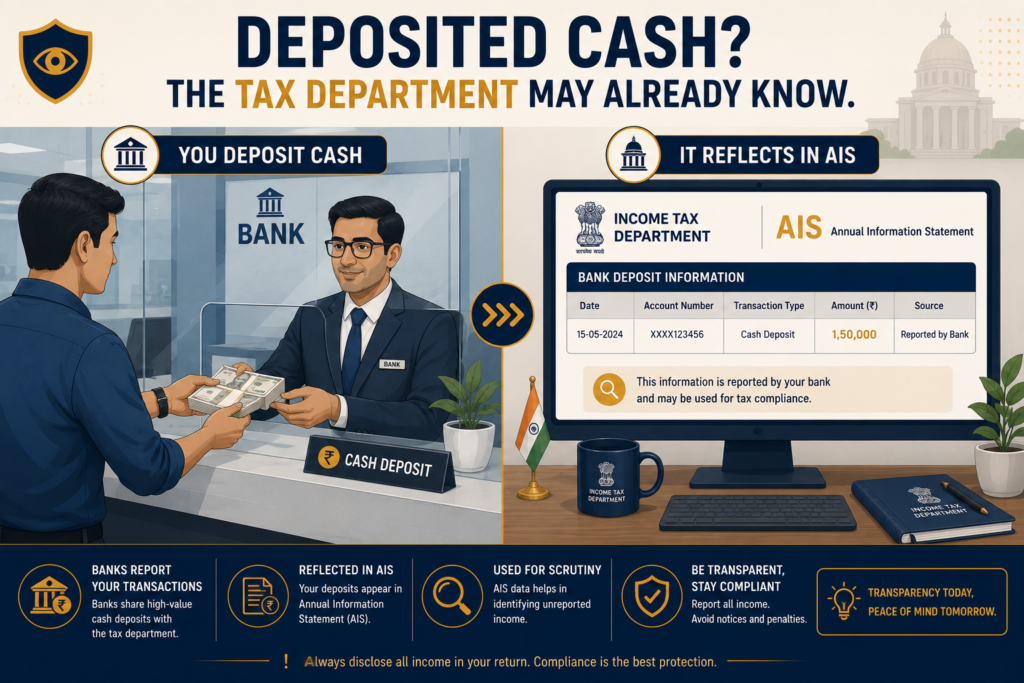
Depositing cash in your bank account is a routine activity. It becomes a tax event the moment the amount crosses a threshold that banks must report to the Income Tax Department — or when the deposit cannot be reconciled with the income declared in your ITR. Both intentional evasion and innocent cash handling trigger the same flag and require the same documentation to resolve. So, cash deposits and tax scrutiny following such deposits become a core discussion for this post.
Quick answer
Cash deposits in savings accounts exceeding ₹10 lakh per year, and in current accounts exceeding ₹50 lakh, are reported by banks to the Income Tax Department under Section 285BA. An unexplained deposit can be added to income under Section 68 and taxed at approximately 81% — with no deductions permitted.
Before reading:
- Have you downloaded your AIS to see what cash data your bank has reported?
- Can you document the source of every large deposit — with paperwork, not just an explanation?
- If a notice has arrived, do you know which section it was issued under and the response deadline?
The department already knows: how cash deposits are tracked
India’s banking system is integrated with the income tax system through the SFT (Statement of Financial Transactions) mechanism under Section 285BA. Banks, post offices, and other specified entities file Form 61A by 31 May each year, reporting high-value transactions of the previous financial year. This data flows into the Annual Information Statement — the AIS — which every taxpayer can view on the income tax e-filing portal.
The AIS shows what your bank has reported: total cash deposited in savings accounts, withdrawals, fixed deposits opened, and other financial activity. The department’s system then compares this against what you declared in your ITR — automatically. A salaried individual who declares ₹6 lakh in income but whose bank shows ₹18 lakh in cash deposits is flagged without anyone manually reviewing the return.
The first step after any large cash deposit is to download your AIS — our post on high-value transactions and income tax notices explains what the AIS shows, how to read it, and how to submit feedback if an entry is incorrect.
What thresholds trigger SFT reporting
Savings accounts: Cash deposits aggregating to ₹10 lakh or more in a financial year are reported. Ten deposits of ₹1 lakh through the year trigger reporting just as a single ₹10 lakh deposit would.
Current accounts: Cash deposits or withdrawals of ₹50 lakh or more per year are reported. Businesses with high cash turnover routinely cross this.
PAN aggregation matters: Thresholds apply across all accounts under the same PAN at all banks combined. Two savings accounts at different banks each receiving ₹6 lakh together cross the ₹10 lakh limit — the individual bank may not report, but the department’s AIS aggregation reflects both.
Below the threshold is not safe: Even deposits below ₹10 lakh can appear in the AIS and trigger questions if they do not match declared income. The SFT threshold determines mandatory Form 61A reporting — it is not a clearance for everything below it.
Section 194N: Banks deduct TDS at 2% on cash withdrawals above ₹1 crore per year (3% if ITR not filed for three years and withdrawal exceeds ₹20 lakh). This is a separate TDS mechanism, often confused with SFT reporting limits.
The notice pathway: from e-campaign to scrutiny
A flagged mismatch does not automatically produce a formal notice. The department typically follows a graduated path.
E-campaign advisory: The compliance portal generates an email or SMS asking you to review a specific AIS entry and explain voluntarily. Not a formal notice. No immediate legal consequence. Ignoring it moves the case forward.
Section 133(6): A formal request for information — bank statements, source documentation, explanation of the deposit. A written, documented response is required within the deadline stated in the notice.
Section 143(2): A scrutiny notice selecting the return for detailed examination. Can result in income additions if the explanation is unsatisfactory.
Section 148A/148: If income is believed to have escaped assessment — particularly for deposits never disclosed in any ITR — a reassessment notice may be issued for prior years.
Responding to the e-campaign advisory with accurate documentation almost always prevents escalation.
If a formal notice has already arrived, our post on high-value transactions and income tax notices explains the specific sections under which notices are issued and the correct response route for each.
What Section 68 means — and why it matters more than the notice itself
Section 68 of the Income Tax Act says: if any sum is found credited in the books of a taxpayer and its nature and source cannot be explained to the assessing officer’s satisfaction, the entire amount is added to the taxpayer’s income.
The tax rate is not the regular slab rate. Under Section 115BBE, unexplained credits under Section 68 are taxed at 60% plus a 25% surcharge — an effective rate of approximately 78%, plus 4% cess. The combined burden is approximately 81% of the unexplained amount.
No expenditure, deduction, loss carry-forward, or set-off is permitted. An additional penalty of 10% of tax under Section 271AAC may apply if the income was not voluntarily disclosed.
On a ₹5 lakh unexplained cash deposit, total exposure exceeds ₹4 lakh. This is what makes source documentation — not the notice — the real issue.
The other cash restrictions most people overlook
Three statutory rules apply independently of the SFT reporting thresholds:
Section 269ST: No person may receive ₹2 lakh or more in cash from a single person in a single day, in a single transaction, or relating to a single event. Penalty: 100% of the amount received. A trader receiving ₹2.5 lakh cash for a sale violates this regardless of whether the money is later deposited.
Section 269SS: Loans, deposits, or advances of ₹20,000 or more cannot be received in cash. Penalty equals the amount of the cash loan received. A family member lending ₹50,000 in cash — even with a loan agreement — violates this provision.
Section 269T: Repayment of loans or deposits of ₹20,000 or more cannot be made in cash. Same penalty structure.
These operate independently. An assessing officer can raise a Section 269SS violation during a routine scrutiny even if the original notice was about something else.
What Suresh’s case shows you
Suresh is a hardware merchant in Indore who operates largely in cash. In FY 2024-25, he deposited ₹14 lakh in his savings account across multiple visits. His ITR showed business income of ₹3.8 lakh.
His bank filed an SFT report showing ₹14 lakh in cash deposits. The AIS reflected this. The system compared ₹14 lakh in deposits against ₹3.8 lakh declared and flagged a mismatch of over ₹10 lakh.
Suresh received an e-campaign advisory asking him to explain.
His actual position: the deposits came from daily business cash sales kept in a home safe before periodic deposit. The ₹3.8 lakh income was net of expenses — the deposits were gross receipts, not unaccounted income.
What resolves this: a reconciliation showing total gross cash sales, expenses incurred, the net income matching the ITR, and a cash flow statement showing deposits as banked business receipts.
What does not resolve it: a verbal statement that “it’s from my hardware shop.” Without a cash book, purchase register, or sales record, there is no evidence for the assessing officer to accept over the AIS data.
The documentation Suresh needed was basic business records every merchant should maintain regardless of whether a notice arrives.
What counts as a valid explanation — and what does not
The burden of proof under Section 68 is on the taxpayer. The explanation must establish both the nature and the source of the credit — assertion without documents is insufficient.
Explanations that work — if documented:
- Business cash sales: Sales register, purchase ledger, and a cash flow reconciliation showing deposits are banked receipts, not unaccounted income. GST returns (if registered) corroborate the sales figure.
- Agricultural income: Land records (7/12 extract), crop sale receipts, mandi receipts. Agricultural income is exempt but must be declared in the ITR.
- Property sale: Registered sale deed, bank account showing proceeds, and capital gains computation in the ITR.
- Gift from a relative: Written gift deed with donor name, relationship, date, and amount. Relatives under Section 56(2) — gifts exempt. From non-relatives above ₹50,000 — taxable and must be declared.
- Loan by NEFT/cheque: Loan agreement, lender’s PAN, bank statement showing the inward transfer. Cash loans above ₹20,000 are a Section 269SS violation — no documentation cures this.
What does not work:
- “Past savings in cash” without prior-year evidence of where those savings originated.
- Retroactive paperwork with no independent corroboration.
- Verbal assertions with no document trail.
The source documentation you need to explain a cash deposit is the same you should maintain year-round — our post on records to keep for income tax covers every record a small business and individual should have ready before any notice arrives.
At a glance: cash deposit thresholds and consequences
Here is a quick-reference infographic covering the key thresholds, the rules that apply, and the consequences of non-compliance.
What to do when a notice arrives
Identify the section. Every notice states its section. Section 133(6) is an information request; Section 143(2) is scrutiny; Section 148A is a pre-reassessment hearing. Response processes and deadlines differ for each.
Log into the compliance portal. Notices appear under e-File → e-Proceedings → View Notices. Confirm whether it is an informal e-campaign advisory (no statutory deadline) or a formal notice (15–30 day response window).
Gather source documentation. Match the questioned deposit to its source: sales register, agricultural records, property sale deed, gift deed, or loan agreement with bank statement. Documentation must pre-date the notice.
Submit AIS feedback if the data is wrong. For duplicate entries, wrong amounts, or mislinked PAN — submit feedback through the AIS portal. Updated feedback modifies the TIS used by the department in assessments.
Respond through e-Proceedings. Upload documentation with a covering explanation through the portal — not by email or post.
Documents to keep ready
- Bank statements for all accounts covering the deposit period and the full financial year
- Cash book or sales register (for business owners) reconciling cash receipts to deposits
- Sales vouchers, purchase bills, and mandi receipts (for traders and agricultural income)
- Gift deed specifying the donor’s name, relationship, date, and amount
- Will or succession certificate and proof of the deceased’s assets (for inheritance)
- Loan agreement with the lender’s PAN, amount, and repayment schedule; bank statement showing inward transfer
- Property sale agreement and registered sale deed (for property sale proceeds deposited)
- AIS and TIS downloaded from the e-filing portal — cross-checked before filing ITR and before responding to any notice
Final takeaway
A large cash deposit is not illegal. What creates risk is the inability to explain its source when the department asks — and the consequences under Section 68 are severe at approximately 81% effective tax with no deductions permitted. The SFT threshold is not a safety limit: deposits below ₹10 lakh can still attract questions if they do not match declared income. The only reliable protection is documentation that pre-dates the deposit — source records, sales registers, gift deeds, or loan agreements that existed before the bank statement entry appeared in anyone’s AIS.
Received an e-campaign advisory or formal notice about a cash deposit, or want to pre-check your AIS before filing this year’s ITR? eTaxMate can review your AIS, identify mismatches, and prepare a documented response to the department.
This blog post is for general information only and does not constitute professional advice. Tax laws are subject to change and their application depends on individual facts and circumstances. Readers should consult a qualified professional before taking any action based on this content. eTaxMate accepts no liability for any action taken based on the information in this post.
Frequently Asked Questions
1. How much cash can I deposit in my bank without getting an income tax notice?
There is no fixed “safe” limit, but banks are required to report cash deposits exceeding Rs 10 lakh per year in savings accounts, and Rs 50 lakh per year in current accounts, to the Income Tax Department under Section 285BA. These thresholds trigger mandatory SFT reporting — but deposits below them can still attract scrutiny if they do not match your declared income in the ITR. The trigger is not just the deposit amount; it is the mismatch between the deposit and your income profile.
2. What happens if I cannot explain a cash deposit to the income tax department?
If the source of a cash deposit cannot be explained to the assessing officer’s satisfaction, the deposit is added to your income as an unexplained cash credit under Section 68. It is then taxed under Section 115BBE at 60%, plus a 25% surcharge, plus 4% cess — an effective rate of approximately 81%. No deductions, losses, or set-offs are allowed against this addition. An additional penalty of 10% of tax may also apply under Section 271AAC if the income was not disclosed voluntarily.
3. Will depositing cash in multiple banks help me avoid income tax scrutiny?
No. SFT thresholds under Section 285BA are applied at the PAN level across all banks and accounts. If you deposit Rs 6 lakh in Bank A and Rs 6 lakh in Bank B — both in the same savings accounts — the combined Rs 12 lakh triggers the threshold even if neither bank individually crosses Rs 10 lakh. The Income Tax Department aggregates all data at the PAN level in the Annual Information Statement.
4. What documents are accepted as proof of source for a cash deposit?
The accepted documentation depends on the source. For business cash sales: sales register, cash book, and GST returns (if registered). For agricultural income: land records, crop receipts, and mandi receipts. For property sale proceeds: registered sale deed and capital gains computation in the ITR. For gifts from relatives: a written gift deed with the donor’s name and relationship. For loans: loan agreement with lender’s PAN and bank statement showing receipt by NEFT or cheque. Cash loans above Rs 20,000 are prohibited under Section 269SS regardless of documentation.
5. What is the difference between an e-campaign advisory and a formal income tax notice for a cash deposit?
An e-campaign advisory is a system-generated informal communication from the compliance portal asking you to review an AIS entry and provide feedback or explanation. It carries no immediate legal consequence and no formal deadline. A formal notice — under Section 133(6), 143(2), or 148 — is a statutory communication with a mandatory response deadline, typically 15–30 days. Ignoring an e-campaign advisory typically results in escalation to a formal notice. Responding accurately and promptly at the advisory stage is the most effective way to close the matter.
6. Is receiving cash above Rs 2 lakh ever permitted?
No, for most categories of transactions. Section 269ST prohibits any person from receiving Rs 2 lakh or more in cash from a single person in a single day, in a single transaction, or in relation to a single event. The penalty is 100% of the amount received. There are very limited exceptions — certain government transactions and some notified categories — but for routine business or personal cash receipts, the Rs 2 lakh ceiling is an absolute prohibition, not merely a reporting threshold.