
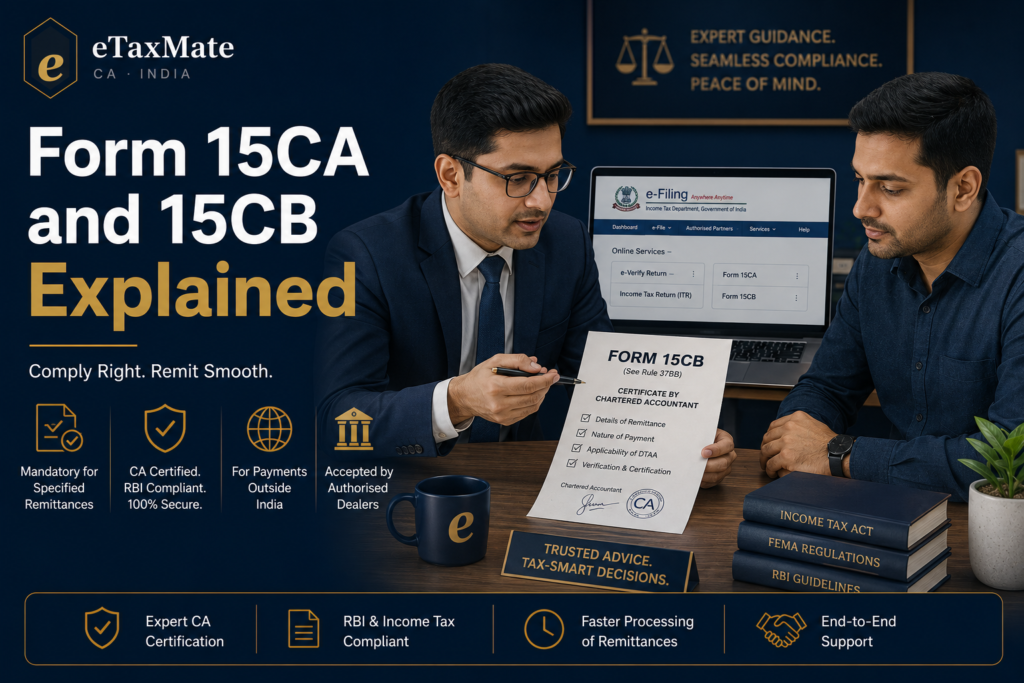
If you have ever tried to send money abroad from India — or received a call from an Indian payer asking for your tax residency documents before they transfer funds to you — you have encountered the Form 15CA and 15CB requirement. These two documents exist because Indian law requires the payer to account for tax before any payment leaves India. The forms catch a lot of people off guard: either the payer does not know they are required, or the NRI recipient does not understand what they need to provide to make the process smooth. This post explains both forms, when they apply, and what the four parts of Form 15CA actually mean.
Quick answer
Form 15CA is an online declaration filed by the payer (the person remitting money abroad) on India’s income tax portal. Form 15CB is a Chartered Accountant’s certificate that the payer must obtain first, for most taxable remittances above Rs 5 lakh in a financial year. Both are required under Rule 37BB of the Income Tax Rules, framed under Section 195(6) of the Income Tax Act 1961.
Before making a foreign remittance, the payer should check:
- Whether the payment type appears on the Rule 37BB exempt list — if it does, neither form is needed.
- Whether the remittance is chargeable to tax in India — if not, Form 15CA Part D applies.
- Whether aggregate taxable remittances for the year will exceed Rs 5 lakh — if yes, Form 15CB from a CA is required before Form 15CA can be filed.
- Whether the recipient is eligible for a DTAA rate — if so, TRC and Form 10F must be in place before the CA issues Form 15CB.
Who has the obligation: the payer, not the recipient
This is the point most commonly misunderstood. The obligation to file Form 15CA and obtain Form 15CB rests on the person making the payment — not on the NRI receiving it.
Whether the payer is an individual buying property from an NRI seller, a company paying a foreign software vendor, a startup paying a foreign consultant, or an NRI repatriating funds from their own NRO account, the payer is the one who must ensure these forms are filed before the bank remits the funds.
The bank will not process the outward remittance without Form 15CA. In most cases above Rs 5 lakh, it will also require Form 15CB from a CA. The bank is acting as the last checkpoint for the government’s requirement that tax is either deducted at source or confirmed as not applicable before money crosses the border.
NRIs are involved in this process in two ways. First, as the recipient of payments from Indian parties — rent from a tenant, fees from an Indian client, property sale consideration — the NRI should know that the Indian payer has this obligation and should proactively give the payer their TRC and Form 10F if a DTAA lower rate is to be claimed. Second, NRIs repatriating their own funds from an NRO account are themselves the payer and must file the forms before the bank will transfer the money abroad.
The Rule 37BB exempt list: when no forms are needed
The Rule 37BB exempt list: when no forms are needed
Rule 37BB specifies a list of payment categories that are completely exempt from the Form 15CA/15CB requirement — the list was expanded over time and now runs to 33 specified categories. If the remittance falls under one of these categories, the payer submits neither form; the bank relies on a simple declaration that the payment is exempt.
The exempt list includes payments such as: advance payment against imports of goods into India, payments for shipping, air freight, and insurance on imported goods, salary paid to a non-resident employee, payments to embassies and consulates, and certain Government of India borrowings. Payments that are purely capital in nature — buying foreign currency for travel under the Liberalised Remittance Scheme (LRS), for example — may fall outside the Section 195 framework entirely.
For most business payments and investment-related remittances — fees for professional services, royalties, rent, interest, capital gains — the exempt list does not apply. The payer must assess taxability and file the appropriate form.
Form 15CA: four parts and when each applies
Form 15CA is filed on the income tax portal (eportal.incometax.gov.in) under e-File → Income Tax Forms → File Income Tax Forms. The form has four parts:
Part A applies when the remittance is taxable in India and the aggregate of all such remittances in the financial year does not exceed Rs 5 lakh. The payer files this themselves — no CA certificate is required. This part is suitable for small or infrequent cross-border payments: a one-off consultancy fee, a small royalty payment.
Part B applies when the remittance is taxable but the payer has already obtained an order or certificate from the Assessing Officer under Section 195(2), 195(3), or 197 of the ITA 1961 authorising remittance at a lower or nil TDS rate. This is less common in routine transactions; it typically arises when the payer has approached the income tax authority directly to confirm the applicable rate.
Part C is the most commonly used part for larger transactions. It applies to all taxable remittances not covered by Parts A or B — that is, any taxable payment where aggregate remittances for the year exceed Rs 5 lakh and no Assessing Officer order exists. Part C requires Form 15CB from a CA before it can be filed; the CA’s acknowledgement number is entered into Part C.
Part D applies when the remittance is not chargeable to tax in India at all — for example, repatriation from an NRE account, where the interest is exempt from Indian tax, or a payment that genuinely falls outside the scope of Indian income tax. No CA certificate is needed, but the payer must confirm the basis for non-taxability.
Form 15CB: what the CA is certifying
Form 15CB is not a rubber stamp. It is a CA’s professional certification — issued under their digital signature — that the following have been examined and confirmed:
The nature of the remittance: what is being paid and why. The CA identifies the payment as interest, royalty, fees for technical services, capital gains, or another category, because the category determines the applicable TDS rate.
The applicable tax rate: whether TDS should be deducted at the domestic rate under the ITA 1961 or at a lower rate under the DTAA between India and the recipient’s country of residence. If a DTAA rate is being applied, the CA verifies that the recipient has provided a valid TRC and Form 10F.
The amount of TDS: the CA confirms the TDS that should be deducted before remittance, or confirms that TDS has already been deposited with the government.
The CA uploads Form 15CB directly on the income tax portal under their own CA login. The acknowledgement number generated is then used by the payer when filing Form 15CA Part C. The sequence is always: Form 15CB first, then Form 15CA Part C.
Flowchart: does your payment need Form 15CA and 15CB?
If the remittance is not taxable in India at all — for example, the interest is exempt or the payment is a capital repatriation from an NRE account — the payer files Form 15CA Part D instead and no CA certificate is needed.
Section 195 under ITA 1961 and ITA 2025
Under the Income Tax Act 1961: Section 195 requires any person responsible for paying a non-resident any sum that is chargeable to tax in India to deduct TDS at the time of payment or credit, whichever is earlier. Section 195(6) requires the payer to furnish the information prescribed under Rule 37BB — that is, to file Form 15CA and, where required, obtain Form 15CB. Failure to deduct TDS makes the payer liable as an assessee-in-default under Section 201, with interest on the shortfall.
There is a separate penalty for the filing itself. Under Section 271-I, failing to furnish Form 15CA or 15CB, or furnishing inaccurate particulars in it, attracts a penalty of ₹1 lakh. This bites even where the TDS was correctly deducted and deposited — because the default being penalised is the failure to file the form, not the failure to pay the tax. For a payer, getting the TDS right is not enough; the declaration must be filed too.
Under the Income Tax Act 2025: The withholding obligation on payments to non-residents is carried forward. The substantive requirement — that a payer must deduct TDS and report the remittance before it leaves India — remains. Section numbers in the 2025 Act have been renumbered; the exact provision reference should be confirmed against the current text of the 2025 Act rather than assumed. eTaxMate’s compliance tools carry updated dual-Act references, so the position here should be read alongside the 2025 Act for any transaction falling after its effective date.
One naming change to note: with effect from 1 April 2026, Forms 15CA and 15CB were renumbered as Forms 145 and 146. The four-part structure, the ₹5 lakh threshold, and the Rule 37BB exemptions are all unchanged — only the form numbers differ, and filings made before that date under the old numbers remain valid. This post uses the widely recognised 15CA/15CB labels throughout.
From the NRI’s side: what to give the payer
An NRI receiving income from India — rental income from an Indian tenant, fees from an Indian client, dividend from an Indian company, or sale consideration from an Indian buyer — does not file Form 15CA or 15CB. That obligation is on the Indian payer.
However, the NRI can significantly affect whether TDS is deducted at the standard domestic rate or at the lower DTAA rate by what they provide to the payer:
Tax Residency Certificate (TRC): A certificate from your resident country’s tax authority confirming you are tax-resident there during the relevant period. Without this, the payer’s CA cannot apply the DTAA rate in Form 15CB.
Form 10F: If your TRC does not contain all seven items required under Rule 21AB, you must file Form 10F online on the income tax portal and give the filed form to the payer. This supplements the TRC.
PAN: Some banks and payers require the NRI’s Indian PAN. Without it, TDS may be deducted at a higher rate under Section 206AA of the ITA 1961 (20% or the applicable rate, whichever is higher).
Provide these documents to the Indian payer before the payment date — not after. Once TDS is deducted at the wrong rate, the only remedy is to file an ITR and claim a refund, which takes months.
Common mistakes
Payer proceeds without checking the exempt list. Paying shipping charges on imported goods or a consulate visa fee and then scrambling to file Form 15CA — neither was required. Check the Rule 37BB list first.
Form 15CA filed before Form 15CB. Part C cannot be filed without the CA’s acknowledgement number. Many first-time payers try to fill the online form and discover mid-way that they need the CA certificate first.
Using Part A when the year’s total exceeds Rs 5 lakh. Part A is valid only if aggregate taxable remittances for the year remain below Rs 5 lakh. If an earlier remittance already crossed the threshold, Part C and Form 15CB are required even for a small follow-on payment.
NRI does not provide TRC in time. The bank transfer is scheduled, the CA cannot confirm the DTAA rate without TRC and Form 10F, and TDS ends up at 30% instead of 10-15%. The NRI then has to file an ITR to recover the excess — a months-long wait that was avoidable.
CA issues Form 15CB for the wrong financial year. Form 15CB is year-specific. A certificate prepared for FY 2024-25 cannot be used for a remittance processed in FY 2025-26.
Checklist
📋 Before remitting funds to or from India:
- Check whether the payment type is in the Rule 37BB exempt list (33 categories)
- If taxable: identify the applicable TDS rate — domestic or DTAA
- If DTAA rate: ensure recipient has provided valid TRC and Form 10F
- Engage a CA to prepare and upload Form 15CB (required for taxable remittances above Rs 5 lakh)
- File Form 15CA (correct Part) on eportal.incometax.gov.in using the 15CB acknowledgement number
- Submit Form 15CA and Form 15CB to the authorised dealer bank
- Deduct and deposit TDS with the government before or at the time of remittance
- Retain copies of both forms, bank outward remittance advice, and TDS challan permanently
Final takeaway
Form 15CA and 15CB exist to ensure the government’s tax is accounted for before money leaves India. For payers, the rule is straightforward: check the exempt list, then determine taxability, then get the CA certificate if needed, then file the form. For NRIs on the receiving end, the most useful thing you can do is have your TRC and Form 10F ready before your Indian payer asks — because without them, the default TDS rate applies and recovering the excess takes far longer than providing the documents upfront.
Need Form 15CB certification or Form 15CA filing support for an upcoming remittance? eTaxMate can assess the taxability of your payment, apply the correct DTAA rate, issue Form 15CB under digital signature, and file Form 15CA on the portal before your bank transfer date.
This blog post is for general information only and does not constitute professional advice. Tax laws are subject to change and their application depends on individual facts and circumstances. The position described under the ITA 2025 should be verified against the current text of the Act. Readers should consult a qualified professional before acting on any information in this post. eTaxMate accepts no liability for any action taken based on this content.
Frequently Asked Questions
1. What is the difference between Form 15CA and Form 15CB?
Form 15CA is an online declaration filed by the payer (the person remitting money abroad) on India’s income tax portal. It informs the government about a cross-border payment and the TDS applicable. Form 15CB is a certificate issued by a Chartered Accountant that must be obtained before Form 15CA Part C can be filed. The CA verifies the nature of the payment, the applicable TDS rate (domestic or DTAA), and that taxes have been correctly accounted for. The CA uploads Form 15CB under their own digital signature, and the resulting acknowledgement number is referenced in Form 15CA.
2. When is Form 15CB not required?
Form 15CB is not required in three situations: when the remittance falls in one of the 28 exempt categories listed in Rule 37BB (such as import payments for goods, shipping costs, or embassy payments); when the aggregate taxable remittances for the year do not exceed Rs 5 lakh, in which case Form 15CA Part A suffices; or when the remittance is not chargeable to tax in India at all, in which case Form 15CA Part D is filed without any CA certificate.
3. Who is required to file Form 15CA — the payer or the NRI recipient?
The payer — the person making the cross-border payment — is responsible for filing Form 15CA. This could be an Indian resident paying rent or fees to an NRI, a company paying a foreign vendor, or an NRI repatriating funds from their own NRO account. The NRI recipient does not file Form 15CA. However, the NRI can affect the outcome by providing a Tax Residency Certificate and Form 10F to the payer in time for the CA to apply the DTAA rate when issuing Form 15CB.
4. What happens if Form 15CA is not filed before a foreign remittance?
The bank will not process the outward remittance without Form 15CA for payments that require it. If the remittance goes through without the form being filed, the payer can face penalties under FEMA and the Income Tax Act, and may be treated as an assessee-in-default for failure to deduct TDS under Section 195 of the Income Tax Act 1961. The payer becomes personally liable for the TDS that should have been deducted.
5. Does Form 15CA and 15CB apply to NRE account repatriations?
Generally no. NRE account balances consist of funds remitted from abroad and NRE interest, which is exempt from Indian income tax. A repatriation from an NRE account is typically not a taxable payment, so Form 15CA Part D (no-CA-certificate required) applies, or in many cases the bank simply processes the transfer on the basis of an A2 form. Confirm with your specific bank, as practices can vary.
6. Can Form 15CA be filed after the payment is made?
No. Form 15CA must be filed before the bank processes the remittance. Banks are required to collect the form as a condition of processing the outward transfer. If TDS was deducted at the wrong rate because Form 15CB was not prepared in time, the CA cannot revise the certificate retroactively for the same transaction. The NRI’s remedy for excess TDS is to file an Indian ITR and claim a refund.