

If you earn income from India while living abroad, two countries have an interest in taxing that income: India, because the income originates there, and your country of residence, because you are a tax resident there. Without any agreement between the two governments, you could end up paying tax twice on the same rupee. That is what a Double Taxation Avoidance Agreement — DTAA — is designed to prevent. This post explains how DTAA double taxation relief work, what they cover, and the concrete steps to claim the benefit before TDS is deducted in India.
Quick answer
A DTAA is a bilateral treaty between India and another country that determines which country gets to tax which income, and at what rate. Where both countries have a right to tax, the NRI pays tax in India (usually through TDS) and then claims credit for that tax in their country of residence — so the same income is not taxed twice in full.
Before claiming DTAA relief in India, check:
- Whether India has a DTAA with your country of residence — India has treaties with over 90 countries.
- Whether the type of income you are receiving (interest, dividend, capital gains, salary) is covered by your specific treaty.
- That you have a valid Tax Residency Certificate (TRC) from your resident country for the relevant financial year.
- Whether your TRC covers all seven fields required under Rule 21AB — if not, file Form 10F on India’s e-filing portal before the payment date.
What DTAA does: the two methods of relief
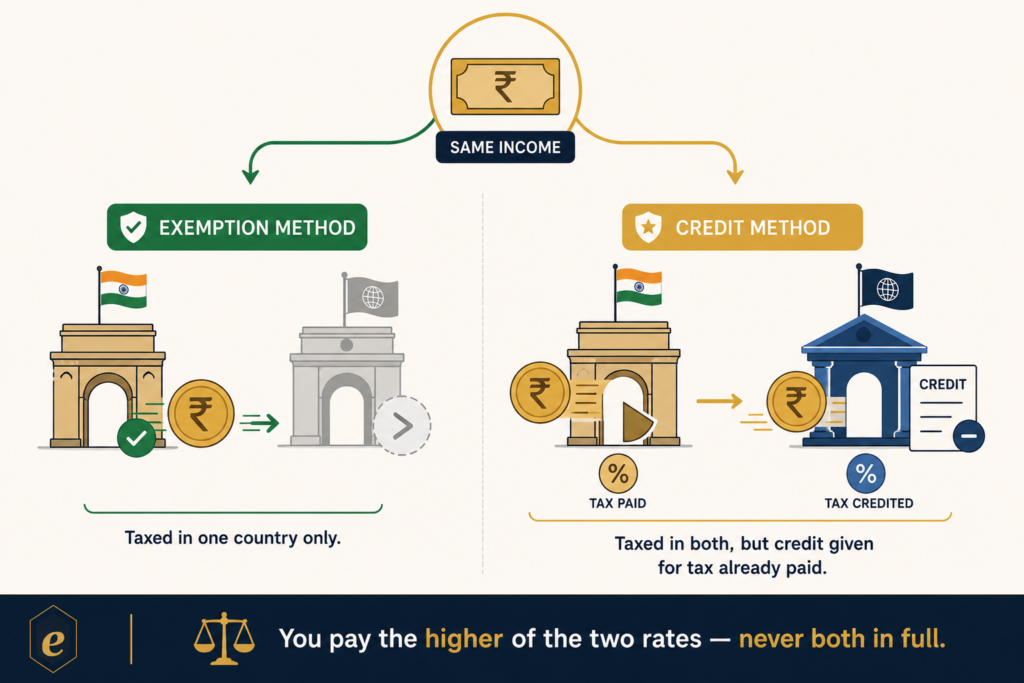
Every DTAA uses one of two mechanisms to prevent double taxation.
The exemption method: The income is taxed in only one country and fully exempt in the other. For example, some treaty articles provide that salary income is taxable only in the country where the work is performed, meaning India has no right to tax salary earned and paid entirely outside India.
The credit method: Both countries retain the right to tax the income, but the country of residence gives a tax credit for the tax already paid in the source country. In practice, this is more common for passive income — interest, dividends, royalties — flowing out of India. The NRI pays TDS in India at the DTAA rate, then claims credit for that Indian tax against the tax liability in their country of residence.
Most Indian DTAAs use the credit method for most income types. The result is that the effective rate on India-source income is the higher of the two countries’ rates — not the sum of both.
India’s treaty network: what income is covered
India has DTAAs with over 90 countries, including the UAE, the US, the UK, Singapore, Germany, Canada, Australia, and most countries where Indian professionals and businesspersons are commonly resident.
Each DTAA is a separate treaty with its own articles and rates. A DTAA typically covers these income categories through specific numbered articles: employment income (salary), business income and permanent establishment, dividends, interest, royalties and fees for technical services, capital gains, and income from immovable property.
Not all DTAAs cover all income types equally. The India-UAE DTAA, for example, does not have a specific article on capital gains — which means capital gains on Indian assets remain taxable at Indian domestic rates for UAE-resident NRIs, regardless of the treaty. The India-US DTAA covers capital gains but with conditions. Always check the specific treaty article for your income type and country of residence before assuming a DTAA benefit applies.
DTAA rates on common income types
Below are indicative rates under a few major treaties. Actual rates may vary depending on the treaty article’s conditions; confirm with the text of the specific treaty.
Interest on NRO deposits and bonds: India-UAE: 12.5% | India-US: 15% | India-UK: 15% | India-Singapore: 15% | India-Germany: 10%
Domestic rate (without DTAA): 30% (plus surcharge and cess) for most NRI interest income.
Dividends: India-US: 15% (for substantial holding) or 25% | India-UK: 15% | India-Singapore: 15% | India-UAE: Not covered (domestic rate applies)
Royalties and Fees for Technical Services: India-US: 15% | India-UK: 15% | India-Singapore: 15% | India-UAE: Not covered explicitly in all articles
Capital gains on listed equity: Following amendments to the India-Mauritius and India-Singapore treaties, the earlier capital-gains exemption these routes offered was phased out — shares acquired on or after 1 April 2017 are taxable in India. These treaties have since seen further anti-abuse changes: the India-Mauritius protocol was amended again in 2024 to add a Principal Purpose Test, which can deny treaty benefits where obtaining them was a main purpose of an arrangement. More broadly, many DTAAs give India taxing rights on capital gains from Indian assets, with the NRI claiming credit in their resident country. Always check the current text of the specific treaty for your income type and country.
How to claim DTAA relief step by step
Step 1 — Obtain a TRC. Apply to the tax authority in your country of residence for a Tax Residency Certificate covering the financial year in which you will receive India-source income. The TRC is the foundational document for any DTAA claim; without it, the Indian payer cannot apply the treaty rate.
Step 2 — Check your TRC against Rule 21AB. Your TRC must contain seven specific items: your name, status (individual/company), nationality, country of tax residence, Taxpayer Identification Number (TIN) in that country, the period for which you are resident there, and your address during that period. If any item is missing, you must file Form 10F online on eportal.incometax.gov.in to supply the missing details.
Step 3 — File Form 10F if needed. Log in to the income tax portal with your PAN, navigate to e-File → Income Tax Forms → File Income Tax Forms, and file Form 10F for the relevant financial year. Download the filed form.
Step 4 — Give TRC and Form 10F to the Indian payer. Submit both documents to the bank, company, or fund house that is making the payment to you — before the payment or interest credit date. The payer’s accountant uses these to determine the applicable DTAA rate.
Step 5 — Payer applies DTAA rate. Armed with the TRC and Form 10F, the payer deducts TDS at the lower DTAA rate instead of the standard domestic rate. The payer’s CA issues Form 15CB at the DTAA rate and files Form 15CA. (From 1 April 2026, Forms 15CA and 15CB are renumbered Forms 145 and 146; the requirements are unchanged.)
Step 6 — File ITR in India. File your Indian ITR for the financial year, declaring all India-source income and the TDS deducted. If the TDS deducted is more than your actual liability after applying the DTAA, claim the excess as a refund.
Step 7 — Claim Foreign Tax Credit in your resident country. Furnish proof of Indian TDS (TDS certificate from the payer) to your resident country’s tax authority and claim credit for the tax paid in India against your liability there.
Flowchart: from Indian income to DTAA relief
Where no DTAA exists — or where the specific income type is not covered by an existing treaty — Section 91 of the ITA 1961 provides unilateral relief. The NRI can claim credit in India for the foreign tax paid abroad, limited to the Indian tax rate on that income. Section 91 relief is narrower and less favourable than a DTAA credit, but it prevents total double taxation in the absence of a treaty.
Tie-breaker clauses: when both countries want to tax you
A complication arises when an NRI is classified as a tax resident in both India and the country where they live. India’s residential status rules under Section 6 of the ITA 1961 can classify a person as a resident if they spend 182 days or more in India in a financial year (or 60 days if certain additional conditions are met). If they are also tax-resident in another country, both countries have a claim.
Most DTAAs contain a tie-breaker article that resolves this in a prescribed sequence:
First, a person is considered resident where they have a permanent home available to them. If permanent homes exist in both countries, the tie-breaker moves to the “centre of vital interests” — where personal and economic relations are closer. If that is also inconclusive, the test moves to habitual abode (where the person normally lives), then to nationality, and finally to mutual agreement between the two competent authorities.
The tie-breaker outcome determines which country treats the person as a resident for treaty purposes — and therefore which country gives credit rather than taxing the income as a source country. NRIs who spend significant time in India during a year — for family reasons, business, or during transitions — should track their day count carefully. Crossing the residential threshold while expecting non-resident treatment can create unexpected Indian tax liabilities.
Section 90, Section 91, and ITA 2025
Under the Income Tax Act 1961: Section 90 empowers the Central Government to enter into DTAAs and gives those treaties force in Indian law. Section 90(2) provides that a taxpayer can elect to be governed by the treaty provisions where they are more beneficial than the domestic law. Section 91 provides unilateral relief where no DTAA exists.
The withholding obligation under Section 195 (TDS on payments to non-residents) is directly linked to the DTAA framework — if a valid TRC and Form 10F are in place, the payer deducts at the DTAA rate under Section 195. This falls within the mandatory dual-Act cluster: withholding on payments to non-residents must be assessed under both the 1961 and 2025 Acts.
Under the Income Tax Act 2025: The DTAA relief framework — treaty override of domestic law where the treaty is more beneficial, and unilateral relief where no treaty exists — is carried forward from the 1961 Act. The withholding provisions for payments to non-residents and the TRC/Form 10F documentation requirements also continue. Section numbers in the 2025 Act are renumbered; the exact provision references should be confirmed against the current text of the 2025 Act. The substantive position described here is based on the ITA 1961 as in force and is expected to carry through under the 2025 framework.
Foreign Tax Credit and Form 67
When an NRI pays TDS in India and then needs to claim credit for that tax in their country of residence, the Indian tax paid is evidenced through the TDS certificate (Form 16A) issued by the Indian payer.
In India, NRIs with foreign-source income who have paid tax abroad can claim Foreign Tax Credit (FTC) in their Indian ITR through Form 67. The filing deadline was relaxed by a 2022 amendment: Form 67 can now be filed up to the end of the relevant assessment year, rather than strictly by the ITR due date as under the earlier rule. Confirm the exact timeline for your assessment year against the current Rule 128, but the position is now more forgiving than “before the ITR due date.”
Under the Income Tax Act 1961: Form 67 and the Foreign Tax Credit rules (Income Tax Rules, Rule 128) require: the name of the country where tax was paid, the nature of the income, the tax paid (in foreign currency and INR equivalent), and the Indian tax liability on that income. The FTC is limited to the lower of Indian tax on that income and the foreign tax paid.
Under the Income Tax Act 2025: The Foreign Tax Credit mechanism is carried forward. Confirm exact provision references against the 2025 Act; the Rule 128 equivalent and Form 67 process are expected to continue in substance.
Common mistakes
Not providing TRC and Form 10F before the payment date. Once TDS is deducted at the domestic rate (30%), the bank or fund house cannot revise it. The remedy is an ITR refund — months later — instead of the correct lower rate at source.
Assuming DTAA covers all income from that country. Many NRIs assume the India-UAE DTAA, for example, covers capital gains. It does not have a specific capital gains article, meaning Indian domestic rates apply. Check each income article in the specific treaty.
Using an expired TRC. TRCs are issued for a specific period (often a calendar year or financial year in the resident country). A TRC valid for 2023 cannot support a DTAA claim for 2024-25.
Treating DTAA as automatic. DTAA relief at source is not automatic — the payer must be given the documentation before making the payment. Without TRC and Form 10F, the domestic rate applies by default.
Not filing Form 67 in India. NRIs with foreign income who pay tax abroad and wish to claim credit against Indian tax must file Form 67 before the ITR due date. Forgetting Form 67 means the FTC claim may be rejected.
Ignoring Section 206AA — but knowing its exception. If the NRI has no Indian PAN, TDS defaults to the higher of the applicable rate or 20% under Section 206AA, regardless of any DTAA. But this is not absolute: under Rule 37BC, a non-resident can avoid the 206AA higher rate on interest, royalty, fees for technical services, and certain other payments by furnishing prescribed alternative details — name, email, contact number, address, the TRC, and the tax identification number of their home country. So a PAN is the simplest route, but its absence does not automatically forfeit the treaty rate on these income types.
Checklist
📋 Before your next India payment arrives:
- Confirm India has a DTAA with your country of residence
- Identify which income article of the treaty covers your type of income (interest, dividends, royalties, etc.)
- Obtain a TRC from your resident country’s tax authority for the current financial year
- Check the TRC against the seven Rule 21AB requirements; file Form 10F if any are missing
- Submit TRC and Form 10F to the Indian payer before the payment or interest credit date
- Confirm you have a valid Indian PAN (or, if not, the Rule 37BC details — TRC and home-country TIN — to avoid the Section 206AA higher rate on interest, royalty, and FTS)
- After year end: file Indian ITR declaring India-source income and TDS credit
- File Form 67 in India before the ITR due date” to: “File Form 67 in India by the end of the relevant assessment year if claiming FTC for foreign taxes paid.
- Collect your TDS certificate (Form 16A) from the Indian payer — needed for FTC claim in your resident country
Final takeaway
DTAA relief is not a loophole — it is the mechanism two governments have agreed on to ensure the same income is not fully taxed twice. Claiming it requires preparation: the right residency certificate, the right form filed on the right portal, delivered to the right person before the right date. None of this is difficult once it is understood, but the timing is non-negotiable. An NRI who prepares their TRC in March and sends it to their Indian bank before April’s interest credit date will pay far less at source than one who tries to sort it out in July through an ITR refund.
Need a DTAA relief working for a specific income type or country? eTaxMate can review your treaty position, prepare the Form 10F, coordinate with the Indian payer, and file Form 67 in your ITR to ensure you receive full credit for taxes paid in India.
This blog post is for general information only and does not constitute professional advice. Tax treaty provisions and domestic law are subject to change; their application depends on the specific facts of each case and the relevant treaty text. The ITA 2025 references should be verified against the current text of the Act. Readers should consult a qualified professional before relying on any DTAA position. eTaxMate accepts no liability for any action taken based on this content.
Frequently Asked Questions
1. What is DTAA and how does it help NRIs?
DTAA (Double Taxation Avoidance Agreement) is a bilateral treaty between India and another country that prevents the same income from being taxed in full by both countries. For NRIs, it typically means that India taxes their Indian-source income (such as interest, rent, or capital gains) at a lower rate than the standard domestic TDS rate, and their country of residence then gives them credit for the Indian tax paid — so the effective tax burden is the higher of the two countries’ rates, not the sum of both.
2. How do NRIs claim DTAA benefit on Indian income?
To claim a DTAA benefit at source in India, the NRI must provide the Indian payer with a Tax Residency Certificate (TRC) from their resident country’s tax authority and, if the TRC is incomplete, a filed Form 10F from India’s e-filing portal. These documents must be submitted before the payment or interest credit date. The Indian payer then deducts TDS at the lower DTAA rate. If TDS has already been deducted at the higher domestic rate, the NRI must file an ITR in India to claim the excess as a refund.
3. Does DTAA cover capital gains on Indian shares for UAE-based NRIs?
The India-UAE DTAA does not have a specific capital gains article. This means India retains full taxing rights on capital gains from Indian assets for UAE-resident NRIs, and the standard Indian domestic capital gains rates apply — 20% for short-term and 12.5% for long-term (on equity, post July 2024). UAE-based NRIs cannot claim a lower treaty rate on Indian equity capital gains. NRIs in countries whose DTAAs do include capital gains articles should check the specific article for conditions.
4. What is the difference between Section 90 and Section 91 of the Income Tax Act?
Section 90 of the Income Tax Act 1961 gives legal effect to India’s bilateral DTAAs and allows taxpayers to elect the more beneficial of treaty provisions or domestic law. Section 91 provides unilateral relief where India does not have a DTAA with a particular country — the taxpayer can claim credit for foreign tax paid abroad, but the credit is limited to the Indian tax rate on that income. Section 90 relief (via treaty) is generally more favourable than Section 91 unilateral relief.
5. What is Form 67 and when must it be filed?
Form 67 is how a taxpayer claims Foreign Tax Credit in their Indian ITR for taxes paid in another country. NRIs with foreign income who have paid tax abroad and want to offset it against Indian tax must file it. Following a 2022 relaxation, Form 67 can be filed up to the end of the relevant assessment year, rather than strictly by the ITR due date as before. The form requires details of the foreign income, the country where tax was paid, the foreign tax amount, and the Indian tax on that income.
6. What happens if an NRI does not have an Indian PAN when receiving income from India?
Under Section 206AA, without a PAN, TDS defaults to the higher of the applicable rate or 20%, regardless of any DTAA. However, Rule 37BC relaxes this for non-residents on interest, royalty, fees for technical services, and certain other payments: if the NRI furnishes prescribed details — including their Tax Residency Certificate and home-country tax identification number — the treaty rate can still apply. A PAN is the simplest route, but its absence does not always forfeit the DTAA rate.