
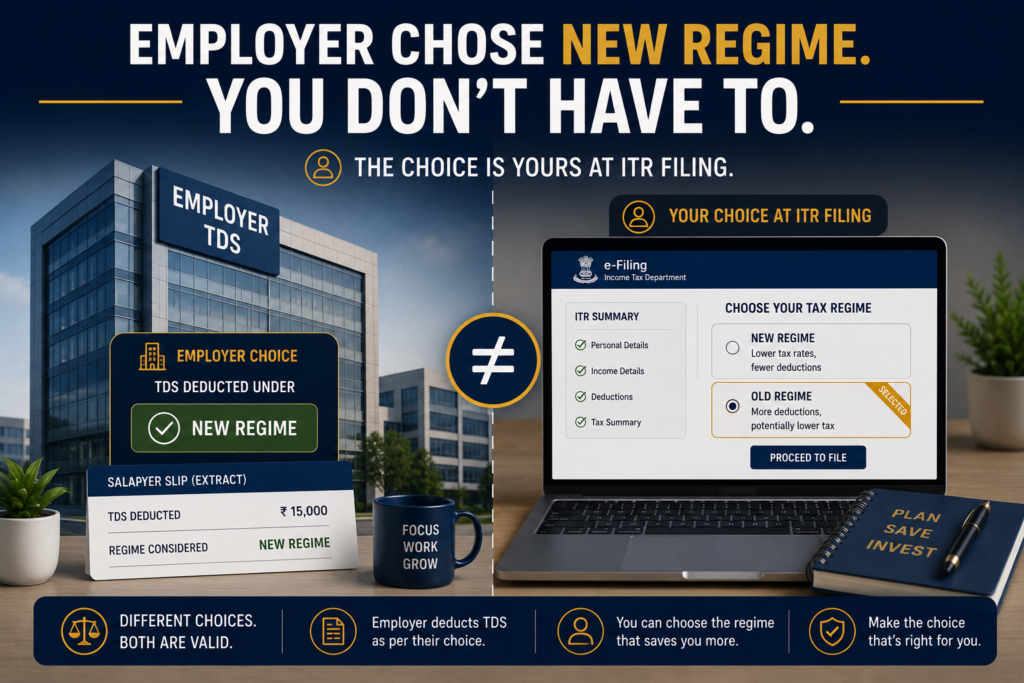
Your employer chose new tax regime to calculate TDS on your salary. Your Form 16 reflects that. Now you are filing your ITR, you have done the numbers, and the old regime would save you more tax. Are you stuck with your employer’s choice? The answer is no — and the law is explicit about it.
Quick answer
Your employer’s regime choice is for TDS purposes only. It is not binding on your ITR. Salaried individuals can switch between the old and new regime every year at filing time, regardless of what regime the employer used for TDS. The statutory basis is Section 115BAC(6) of the Income Tax Act 1961.
Before acting, check:
- Do you have only salary income, or also business or professional income? The switch process differs for each.
- Are you filing within the original due date? The option to switch lapses on a belated return.
- Have you compared your liability under both regimes? Switching without calculating is guesswork.
What your employer’s regime choice actually does
At the start of a financial year, your employer asks you to declare which tax regime to use for TDS. If you say new regime, monthly TDS is computed at new-regime slab rates with no Chapter VI-A deductions applied. If you say old regime, your employer factors in declared investments — LIC, PPF, HRA, and so on.
This has one purpose: to keep monthly TDS broadly accurate. It does not lock your ITR.
Under Section 115BAC(6) of the Income Tax Act 1961, the final regime election is made when you file your income tax return. The employer declaration is a TDS tool — nothing more. The income tax department’s own guidance confirms that salaried individuals in non-business cases can change their regime every year directly in the ITR.
Here is how the two choices compare — and why they are completely separate decisions.
The rule that gives you a second chance
The new regime is now the default under Section 115BAC. Every salaried individual is assumed to be in it unless they actively opt out.
When you file ITR-1 or ITR-2, the form asks: “Do you wish to exercise the option u/s 115BAC(6) of opting out of the new tax regime? (default is No).”
Select No and your tax is computed under the new regime. Select Yes and your tax is computed under the old regime — giving you access to every Chapter VI-A deduction you qualify for: 80C, 80D, HRA, home loan interest, and others.
That single Yes/No answer is your regime election. Your employer’s earlier declaration is irrelevant at this point.
The main reason salaried employees switch to the old regime at ITR time is to claim 80C, 80D, and HRA deductions unavailable in the new regime — our post on income tax deductions under the old regime covers every major one.
Two very different situations: salaried vs business income
This is the most important distinction in the topic, and conflating the two causes real errors.
Purely salaried (filing ITR-1 or ITR-2): Switch freely every year at filing time. No separate form required — just answer the Yes/No question in the ITR. You can switch to old regime this year, go back to new next year, and repeat indefinitely.
Business or professional income (filing ITR-3 or ITR-4): Cannot switch through the ITR question alone. You must file Form 10-IEA on the income tax e-filing portal before the ITR due date under Section 139(1). Critically, this switch is permitted only once in a lifetime — once you exercise the option and later switch back to new, you cannot return to old again.
Most salaried employees with no side business fall in the first category. A salaried employee who also freelances, runs a consultancy, or has proprietorship income falls in the second.
If you are unsure which regime is actually better for your income level, our comparison of the old tax regime and new tax regime walks through the full trade-off before you decide.
What Priya’s case shows you
Priya is a salaried software engineer in Pune earning ₹14 lakh per year. At the start of FY 2025-26, she told her employer to use the new regime for TDS — her investments were not finalised yet and she wanted simpler paperwork. Her employer deducted TDS accordingly.
By March 2026, Priya had invested ₹1.5 lakh in PPF and ELSS, paid ₹18,000 in health insurance premiums for her parents, and accumulated ₹1.8 lakh in home loan interest on a self-occupied property. She ran the numbers:
- New regime: Tax on ₹14 lakh minus ₹75,000 standard deduction = tax on ₹13.25 lakh
- Old regime: Tax on ₹14 lakh minus standard deduction (₹50,000) + 80C (₹1.5 lakh) + 80D (₹18,000) + Section 24(b) home loan interest (₹2 lakh) = tax on roughly ₹10 lakh
The old regime saves her significantly. When she files her ITR-2, she selects Yes to the opt-out question. Her return is processed under the old regime, TDS already deducted under the new regime is credited, and she receives a refund for the excess.
Her employer’s choice did not trap her.
How to switch regimes when filing your ITR
For salaried individuals filing ITR-1 or ITR-2, the steps are:
- Log in to the income tax e-filing portal and begin your ITR for the relevant assessment year.
- When the form asks “Do you wish to exercise the option u/s 115BAC(6) of opting out of the new tax regime?” — select Yes to switch to the old regime.
- Enter all eligible deductions: 80C, 80D, HRA, home loan interest under Section 24(b), and others you can legitimately claim.
- The system computes your liability under the old regime, compares it against TDS already deducted, and shows you either a refund or a balance demand.
- File and e-verify within the original due date.
No separate form. No communication with your employer. The ITR itself is the election.
If you stay with the new regime, you are still entitled to a ₹75,000 standard deduction on salary — our guide to deductions available under the new regime covers what else survives.
What changes after you switch — and what does not
When you file under the old regime, your Form 16 (prepared under the new regime) will show a different TDS figure than your final tax liability. This is expected. The e-filing system credits the TDS in your Form 26AS or AIS against the tax computed under whichever regime you elect. If TDS exceeds your old-regime liability, the excess becomes a refund. If your old-regime liability is higher, pay the difference as self-assessment tax before filing.
Your employer does not need to issue a revised Form 16. The reconciliation happens through the ITR.
When you cannot change the regime at ITR stage
There are situations where the switch is not permitted, even for salaried individuals.
You filed a belated return. If you miss the original ITR due date under Section 139(1) — typically 31 July for salaried individuals without audit — and file under Section 139(4), you lose the right to opt for the old regime for that year. The new regime becomes compulsory. This is one of the least-known consequences of late filing.
You have business income and missed the Form 10-IEA deadline. Form 10-IEA must be filed before the due date under Section 139(1). A late submission is invalid for that year.
You already exhausted your one-time switch (business income filers only). Having previously switched from new to old and then back to new, you cannot return to old again. Purely salaried individuals are not subject to this restriction.
You try to change regime via a revised return. The election must be in the original ITR filed within the due date. A revised return cannot alter the regime choice.
Documents to keep ready
- Form 16 (Part A and Part B) from your employer — shows TDS deducted and the regime used by employer
- Form 26AS or Annual Information Statement (AIS) downloaded from the e-filing portal — cross-check TDS credit before filing
- Investment proofs if switching to old regime: 80C receipts (PPF passbook, ELSS statements, LIC premium receipts), health insurance premium receipts for 80D, home loan interest certificate for Section 24(b), rent receipts and landlord PAN for HRA
- Bank interest statements for 80TTA deduction (if below 60) or 80TTB (if senior citizen)
- Any Form 12BAA submitted to your employer mid-year declaring other income or deductions (relevant for cross-checking TDS accuracy)
Final takeaway
Your employer’s regime choice is a TDS instruction, not a tax filing commitment. Section 115BAC(6) gives every salaried individual the right to choose their regime at ITR time — independently of what was declared to the employer. For ITR-1 and ITR-2 filers, it is one question in the filing form. The only situation where this flexibility disappears is if you file after the original due date. Protect the 31 July deadline, not the April declaration.
Confused about whether switching regimes at ITR stage makes sense for your income, or unsure whether your deductions justify the old regime? eTaxMate can compare your tax liability under both regimes, identify what you can legitimately claim, and handle your filing correctly.
This blog post is for general information only and does not constitute professional advice. Tax laws are subject to change and their application depends on individual facts and circumstances. Readers should consult a qualified professional before taking any action based on this content. eTaxMate accepts no liability for any action taken based on the information in this post.
Frequently Asked Questions
1. My employer deducted TDS under the new regime. Can I file my ITR under the old regime?
Yes. Your employer’s regime choice is only for TDS purposes and is not binding on your ITR. Under Section 115BAC(6) of the Income Tax Act 1961, salaried individuals can choose their regime independently when filing. If you file ITR-1 or ITR-2, simply select “Yes” to the opt-out question in the form. Any excess TDS already deducted will be refunded after processing.
2. Do I need to file Form 10-IEA to switch from new to old regime?
It depends on your income type. Purely salaried individuals filing ITR-1 or ITR-2 do not need Form 10-IEA — the regime choice is made directly in the ITR form itself. Form 10-IEA is mandatory only for taxpayers with business or professional income filing ITR-3 or ITR-4, and it must be submitted before the ITR due date under Section 139(1).
3. Can a salaried person switch tax regime every year?
Yes. Salaried individuals with no business or professional income can switch between the old and new regime every single year when filing their ITR. There is no cap on how many times you can switch. This is unlike business-income taxpayers, who can switch from new to old regime only once in their lifetime.
4. What happens if I file my ITR late — can I still choose the old regime?
No. The option to choose the old regime is available only if you file your ITR on or before the original due date under Section 139(1). If you file a belated return under Section 139(4) after missing the due date, you are locked into the new regime for that year. This is one of the most significant penalties for late filing that most taxpayers do not know about.
5. My Form 16 shows new regime figures. Will this cause a mismatch if I file under old regime?
No mismatch or problem arises. Form 16 reflects what your employer computed for TDS purposes. When you file your ITR under the old regime, the e-filing portal credits the TDS shown in Form 26AS or your AIS against your actual tax liability under the regime you elect. If TDS exceeds your old-regime liability, you receive a refund. Your employer does not need to issue a revised Form 16.
6. I have a small freelance income alongside my salary. Which route applies to me for switching regimes?
If you have any income from business or profession — including freelance, consultancy, or proprietorship income — you are in the business-income category for this purpose. You must file Form 10-IEA on the e-filing portal before the ITR due date to opt for the old regime. The once-in-a-lifetime restriction on switching back from new to old also applies to you. Filing under ITR-4 or ITR-3 without Form 10-IEA will result in your return being processed under the new regime.