
If you are a salaried employee waiting for the last week of July to start your return, you are setting yourself up for a rushed, error-prone filing. The return for income earned in FY 2025-26 is due by 31 July 2026, and most filing mistakes happen because people scramble for documents at the last minute instead of preparing early. A clean ITR filing checklist, assembled weeks before the deadline, is the single biggest difference between a smooth refund and a tax notice. This post walks through the seven things every salaried taxpayer should keep ready before they log in.
Quick answer
Before you file your return for AY 2026-27, keep seven things ready: Form 16, your AIS, Form 26AS, bank and interest details, proof of any deductions, capital gains statements, and your last year’s return. The earlier you gather these, the easier it is to catch mismatches before they become problems.
Before acting, check:
- Has your employer issued Form 16 for FY 2025-26?
- Does your AIS match your actual income and TDS?
- Have you decided between the old and new tax regime?
Why the checklist matters more this year
The return you file in 2026 covers income earned between 1 April 2025 and 31 March 2026 (FY 2025-26, assessment year AY 2026-27). This year sits at an unusual crossroads. The new Income Tax Act 2025 came into force on 1 April 2026, but the return you file now is still governed entirely by the old Income Tax Act 1961, because it relates to income earned before the new Act began. In plain terms: nothing about the new Act changes how you file this particular return. You file under the same rules as before.
The Income Tax Department has already notified all ITR forms for AY 2026-27 and opened the e-filing portal, so there is no reason to wait. The new tax regime remains the default. If you want the old regime, you must actively choose it while filing.
The reason a checklist matters is simple: the portal now pre-fills a large amount of your data from your AIS and Form 26AS. If your own records do not match what the department already has, the mismatch surfaces immediately, and an unresolved mismatch is one of the most common reasons salaried taxpayers receive a notice. Preparation is no longer about gathering paper. It is about reconciling what you know against what the department already knows.
The 7 things to keep ready before filing
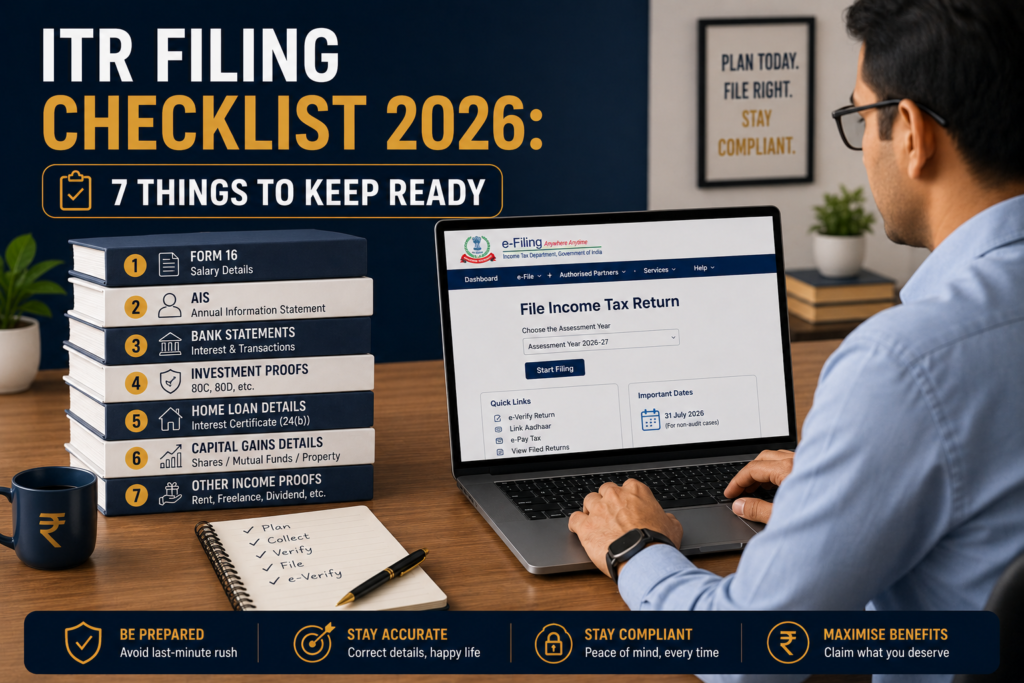
Here is the working ITR filing checklist for a salaried individual.
1. Form 16 from your employer. This is your single most important document. Part A shows the tax deducted at source (TDS) on your salary and deposited with the government. Part B shows your salary breakup and the deductions your employer already accounted for. Employers are required to issue Form 16 by 15 June following the financial year, so for FY 2025-26 you should have it well before the July deadline. If you changed jobs during the year, collect a Form 16 from every employer — a common oversight that leaves income under-reported.
2. Your Annual Information Statement (AIS). The AIS is a consolidated record of your financial transactions as reported to the department — salary, interest, dividends, mutual fund and share transactions, and more. Download it from the portal and read it line by line. If your bank reported ₹40,000 of interest but you only declared ₹10,000, that gap will be flagged. The AIS is also where high-value transactions show up, so it is worth checking even if you think your affairs are simple.
3. Form 26AS. This is your tax credit statement. It shows all TDS and tax payments credited against your PAN. Cross-check it against your Form 16: the TDS your employer claims to have deducted should appear here. If it does not match, the deductor has either not deposited the tax or quoted the wrong PAN, and you need that fixed before filing — otherwise you may not get credit for tax already paid.
4. Bank account and interest details. Keep your savings account interest, fixed deposit interest, and recurring deposit interest figures ready. Banks report this in your AIS, and savings interest up to ₹10,000 is deductible under Section 80TTA (only under the old regime). You will also need a pre-validated bank account on the portal for any refund to be credited.
5. Proof of deductions and exemptions. If you plan to use the old regime, gather your Section 80C investments (PPF, ELSS, life insurance, principal on a home loan), Section 80D medical insurance premiums, your home loan interest certificate, and rent receipts or your landlord’s PAN if you are claiming HRA. Under the new regime, most of these are not allowed, so this step matters only if you are choosing the old regime.
6. Capital gains statements. If you sold shares, mutual funds, or property during FY 2025-26, get the capital gains statement from your broker or fund house. These transactions appear in your AIS, so they cannot quietly be left out. Note that the Section 87A rebate cannot be set off against tax on certain capital gains, so if you have capital gains, do not assume zero tax just because your total income looks below the threshold.
7. Last year’s ITR and a copy of your PAN and Aadhaar. Your previous return helps you carry forward any losses and stay consistent on items like house property. Your PAN must be linked to your Aadhaar for the return to process, and you will e-verify the return using an Aadhaar OTP or net banking.
Old regime or new regime: decide before you start
This decision should happen before you open the filing utility, not midway through. For AY 2026-27, the new tax regime is the default and applies automatically unless you opt out.
Under the new regime, salaried taxpayers get a standard deduction of ₹75,000, and a resident individual with taxable income up to ₹12 lakh pays zero tax because of the Section 87A rebate of up to ₹60,000. For a salaried person, that means income up to ₹12.75 lakh can effectively attract no tax once the standard deduction is applied. But the new regime disallows most popular deductions — 80C, 80D, HRA, and home loan interest on a self-occupied house among them.
The old regime keeps a lower standard deduction of ₹50,000 and a much smaller Section 87A rebate (income up to ₹5 lakh), but it allows the full range of deductions and exemptions. The honest rule of thumb: if you have substantial deductions — heavy 80C, large HRA, a home loan — the old regime can still win. If your deductions are modest, the new regime is usually simpler and lower. Run both before you commit.
How to assemble your documents before filing
Work through this in order rather than jumping straight to the portal.
First, download your AIS and Form 26AS from the income tax portal and read them both. Second, place your Form 16 next to Form 26AS and confirm the TDS figures match. Third, total up your interest income from every bank account and check it against the AIS. Fourth, decide your regime and pull only the deduction proofs that regime allows. Fifth, log in and let the portal pre-fill, then correct anything that does not match your records — never accept pre-filled data blindly.
Take Priya, a Bengaluru-based analyst who changed jobs in October 2025. She collected a Form 16 from both employers, but the portal pre-filled only one. By checking her AIS first, she caught the missing salary before filing and avoided a notice. The lesson: reconcile before you submit, not after.
When you should not rush to file
Early preparation is good, but premature filing is not. Step back in these situations:
- Your AIS or Form 26AS is still updating. TDS data and high-value transactions can take time to reflect fully. Filing before your statements settle risks a mismatch you will have to correct later.
- You have not received Form 16 from a previous employer. If you changed jobs, do not file with only one Form 16. Missing salary almost always surfaces, and under-reporting income is far harder to explain than a slightly delayed return.
- You have capital gains you have not reconciled. Broker statements and the AIS can differ. File only once they agree.
- You are unsure which regime is better. Switching after filing is restricted, so run both calculations first rather than guessing and regretting it. Use our Old Vs New Regime Calculator for correct selection of regime.
Filing early is a virtue only when your data is clean. A correct return in mid-July beats a hasty one in May that you have to revise.
Quick pre-filing checklist
📋 Keep these ready before you log in:
- Form 16 (Part A and Part B) from every employer for FY 2025-26
- AIS and Form 26AS downloaded and reconciled against your records
- Bank account number, IFSC, and a pre-validated account for refunds
- Interest certificates for savings, FD, and RD
- Deduction proofs (only if opting for the old regime): 80C, 80D, HRA, home loan
- Capital gains statements from brokers or fund houses
- Last year’s acknowledged ITR and PAN linked to Aadhaar
Final takeaway
The deadline is 31 July 2026 for ITR 1 and ITR 2 & 31 August 2026 for ITR 3 and ITR 4 but the work that prevents errors happens weeks earlier. The point of an ITR filing checklist is not just to collect documents — it is to reconcile what you know against what the department already sees in your AIS and Form 26AS before you submit. Get the seven items in order, decide your regime in advance, and file only when your numbers agree. That is the difference between a quiet refund and an avoidable notice.
Confused about which documents apply to your situation, or worried about a mismatch in your AIS or Form 26AS? eTaxMate can help you review your records, decide between the old and new regime, and file your return correctly before the deadline.
This blog post is for general information only and does not constitute professional advice. Tax laws are subject to change and their application depends on individual facts and circumstances. Readers should consult a qualified professional before taking any action based on this content. eTaxMate accepts no liability for any action taken based on the information in this post.
Frequently Asked Questions
1. What documents do I need to file ITR for AY 2026-27?
Salaried taxpayers should keep seven things ready: Form 16 from every employer, the Annual Information Statement (AIS), Form 26AS, bank and interest details, deduction proofs if using the old regime, capital gains statements, and last year’s return. Your PAN must also be linked to Aadhaar for the return to process.
2. Do I need Form 16 from both employers if I changed jobs?
Yes. If you worked for more than one employer during FY 2025-26, you need a Form 16 from each. The portal often pre-fills only one, so collecting all of them prevents you from under-reporting salary — one of the most common reasons salaried taxpayers receive a notice after filing.
3. Which tax regime is the default for AY 2026-27?
The new tax regime is the default and applies automatically unless you opt out. It offers a ₹75,000 standard deduction and zero tax up to ₹12 lakh of taxable income through the Section 87A rebate, but disallows most deductions like 80C, 80D, and HRA. Choose the old regime only if your deductions are substantial.
4. Why should I check my AIS before filing?
Your AIS lists income and transactions already reported to the department — salary, interest, dividends, and share or property sales. The portal pre-fills from it, so any gap between the AIS and your own records gets flagged immediately. Reading it line by line before filing lets you catch and fix mismatches before they turn into a notice.
5. Can I file ITR before receiving my full AIS and Form 26AS?
It is better to wait. TDS data and high-value transactions can take time to fully reflect in your AIS and Form 26AS. Filing before these statements settle risks a mismatch you will have to correct through a revised return later. File once your statements are complete and agree with your own records.