
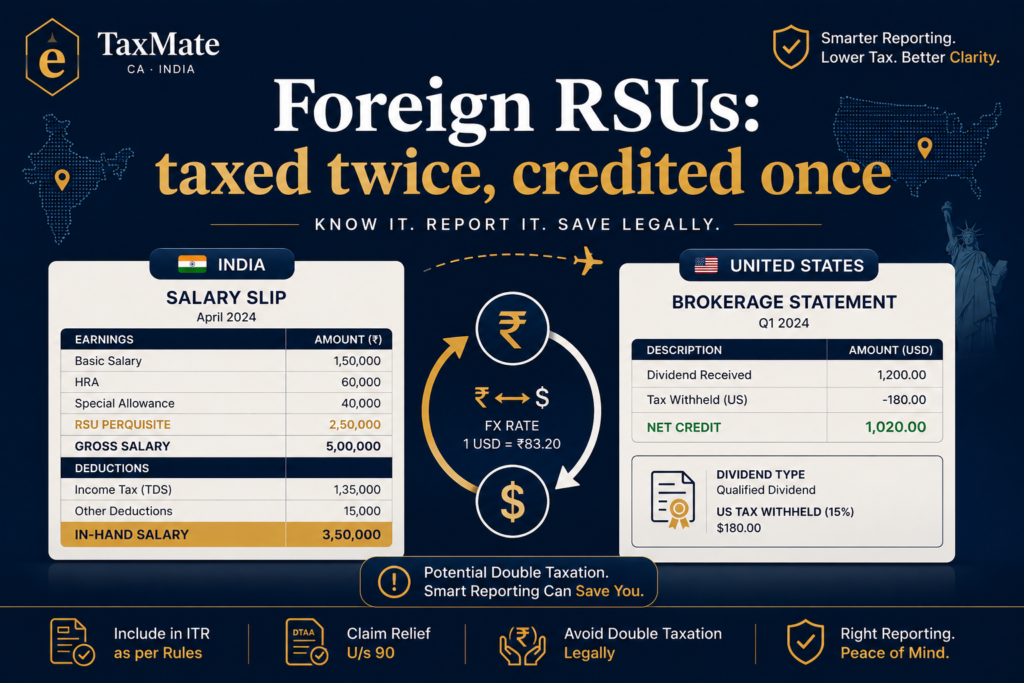
If your salary slip comes from the Indian arm of a US-headquartered company — the kind of setup common at Atlassian, IBM, and dozens of similar firms — but your equity comes from the US parent, you are not dealing with one tax event. You are dealing with three, in two countries, with different forms for each. Foreign RSU taxation in India is not complicated because the law is unclear. It is complicated because most employees only ever look at one piece of the puzzle at a time. This post lays out all three pieces together, and where each one needs to show up in your return.
Quick answer
Foreign RSUs create three separate, sequential tax events in India — vesting (taxed as salary), dividends (taxed again, with US tax withheld), and sale (taxed as capital gains) — and each one needs its own line in your return. Miss any one of them and the mismatch usually surfaces as a notice, not a refund.
Before filing, check:
- Which RSU tranches vested this year, and at what fair market value (FMV)?
- Did you receive any dividend on shares you already hold, and was US tax withheld (check Form 1042-S)?
- Did you sell any vested shares this year, and can you compute the holding period from the vesting date?
- Are you Resident and Ordinarily Resident (ROR) — because Schedule FA applies only to ROR taxpayers?
Why a foreign RSU creates three separate tax events, not one
Most salaried employees think of their RSUs as one transaction: “I got shares.” In practice, three distinct tax triggers stack on top of each other over the life of a single grant — grant, vesting, holding, and eventual sale — and Indian tax law taxes different stages differently.
At grant, nothing happens. You have a promise, not an asset, so there is no tax. The first real tax event is vesting, when the shares are actually delivered to you. The second is any dividend the foreign parent pays while you continue to hold those shares. The third is the eventual sale. Each of these sits under a different head of income, uses a different exchange rate rule, and in the case of dividends, involves tax withheld by a foreign government that India only partly lets you recover.
Stage 1: Foreign RSU taxation begins at vesting, taxed as salary
When RSUs vest, the fair market value of the shares on the vesting date is added to your salary as a perquisite under Section 17(2) of the Income-tax Act, 1961, and taxed at your slab rate. Because RSUs carry no exercise price, the entire FMV becomes taxable — there is no cost to subtract. The FMV is converted to rupees using the SBI TT Buying Rate on the vesting date, as prescribed under the Income-tax Rules, and your employer deducts TDS on this value under Section 192, usually through a “sell to cover” mechanism that liquidates part of your shares.
Consider Priya, a product manager in Bengaluru employed by the Indian subsidiary of a US-listed software company. 300 of her RSUs vest at an FMV of $40 per share. At an exchange rate of ₹85, that is a perquisite of ₹10,20,000, added straight to her Form 16 salary and taxed at her marginal rate.
This is the piece most employees already understand, because it appears in Form 16. The next two stages are where things go missing.
Stage 2: Dividends on foreign RSU shares are taxed in both countries
If you continue holding vested shares, any dividend the US company pays is income in India, taxable under “Income from Other Sources” at your slab rate — there is no concessional rate for foreign dividends, unlike the old domestic dividend distribution regime. The full gross dividend is taxable, not just what actually reaches your bank account.
The complication is that the US government withholds tax at source before the dividend is paid out. Under Article 10 of the India-US tax treaty, this withholding is typically capped at 25% for a retail shareholder, and your broker issues Form 1042-S as proof of the amount withheld. Continuing Priya’s example: her 300 shares pay an annual dividend of roughly $360. At ₹85, that is a gross dividend of ₹30,600. The US withholds 25%, or about ₹7,650. India taxes the same ₹30,600 again at her slab rate, working out to roughly ₹9,180.
She does not pay both amounts in full. She can claim credit for the US tax against her Indian liability — but only up to the lower of the two figures, which is where Form 67 comes in.
Stage 3: Selling the shares brings capital gains into the picture
When the shares are eventually sold, the gain is calculated as sale price minus the FMV already taxed at vesting — that FMV becomes the cost of acquisition, so the same rupee of value is never taxed twice. Foreign shares are always treated as unlisted for this purpose in India, regardless of how liquid they are on a US exchange, which changes the holding period test. A holding of more than 24 months from the vesting date qualifies as long-term; anything shorter is short-term and taxed at slab rates.
For shares sold on or after 23 July 2024, long-term capital gains on unlisted shares are taxed at 12.5% under Section 112, without indexation. If Priya sells 100 of her shares after 30 months at $55, her gain is $15 per share on 100 shares — about ₹1,27,500 at the exchange rate on the vesting date — taxed at 12.5%, roughly ₹15,940.
How Form 67, Schedule FSI, and Schedule TR fit together
These three pieces come together at filing time through a specific sequence, and the order matters.
Form 67 is filed online through the income tax e-filing portal, before your ITR is filed — not alongside it, and never after. It records, country by country, the nature of the foreign income and the foreign tax paid or withheld on it. Once filed, the exact same figures must be mirrored in Schedule FSI (Foreign Source Income) of your ITR — the gross income, not the net amount after US withholding. Schedule TR (Tax Relief) is where the actual credit is claimed under Section 90, and the system computes it as the lower of the foreign tax paid and the Indian tax payable on that specific slice of income.
If you are Resident and Ordinarily Resident and hold foreign shares at any point during the calendar year, Schedule FA also applies — separately from FSI and TR, and on a calendar-year basis rather than the usual April-to-March financial year. This continues every year the shares are held, even in a year with zero dividend or sale activity, until the holding is fully disposed of.
What to do when Form 1042-S lands in your inbox
The moment your US broker or equity plan administrator sends Form 1042-S, treat it as the trigger to start the filing sequence — not something to file away until March.
First, confirm the residential status question is settled: Schedule FA applies only if you are ROR. Then check whether any dividend was actually received on shares you hold — if not, there is nothing to reconcile this year beyond the FA holding disclosure. If a dividend was received, check the 1042-S for US tax withheld. Where tax was withheld, Form 67 must be filed before your ITR due date, with the 1042-S or broker statement as supporting proof, and the figures carried into Schedule FSI and Schedule TR. Where no tax was withheld, the dividend is still taxable in India, just without any credit to claim.
| Step | Condition | Action | Where it goes |
|---|---|---|---|
| 1 | Dividend received on RSU shares this year? — No | Report the holding only in Schedule FA | Schedule FA |
| 1 | Dividend received on RSU shares this year? — Yes | Move to step 2 | — |
| 2 | US tax withheld per Form 1042-S? — No | Report full dividend; no credit to claim | Schedule OS |
| 2 | US tax withheld per Form 1042-S? — Yes | File Form 67 before the ITR due date | Form 67 → Schedule FSI |
| 3 | After Form 67 is filed | Claim credit for the lower of US tax paid and India tax payable | Schedule TR |
Variations and edge cases
- Resident but Not Ordinarily Resident (RNOR) or Non-Resident: Schedule FA does not apply, and depending on residential status, foreign dividend and capital gains may fall outside India’s taxing rights entirely. Confirm your residential status separately before assuming this flow applies.
- Vested this year: Run the Stage 1 perquisite calculation first; the vesting event and the dividend event are reported through different heads of income even if they land in the same ITR.
- Sold shares this year: Layer the capital gains calculation from Stage 3 on top of this flow — it does not replace the dividend and FA reporting.
When you should not claim the full US tax as credit
Do not assume the entire amount shown as withheld on Form 1042-S comes back to you. The foreign tax credit is capped at the lower of the US tax paid and the Indian tax payable on that same income — if your slab rate is below the US withholding rate, part of that foreign tax is permanently lost, with no carry-forward and no refund from either side.
Do not file Form 67 after your ITR due date and expect the credit to survive; a late Form 67 is one of the most common reasons FTC claims get denied on processing, even when every other detail is correct. And do not skip Schedule FA in a year when you held shares but received no income from them — the disclosure obligation is about holding the asset, not about earning something from it.
Documents and records to keep ready
- Equity plan vesting statement showing FMV and vesting date for each tranche
- Broker or plan administrator dividend statement and Form 1042-S for each tax year
- Form 16 and Form 12BA showing the perquisite already taxed at vesting
- Sale confirmation statements if any shares were sold, showing sale price and date
- SBI TTBR rate records for each relevant vesting, dividend, and sale date
- Proof of Form 67 submission with acknowledgment number, filed before the ITR due date
Final takeaway
A foreign RSU is not one tax event wearing three different hats — it is three separate events that happen to share the same underlying shares. Vesting is taxed as salary, dividends are taxed in both countries with only partial relief, and sale brings in capital gains calculated from the FMV already taxed once. Keeping these three threads separate, and filing Form 67 before your return rather than as an afterthought, is what keeps a straightforward equity grant from turning into a mismatch notice.
Confused about foreign RSU taxation, dividend withholding, or which schedules apply to your equity income? eTaxMate can help you review your vesting, dividend, and sale records, identify what applies to your specific filing, and handle the Form 67 and Schedule FA compliance correctly.
This blog post is for general information only and does not constitute professional advice. Tax laws are subject to change and their application depends on individual facts and circumstances. Readers should consult a qualified professional before taking any action based on this content. eTaxMate accepts no liability for any action taken based on the information in this post.
Frequently Asked Questions
1. Do I have to pay tax in India on RSUs from my company’s US parent?
Yes. The fair market value of the shares on the vesting date is added to your salary and taxed at your slab rate under Section 17(2), regardless of where the parent company is based. This happens at vesting, not at grant or at sale — those are separate, later tax events.
2. Is dividend on foreign RSU shares taxed twice?
The dividend is taxed once in the US through withholding (usually up to 25% under the India-US treaty) and again in India at your slab rate under “Income from Other Sources.” You can claim credit in India for the US tax, but only up to the lower of the two amounts — not the full amount withheld.
3. What is Form 67 and when should I file it?
Form 67 is an online statement filed on the e-filing portal to claim credit for foreign tax paid, such as US withholding on RSU dividends. It must be filed before your ITR due date, and the same figures must match what you report in Schedule FSI and Schedule TR.
4. Do I need to report RSU shares in Schedule FA even if I have not sold them?
Yes, if you are Resident and Ordinarily Resident. Schedule FA requires disclosure of foreign shares you hold at any point in the calendar year, regardless of whether you earned any income from them that year. This continues every year until the shares are fully sold.
5. Can I claim full credit for the US tax withheld on my RSU dividend?
Not necessarily. The foreign tax credit is capped at the lower of the US tax withheld and the Indian tax payable on that same dividend. If your Indian slab rate is lower than the US withholding rate, part of the US tax cannot be recovered in either country.
6. How is capital gains calculated when I sell foreign RSU shares?
The gain is the sale price minus the fair market value already taxed as a perquisite at vesting, since that FMV becomes your cost of acquisition. Foreign shares are treated as unlisted in India, so a holding period beyond 24 months from vesting qualifies for long-term capital gains treatment.