
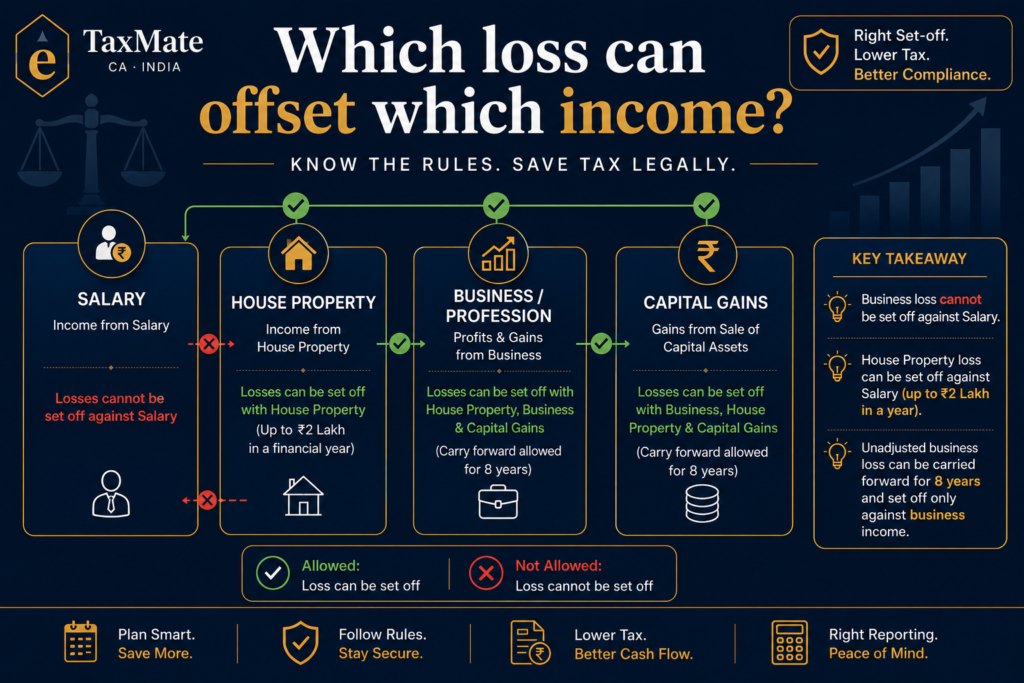
If you have ever had a loss on your house property, a loss from selling shares, or a bad year in a side business, you have probably wondered whether that loss can simply be knocked off against your salary. The answer is not a blanket yes or no, the Income Tax Act, 1961 runs a fairly rigid sequence for set-off of losses, and different losses are allowed to travel to different places. This post on Set-Off of Losses Under Income Tax lays out exactly which loss can go where, in plain tables, and settles a question that trips up even experienced filers: whether you can choose to skip set-off this year and carry the loss forward instead.
Quick answer
Set-off of losses happens in a fixed order — first within the same head (Section 70), then across heads (Section 71) — and it is mandatory wherever the law permits it; you cannot choose to defer it and carry a larger loss forward instead. Only the amount left over after both steps, because there simply wasn’t enough income to absorb it, can be carried forward.
Before assuming a loss can be set off, check:
- Is this loss under a restricted category — capital, speculative, specified business (Section 35AD), or race-horse income?
- Has the loss already been fully or partly absorbed within the same head under Section 70?
- Do you have income under any other head this year to absorb what remains under Section 71?
- Was your return filed on or before the due date under Section 139(1), which most carry-forward claims require?
How set-off actually works: two steps, then a fallback
The Act treats loss adjustment as a sequence, not a menu of options.
Step 1 — Section 70 (intra-head): A loss from one source is first set off against income from another source under the same head. A loss in one business is set off against profit in another business you run; a loss on one house property is set off against rental income from another.
Step 2 — Section 71 (inter-head): Whatever loss survives Step 1 is then set off against income under a different head — salary against business loss, business income against house property loss, and so on — subject to specific exceptions covered below.
Step 3 — Carry forward (Sections 72 to 80): Only what still cannot be absorbed, because there genuinely wasn’t enough income anywhere to soak it up, is carried forward to future years.
Intra-head set-off: adjusting losses within the same head (Section 70)
Most sources within a head can freely absorb each other’s losses. The exceptions are the ones worth memorising.
| Head of income | Can absorb losses from other sources in the same head? | Key exception |
|---|---|---|
| House property | Yes — loss on one property against income from another | None significant |
| Business and profession | Yes — non-speculative business loss against profit of any other non-speculative business | Speculative business loss can be set off only against speculative business income, never regular business profit |
| Capital gains | Partly — short-term capital loss (STCL) can be set off against both STCG and LTCG | Long-term capital loss (LTCL) can be set off only against LTCG, never against STCG |
| Specified business (Section 35AD) | Yes — but only against income from another specified business | Cannot be set off against regular business income |
| Owning and maintaining race horses | Yes — only against income from the same activity | Cannot be set off against any other business income |
Inter-head set-off: adjusting losses across heads (Section 71)
Once a loss survives Section 70 and is still unabsorbed, Section 71 allows it to spill over into other heads — but four categories are firmly walled off.
| Type of loss | Can be set off against other heads (Section 71)? |
|---|---|
| House property loss | Yes, against any other head — but capped at ₹2,00,000 per year against non-house-property income; the balance is carried forward |
| Non-speculative business loss | Yes, against any head except salary |
| Speculative business loss | No — confined entirely to speculative business income |
| Loss from specified business (Section 35AD) | No — confined entirely to specified business income |
| Capital loss (short or long-term) | No — capital losses cannot leave the Capital Gains head at all, even in the same year |
| Race-horse loss | No — confined entirely to race-horse income |
Notice the pattern: house property loss is the most flexible loss in the Act, while capital loss is the most restricted — it cannot even reach your salary or business income in the same year it arises, let alone in later years.
Can salary ever show a loss? Can “other sources” show a loss?
Salary cannot show a loss. The deductions permitted under Section 16 — standard deduction, entertainment allowance for government employees, professional tax — are computed as the lower of a fixed limit and the actual amount, and they cannot exceed the salary itself. There is no mechanism in the Act by which taxable salary income turns negative. If you have heard someone describe a “loss from salary,” they are almost certainly describing a business loss that they are trying, incorrectly, to set off against their salary — which Section 71 specifically blocks.
Income from other sources can show a loss, and it is one of the more flexible categories. This typically happens when interest paid on money borrowed to earn interest income exceeds the interest earned, or when the cost of letting out machinery or furniture on hire exceeds the rent received.
Such a loss can be set off against any other head under Section 71, with no special restriction. The one hard exception sits inside this same head: winnings from lotteries, crossword puzzles, card games, betting, and similar casual income are taxed at a flat 30% under Section 115BB, and Section 58(4) blocks any expenditure or loss from being set off against such winnings — not within the head, and not from any other head either. A loss from one form of gambling cannot even be set off against winnings from another.
Carry forward of losses: how long, and against what
| Type of loss | Governing section | Carry forward period | Can be set off against, in future years |
|---|---|---|---|
| House property loss | Section 71B | 8 assessment years | Income from house property only |
| Non-speculative business loss | Section 72 | 8 assessment years | Business income (any business, not necessarily the same one) |
| Speculative business loss | Section 73 | 4 assessment years | Speculative business income only |
| Specified business loss (Section 35AD) | Section 73A | No time limit | Specified business income only |
| Capital loss (short or long-term) | Section 74 | 8 assessment years | LTCL against LTCG only; STCL against both STCG and LTCG |
| Race-horse loss | Section 74A | 4 assessment years | Race-horse income only |
| Unabsorbed depreciation | Section 32(2) | No time limit | Any head of income except salary |
Two carry-forward rules deserve a separate mention because they are exceptions to the usual “file on time or lose the loss” rule under Section 80. House property loss can still be carried forward even if the return is filed late, and unabsorbed depreciation can be carried forward regardless of when — or whether within the due date — the return was filed. Every other loss in the table above needs the return filed on or before the due date under Section 139(1) to preserve the right to carry it forward.
Is set-off mandatory in the year of the loss?
This is the part most people get wrong. Set-off under Sections 70 and 71 is not optional. If you have a loss under one head and income under another head that can legally absorb it, the law does not give you the choice to skip the adjustment this year and carry a bigger loss forward instead — even if that would appear more tax-efficient, for instance because the income it would offset is taxed at a lower rate. The set-off happens first; only what genuinely cannot be absorbed — because there is no income anywhere to absorb it — goes into carry forward.
Where there is a genuine choice, it is a narrow one: if you have multiple losses that could each be set off against the same income, you are free to choose the combination that benefits you most. What you cannot do is decline set-off altogether to preserve a loss for a future year.
What to do when you have a loss this year
Work through the sequence in order, not the section numbers in order.
First, identify whether the loss falls into one of the four restricted categories — capital, speculative, specified business, or race-horse. If it does, its journey ends within that category; there is no inter-head step to consider. If it does not, apply Section 70 first, setting it off against any other income in the same head.
Whatever remains, check whether you have income under any other head this year — if you do, Section 71 requires you to set it off there, subject to the house property cap and the salary exclusion for business loss. Only the portion that still cannot find a home carries forward under Sections 72 to 80, and only if your return is filed on time.
When you should not assume a loss can be set off
Do not assume a capital loss can rescue a bad year on your salary or business income — it cannot leave the Capital Gains head under any circumstance, in the current year or in carry forward. Do not assume a business loss can reduce your taxable salary; Section 71 blocks this specific combination even though business loss is otherwise one of the more flexible losses in the Act.
Do not treat house property loss as unlimited against other heads — the ₹2,00,000 annual cap against non-house-property income is firm, with the excess only available against future house property income. And do not wait until the extended or belated filing window to claim carry forward of a business or capital loss; unlike house property loss and unabsorbed depreciation, these two categories are lost entirely if the original return misses the Section 139(1) due date.
Documents and records to keep ready
- Computation sheets for each head showing income or loss for the year, source by source
- Broker or contract note statements for capital gains/losses, with acquisition and sale dates
- Loan statements showing interest paid, where relevant to a house property or other-sources loss
- Prior years’ ITR acknowledgments and Schedule CFL entries, to track carried-forward balances and remaining years
- Proof of the return being filed on or before the Section 139(1) due date, for losses that require it
Final takeaway
Set-off of losses is a sequence, not a choice — same head first, other heads next, and only the true leftover gets carried forward. Salary cannot generate a loss, capital loss cannot leave its own head, and house property loss is capped at ₹2,00,000 against everything else. Knowing which box a loss sits in before you file saves far more tax stress than any deduction you might claim later.
Unsure which head your loss belongs to, or whether it can be set off this year versus carried forward? eTaxMate can help you review your income computation across all heads, apply the correct set-off sequence, and file your return correctly to preserve your carry-forward rights.
This blog post is for general information only and does not constitute professional advice. Tax laws are subject to change and their application depends on individual facts and circumstances. Readers should consult a qualified professional before taking any action based on this content. eTaxMate accepts no liability for any action taken based on the information in this post.
Frequently Asked Questions
1. Can I set off a loss from my business against my salary income?
No. Section 71 specifically blocks non-speculative business loss from being set off against salary income, even though business loss can generally be set off against most other heads. This is one of the few outright prohibitions in inter-head set-off, so a bad business year cannot directly reduce tax on your salary.
2. Can salary income itself ever be shown as a loss?
No. Deductions permitted under Section 16, such as the standard deduction, are always capped at the lower of a fixed limit and the actual salary, so they can never push taxable salary below zero. There is no provision in the Act for a “loss from salary.”
3. Is it compulsory to set off a loss in the same year, or can I carry it forward instead?
Set-off is mandatory wherever the law allows it. If you have income under a head that can legally absorb a loss, Sections 70 and 71 require that set-off to happen in the same year — you cannot choose to skip it to preserve a larger loss for a future year.
4. Can a capital loss be set off against my salary or business income?
No. Capital losses, whether short-term or long-term, cannot be set off against any head other than Capital Gains, even in the year the loss arises. Long-term capital loss can only be set off against long-term capital gains; short-term capital loss can be set off against both.
5. How long can a business loss be carried forward, and what can it be set off against?
A non-speculative business loss can be carried forward for 8 assessment years under Section 72, and set off only against business income in those years — it does not have to be the same business. The return for the loss year must be filed on or before the Section 139(1) due date to preserve this right.
6. What happens if I file my return late and I have losses to carry forward?
Most losses, including business and capital losses, cannot be carried forward if the original return is filed after the Section 139(1) due date. The two exceptions are house property loss and unabsorbed depreciation, both of which can still be carried forward even from a belated return.